RK-14 is Reachinno’s decision framework for determining which compliance domains, market requirements, engineering validations, evidence packages and lifecycle controls apply to a portable power product.
From product definition to documented market readiness.
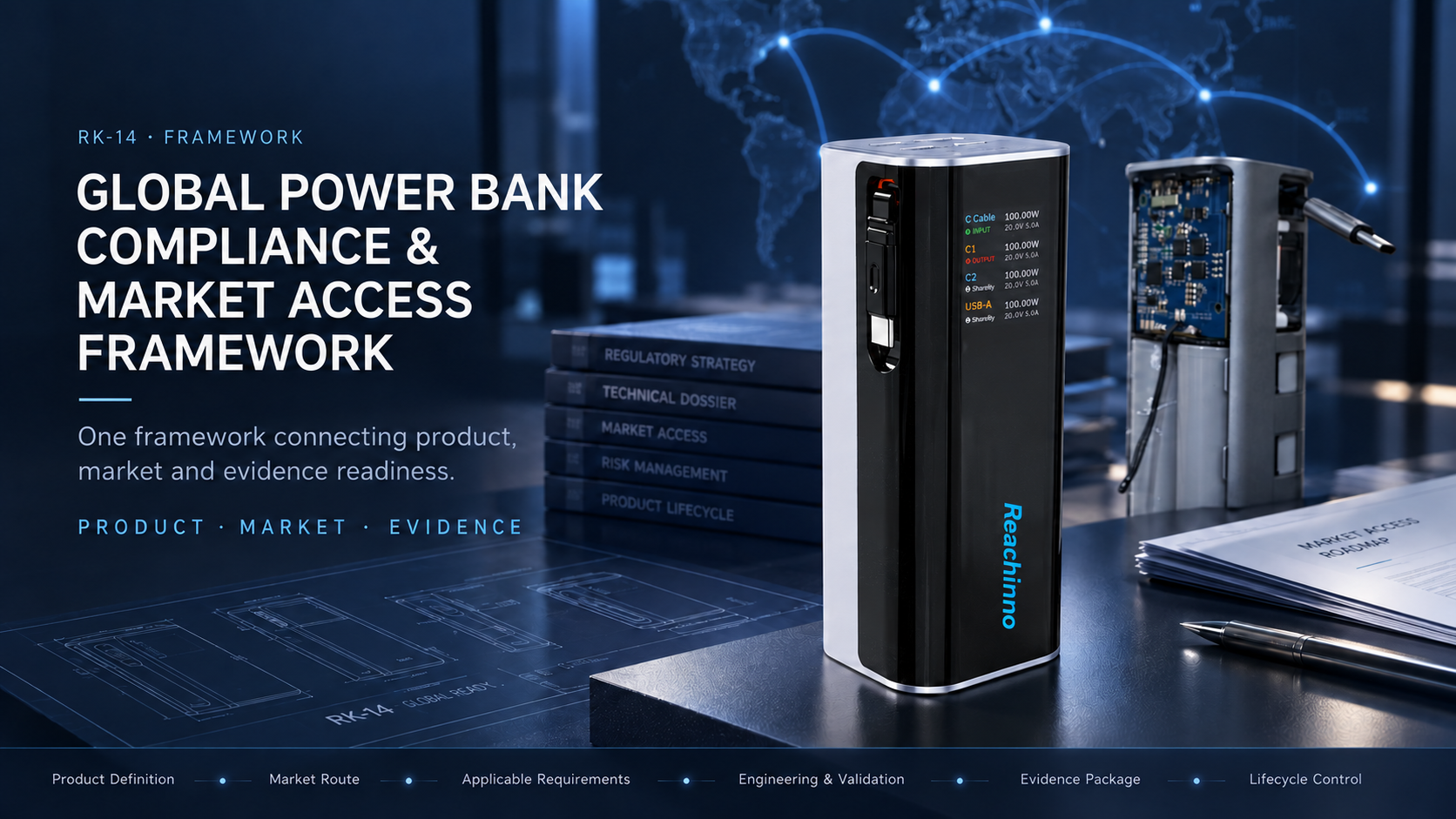
Power Bank Compliance Is Not One Certificate
Power bank compliance is not a single universal certification. Applicability depends on product configuration, battery system, target market, wireless functionality, intended use, commercial channel and the responsible party placing the product on the market.
Market readiness may involve regulation, product and battery safety, transport, EMC/RF, environmental obligations, technology ecosystems, labelling, technical evidence, market responsibility and lifecycle control. These are different requirement types and should not be presented as interchangeable.
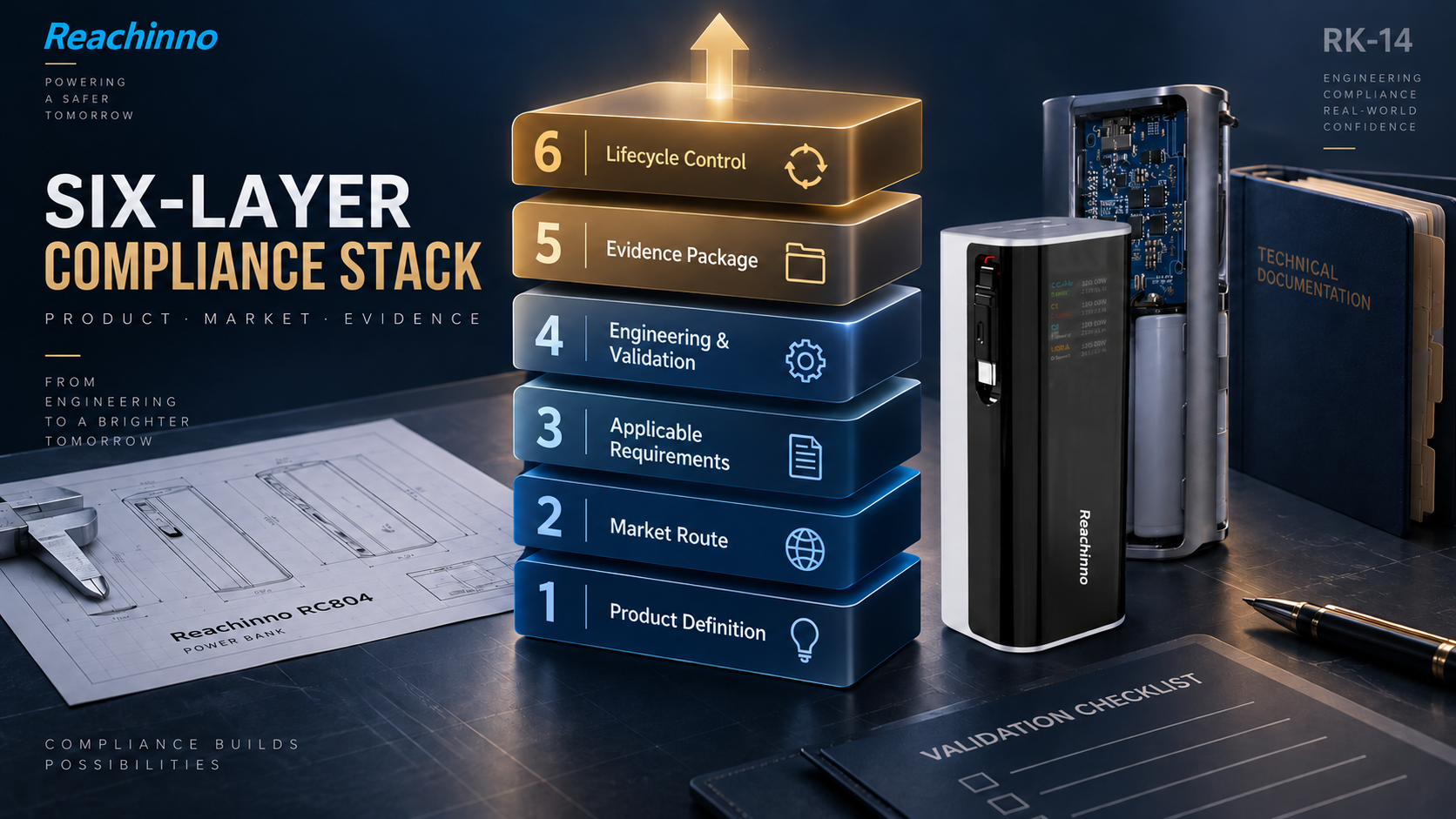
Three Decision Anchors. Six Decision Layers.
PRODUCT · MARKET · EVIDENCE are memory anchors: they help buyers remember what RK-14 is designed to determine. They are not three sequential project gates. The complete operating loop consists of six decision layers.
Product Definition
Define chemistry, Wh, capacity, interfaces, power, wireless functions, intended use and environmental conditions.
Market Route
Define countries, responsible parties, channels, technology ecosystems and application sectors.
Applicable Requirements
Map the requirement domains and current legal, technical, channel and application status.
Engineering & Validation
Translate requirements into architecture, components, tests and controlled samples.
Evidence Package
Connect reports, declarations, labels, traceability and market-responsibility records.
Lifecycle Control
Control supplier, component, firmware, standard and post-market changes after launch.
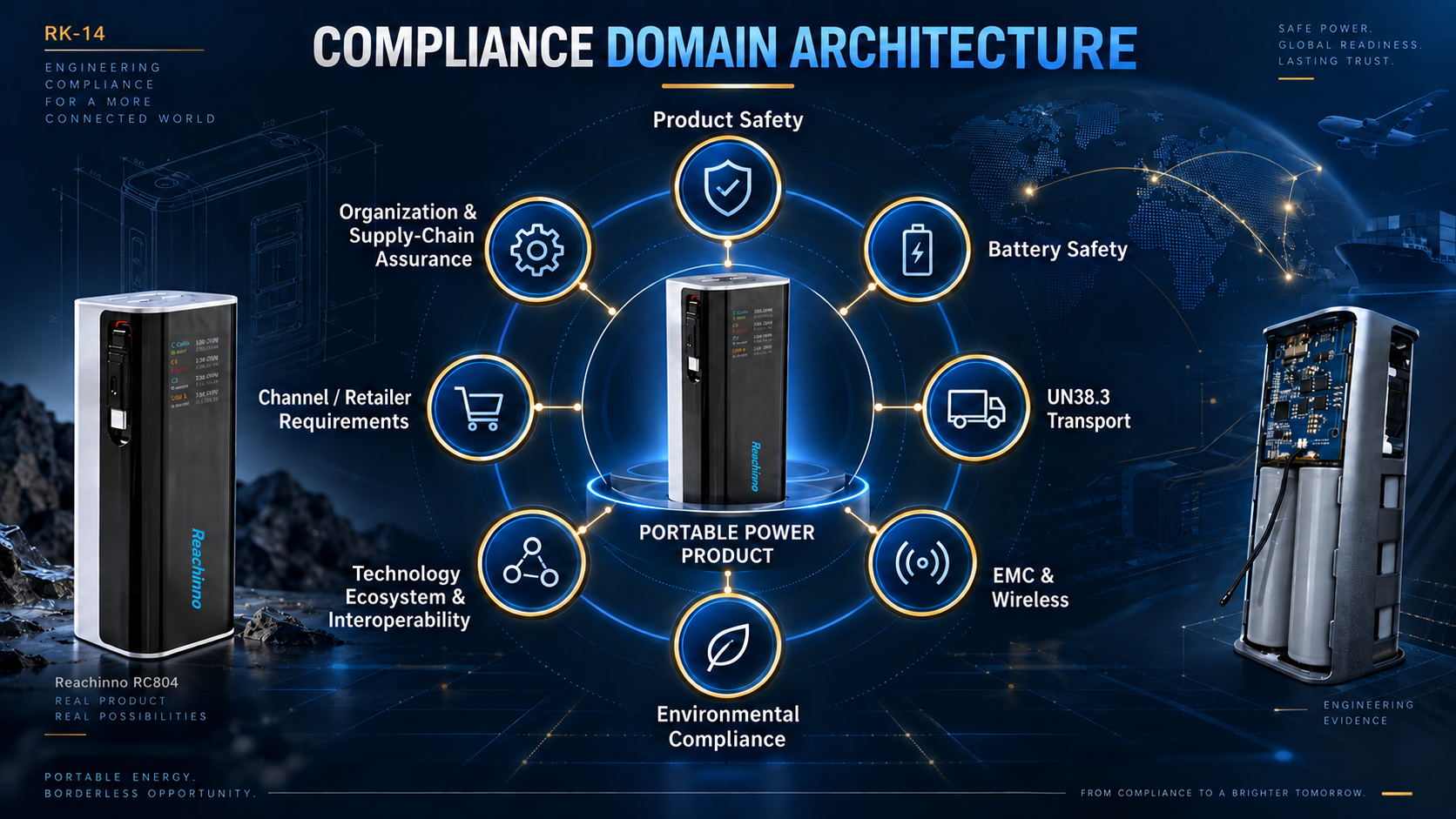
Eight Compliance Domains That Shape Market Readiness
These domains are not all certifications. Depending on the product and market, they may include mandatory regulations, technical standards, transport tests, licensing programs, technology ecosystems, retailer requirements, application validation or organizational assurance systems.
Market Access & Regulatory
Legal and regulatory pathways controlling placement in a target market.
Product & Battery Safety
Safety requirements for cells, battery packs, protection systems and finished products.
Transport & Logistics
Lithium-battery transport tests, classifications, packaging and dangerous-goods documentation.
EMC / RF / Wireless
Electromagnetic compatibility, radio and spectrum requirements triggered by the product.
Environmental & Product Information
Materials, environmental duties, labels, traceability, battery information and EPR.
Technology Ecosystem & Interoperability
Compatibility, licensing, authentication, trademark and ecosystem pathways where applicable.
Application & Performance Validation
Environmental and use-condition validation such as ingress, temperature, drop and ruggedness.
Organization & Supply-Chain Assurance
Management systems, social assurance, material claims and supplier traceability.
WPC/Qi, Apple MFi, USB-IF and Qualcomm programs differ in nature and may involve specifications, testing, certification, licensing, authentication, trademark use or membership depending on the program.
The Portable Power Compliance Ecosystem
Compliance Systems, Standards & Ecosystems Referenced by RK-14
The portable-power ecosystem includes different legal requirements, standards, transport evidence, technology programs, market expectations and organizational assurance systems. The name or mark of a system does not determine its legal status or applicability.
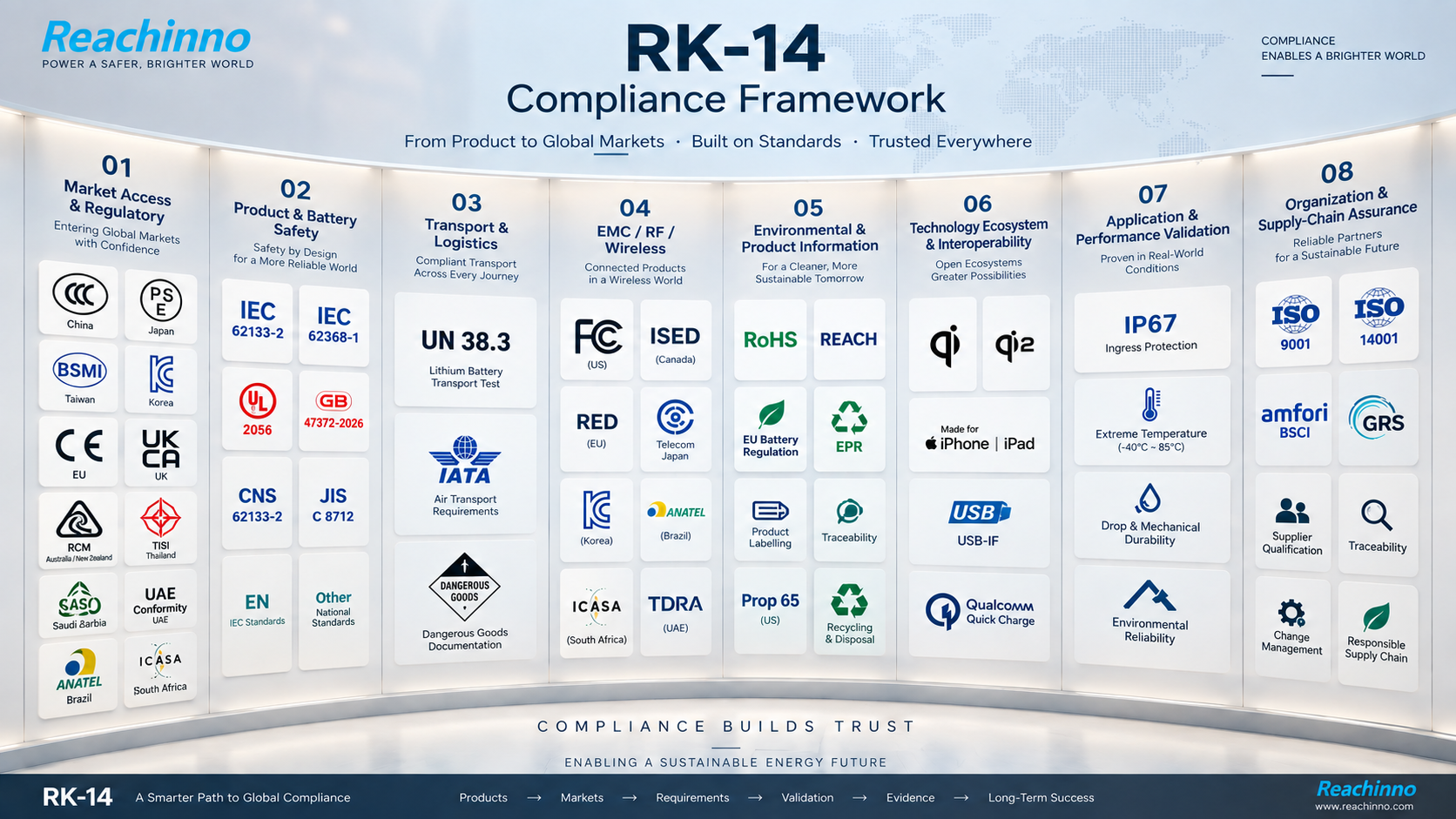
The systems shown above illustrate the compliance landscape referenced by RK-14. Applicability depends on product configuration, target market, technology, intended use and commercial route. Their inclusion does not imply that every requirement applies to every product or that Reachinno or a specific product holds every listed certification.
Different Markets Trigger Different Compliance Paths
RK-14 supports global market assessment while separating markets with published detailed intelligence from markets covered through project-specific assessment. Existing detailed coverage includes China, Taiwan, Japan, Korea, the European Union, the United Kingdom, the United States, Canada, and Australia & New Zealand.
Expansion and project-assessment markets may include Thailand, Saudi Arabia, UAE, Brazil, South Africa, India, Singapore and Malaysia. A market named here does not imply that a dedicated regional page already exists.
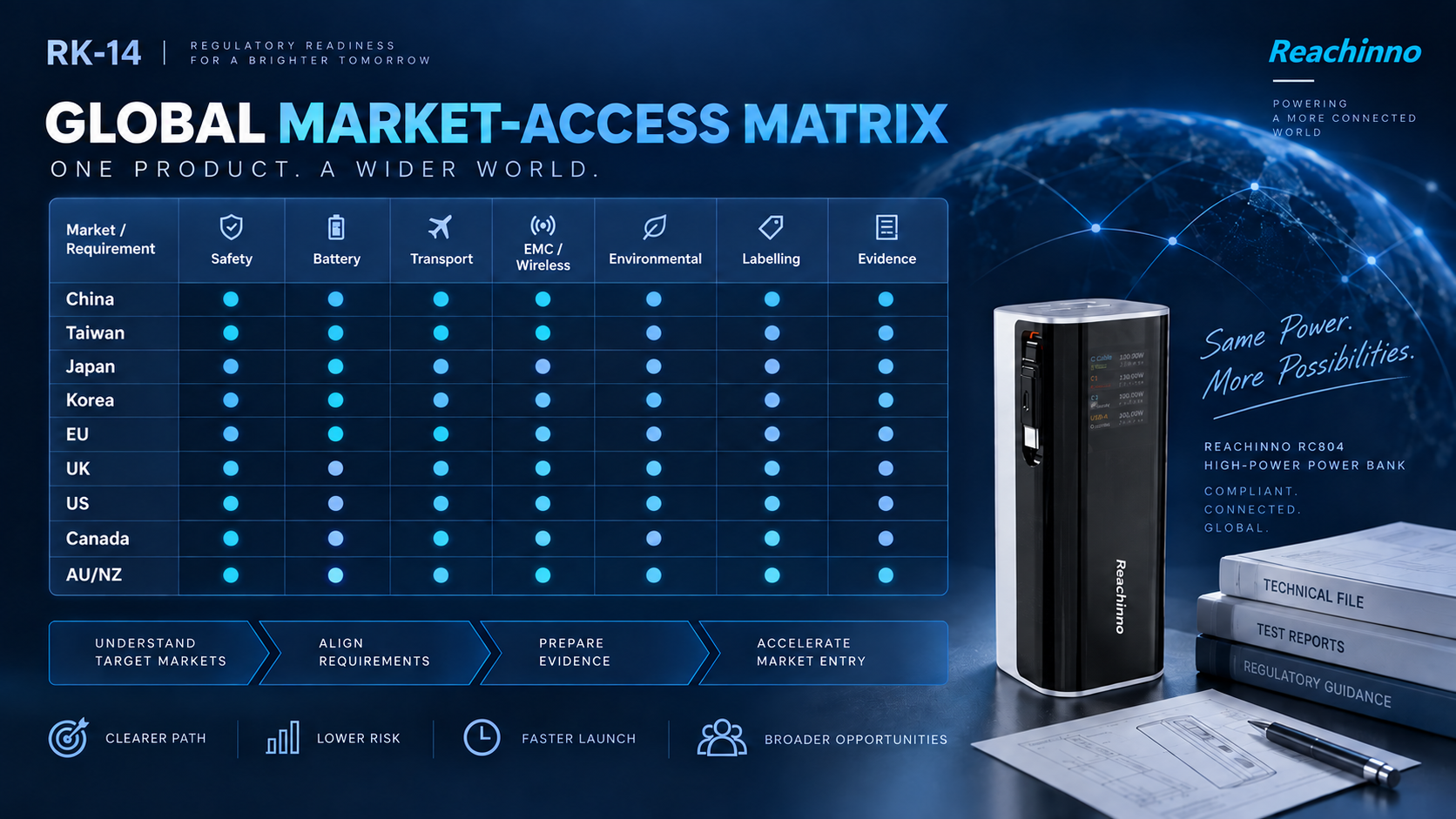
| Market | Product Scope | Authority / System | Requirement Type | Current Status | Safety / EMC / Transport / Environment | Responsible Party & Evidence | Cluster Status | Last Verified |
|---|---|---|---|---|---|---|---|---|
| China | Defined portable battery/product scope | CCC and applicable national requirements | Market access; safety; product information | Scope and transition dates require project confirmation | Assess cell, pack, product, transport and labelling separately | Applicant, manufacturing consistency and traceability evidence | Published | 20 Sep 2026 |
| Taiwan | Scope-dependent portable power products | BSMI / applicable CNS pathway | Market access; proposed/transition where applicable | Confirm final notices and effective dates | Assess safety, transport, EMC/wireless and labelling by configuration | Local route and technical evidence require confirmation | Published | 20 Sep 2026 |
| Japan | Defined battery/product scope | DENAN / PSE where applicable | Market access; safety; transport separate | Confirm classification and responsible party | PSE pathway must not be mixed with UN 38.3 or passenger baggage rules | Importer, marking and technical evidence as applicable | Published | 20 Sep 2026 |
| Korea | Defined product and battery scope | KC / KATS-related pathway | Market access; safety; EMC/RF where triggered | Confirm exact product and standard scope | Do not substitute charger requirements for power-bank requirements | Applicant and evidence route require project review | Published | 20 Sep 2026 |
| European Union | Portable power product as configured | Applicable EU legislation and battery obligations | Mandatory; environmental; responsible-party; RF where triggered | Multiple instruments may apply | Assess safety, EMC/RED, transport, substances, batteries and labelling | Economic operator, declarations, technical file and EPR where applicable | Published | 20 Sep 2026 |
| United Kingdom | Portable power product as configured | GB and Northern Ireland routes | Mandatory; transition; RF/environment where triggered | GB and NI must be assessed separately | Confirm current CE/UKCA/CE+UKNI context for the route | Importer/responsible party and evidence depend on placement route | Published | 20 Sep 2026 |
| United States | Portable power product as configured | Federal, state and channel requirements | Mandatory where triggered; market-driven safety; retail/channel | No single universal power-bank certificate | FCC where triggered; UN 38.3 for transport; safety evidence may be channel-driven | Importer, retailer and marketplace requirements require review | Published | 20 Sep 2026 |
| Canada | Portable power product as configured | Federal and provincial/channel pathways | Transport; RF where triggered; market-driven safety | No single universal mandatory power-bank safety certificate | ISED where wireless/radio applies; transport and channel evidence separate | Importer and retailer expectations require review | Published | 20 Sep 2026 |
| Australia & New Zealand | Exact product and electrical scope | RCM / EESS-related pathways where applicable | Market access; electrical safety; EMC/RF; responsible supplier | Classification and registration route are product-dependent | Do not reduce the route to “RCM + SAA” | Responsible supplier, registration and technical evidence as applicable | Published | 20 Sep 2026 |
This matrix is a routing aid, not legal advice or a universal checklist. Product scope, current rules and evidence must be verified for each project before launch.
Not Every Requirement Has the Same Legal Status
A current legal or compulsory requirement for the defined product and market.
A drafted, announced or transitioning requirement whose final scope and effective dates require monitoring.
A shipment requirement; it is not by itself permission to place the product on a market.
Evidence selected for differentiation, customer confidence or market expectations beyond a legal minimum.
A specification, test, licensing, authentication or logo-use pathway connected to a technology program.
A retailer, marketplace, insurer or customer requirement that may exceed statutory minimums.
A requirement triggered by intended use, environment, performance claim or sector classification.
Your Product Configuration Determines the Compliance Path
RK-14 begins with practical configuration questions: battery chemistry, Wh and capacity, USB-C/PD, wireless charging, radio functionality, target markets, application environment, and retail or marketplace channel.
Compliance Decisions Start in Product Engineering
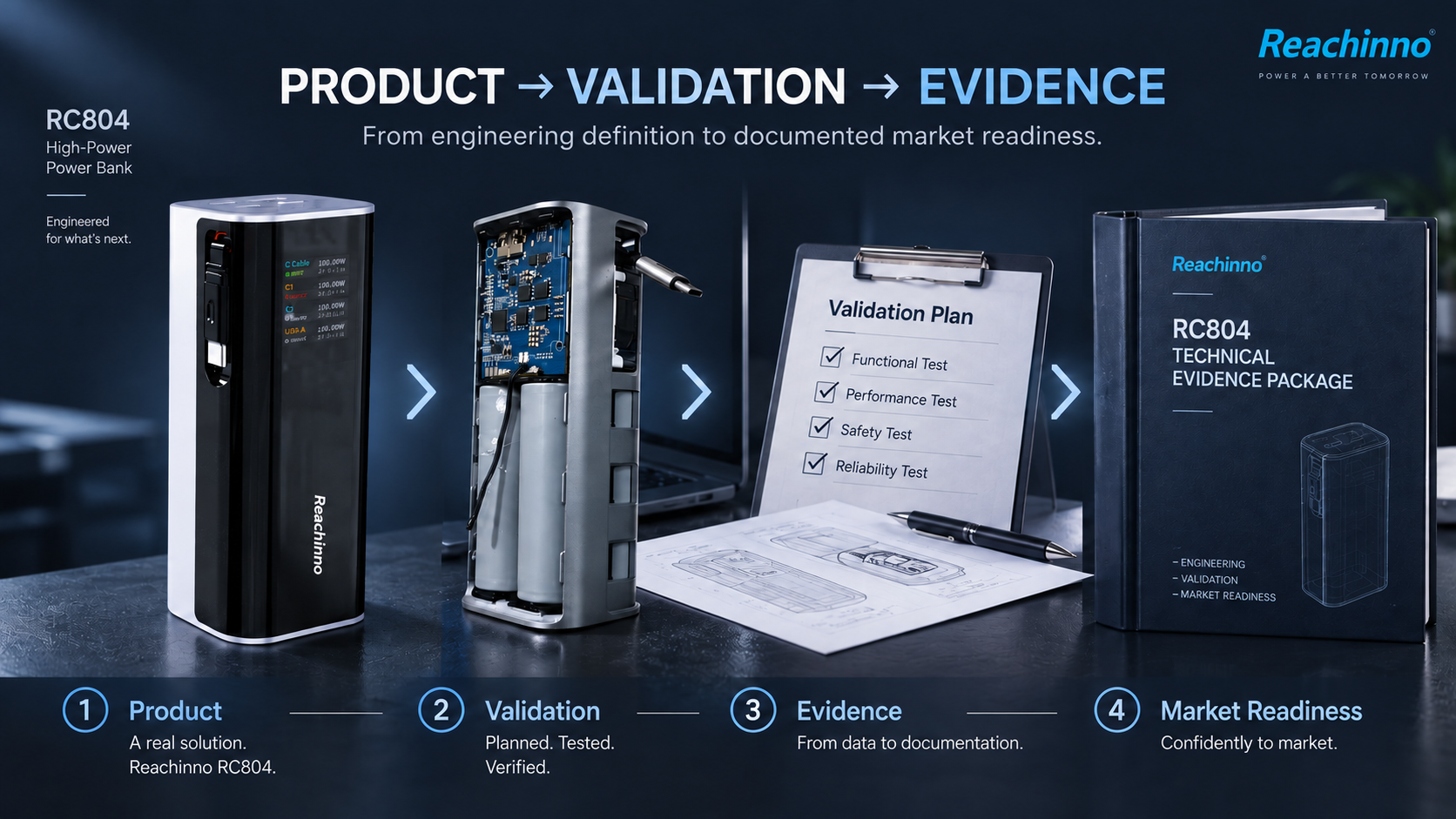
Compliance requirements can influence battery architecture, BMS, power electronics, thermal design, enclosure, interfaces and cables, firmware and validation planning. RC804 is shown as an engineering example—not as a claim that the platform holds every approval or program referenced elsewhere on this page.
Market Readiness Continues After Testing
An evidence package connects the defined product and market route to reviewable records. Depending on the project it may include:
- Test reports
- Technical documentation
- Declarations
- Labels and traceability
- Importer / responsible party records
- EPR / battery responsibility where applicable
- Technology ecosystem evidence
- Transport documentation
- Retail / channel documentation
- Change-control records
Lifecycle Control addresses component substitutions, cell supplier changes, firmware revisions, standard revisions, renewal or surveillance, production consistency and post-market actions. Market readiness ≠ one certificate received.
Explore Market-Specific Compliance Paths
UAE power bank market access: ECAS, battery safety, wireless and importer requirements
Map Your Product’s Compliance Path
Tell us your product configuration, target markets, intended applications and launch plan. Reachinno can help identify the engineering, validation and evidence considerations that should be addressed before tooling and market launch.