Why the US Has No Single “Power Bank Certificate”
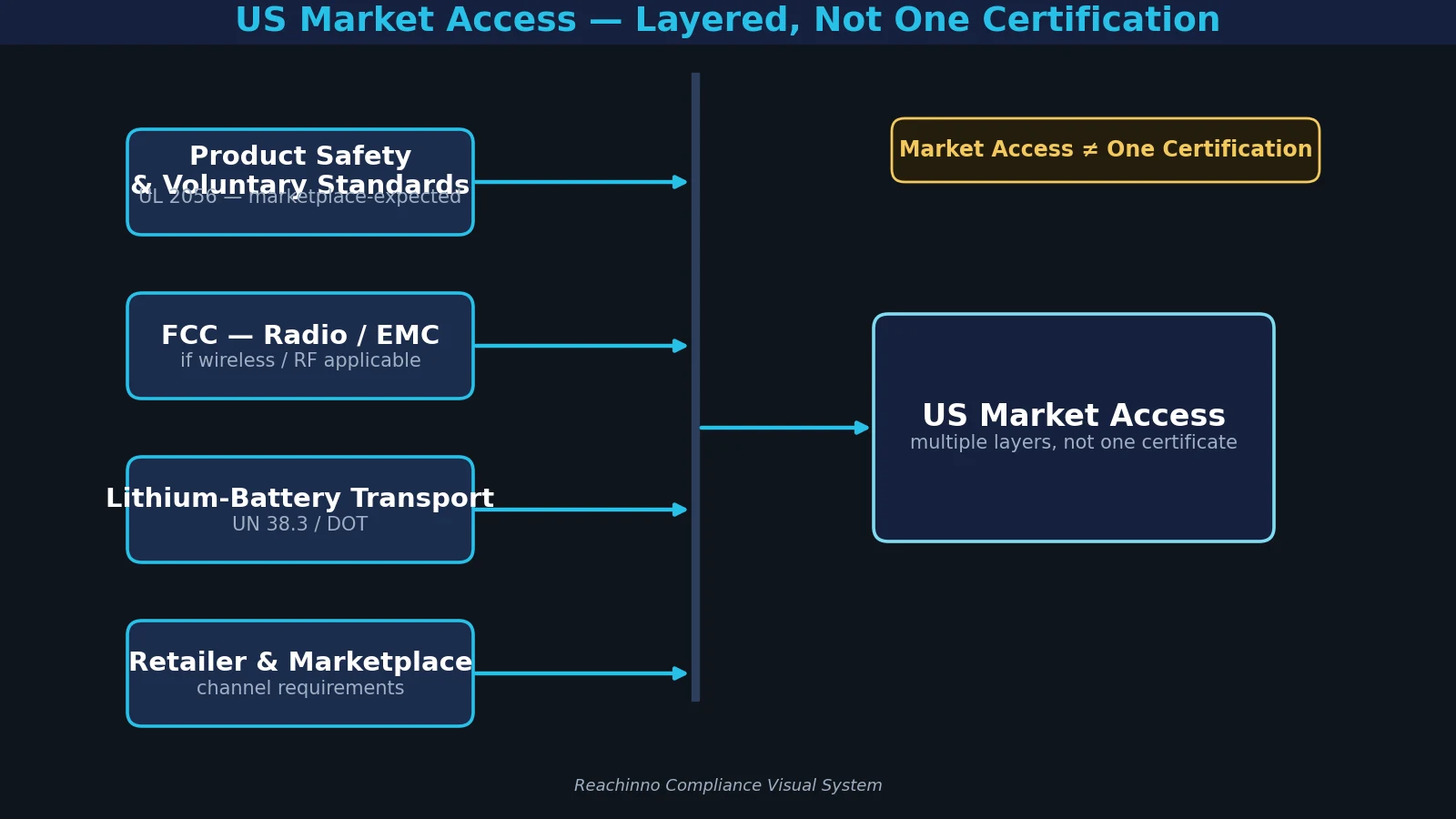
The United States does not operate a single PSE-style or CCC-style mandatory power bank certification. There is no federal agency that stamps one “power bank certificate” before a product can be sold. Instead, US market access is built from several overlapping layers: a federal mandatory layer (FCC), a voluntary-but-de-facto-mandatory safety layer (UL 2056), a transportation layer (UN38.3 / DOT), and a patchwork of state rules (New York, California). For an OEM or ODM, the practical question is not “which certificate?” but “which combination of proofs does my sales channel require?”
This regional assessment follows the Reachinno Global Power Bank Compliance & Market Access Framework™ (RK-14), which connects market-entry requirements with product architecture, compliance planning and engineering validation.
Reachinno Engineering Principle™: In the US, “voluntary standard” and “optional in practice” are not the same thing. UL 2056 is voluntary by statute but mandatory by marketplace.
UL 2056 — The De Facto Safety Baseline (Voluntary, Not Federal)
ANSI/CAN/UL 2056 is the Standard for Safety for Power Banks. The current edition is ANSI/CAN/UL 2056:2026 (published June 2026), preceded by the ANSI/CAN/UL 2056:2024 edition (published February 2025). It covers power banks and portable USB chargers built on lithium-ion cells and evaluates:
- Electrical abuse — overcharge, short circuit, over-discharge, abnormal charging, temperature.
- Mechanical abuse — drop, crush, impact, vibration.
- Environmental — thermal, humidity, and simulated use conditions.
- Battery-system integrity — the protection circuit and pack construction are tested as a system, not just the cells.
UL 2056 is a voluntary consensus standard — the federal government does not force it by law. But in 2026 it functions as a market-access gate for three reasons:
- Amazon US requires a UL 2056 test report (or an equivalent NRTL report) to list power banks. No report, no listing.
- Major retailers (big-box, club, carrier channels) reference UL 2056 in their own compliance specifications.
- New York State requires rechargeable lithium-ion batteries in covered products to meet UL standards (law enacted 2024, effective 2025), which pushes UL 2056 into the statutory frame for products sold there.
Upstream, component-level certifications are usually required before a finished UL 2056 submission: UL 1642 for cells, UL 2054 for battery packs, and UL 62368-1 for the electronics portion (audio/video and ICT equipment safety).
FCC — The Actual Federal Mandatory
Where UL 2056 is voluntary, FCC compliance is legally mandatory to market electronics in the US:
- FCC Part 15 Subpart B (unintentional radiators) — EMC/EMI limits for all digital devices. Mandatory.
- FCC Part 15 Subpart C (intentional radiators) — required if the power bank has wireless functions such as Qi2 wireless charging or Bluetooth, with applicable RF exposure (SAR) evaluation.
No FCC authorization means the product cannot be legally imported or marketed. For a full comparison of how the US approach differs from the EU and China, see our FCC vs CE vs CCC breakdown.
Transportation & Shipping — UN38.3 and DOT
Before any power bank moves by air or sea, UN38.3 testing of the lithium cells/batteries is mandatory. In US domestic and inbound logistics, DOT PHMSA 49 CFR treats power banks as Class 9 miscellaneous hazardous materials — typically UN3481 (equipment containing lithium batteries) or UN3480 (standalone batteries) — with required labeling, SDS, and packaging. Air shipments follow IATA DGR; sea follows IMO IMDG. Our guide to shipping power banks under UN3480 covers the documentation in detail.
Airline Rules — A Transport Rule, Not a Certificate
This is the most commonly confused point. The FAA / DOT carriage limits are transportation rules, not product certifications:
- Spare and loose power banks must travel in carry-on baggage only — never checked.
- 0–100 Wh: allowed without approval.
- 101–160 Wh: up to two batteries with airline approval.
- >160 Wh: prohibited in passenger baggage.
These limits are about safe carriage, not about whether the product is “certified.” See why some power banks are not allowed on airplanes and the 100Wh power bank limit for the engineering implications on cell selection and pack sizing.
State-Level Requirements
- New York — rechargeable lithium-ion battery safety law (enacted 2024, effective 2025) requires covered products’ batteries to meet UL standards; reinforces UL 2056 as a sales condition.
- California — Proposition 65 warning obligations for listed chemicals, plus lithium-battery recycling stewardship; no separate safety certificate beyond federal + UL 2056.
- There is no federal EnergyGuide label requirement for power banks (unlike appliances).
Retail & Marketplace Gate
For most OEM/ODM programs, the real compliance bar is set by the sales channel, not the statute:
- Amazon US: UL 2056 (or equivalent NRTL) test report + FCC. Hard gate.
- Big-box / club / carrier: own specs referencing UL 2056 + FCC + UN38.3, often with NRTL listing.
2026 US Market-Access Checklist
| Layer | Requirement | Type | Note for OEM/ODM |
|---|---|---|---|
| Federal | FCC Part 15 (EMC; RF if wireless) | Mandatory | Legally required to market |
| Safety | UL 2056:2026 | Voluntary, de facto mandatory | Amazon / retail / NY |
| Cells / pack | UL 1642 / UL 2054 | Usually required upstream | Component certificates |
| Electronics | UL 62368-1 | Voluntary (retail) | AV/ICT equipment safety |
| Transport | UN38.3 + DOT 49 CFR | Mandatory for shipping | Class 9 (UN3480 / UN3481) |
| Air carriage | FAA 100 / 160 Wh | Transport rule | Carry-on only |
| State | NY UL law; CA Prop 65 | Varies | Check per destination state |
Common Mistakes
- Treating UL 2056 as optional “because it’s voluntary” — Amazon will reject the listing.
- Conflating airline Wh limits with product certification.
- Forgetting FCC for the electronics portion.
- Assuming a China CCC or EU CE mark satisfies US requirements — it does not.
How Reachinno Supports US Market Access
We design to UL 2056 + FCC from the schematic stage, prepare UN38.3 and DOT documentation, and support NRTL submission and Amazon compliance packets. The same platform evidence feeds downstream regional programs — for example, our RC804 145W platform is engineered against this multi-standard stack. For the full global picture, start from our global power bank compliance and market access guide.
Official Sources
This guide draws on official US government and recognised-standards sources.
FCC — Radio & EMC Requirements
Federal Communications Commission: equipment authorization and radio/EMC rules
CPSC — Consumer Product Safety
U.S. Consumer Product Safety Commission
U.S. DOT / PHMSA — Lithium-Battery Transport (UN 38.3)
Pipeline and Hazardous Materials Safety Administration: hazmat / lithium-battery transport
UL — UL 2056 (Voluntary Power-Bank Safety Standard)
UL: UL 2056 Standard for Safety for Power Banks
This guide is based primarily on official US government and recognised-standards sources and is intended for product-development and market-access planning. It is not legal advice and does not replace confirmation with the FCC, CPSC, PHMSA, an accredited testing laboratory or the applicable certification authority.
Frequently Asked Questions
Is UL 2056 required by US federal law?
No. UL 2056 is a voluntary consensus standard. But it is required in practice by Amazon, major retailers, and — for covered products — New York State law, so most OEM/ODM programs must hold it to sell.
Do I need FCC certification for a power bank?
Yes. FCC Part 15 (EMC) is mandatory for the electronics; if the product has wireless functions (Qi2, Bluetooth), Part 15 intentional-radiator rules and RF exposure evaluation also apply.
Can I fly with a 20,000 mAh power bank?
Capacity in mAh does not equal Wh. A typical 20,000 mAh / 3.7 V cell pack is about 74 Wh, which is within the 0–100 Wh carry-on allowance. Always convert to Wh and keep the power bank in carry-on baggage.
Does a CE or CCC mark satisfy US requirements?
No. The US, EU, and China operate separate compliance regimes. US market access requires FCC (mandatory) and, in practice, UL 2056 — neither is granted by CE or CCC.