Canada Has No Single “Power Bank Certificate”
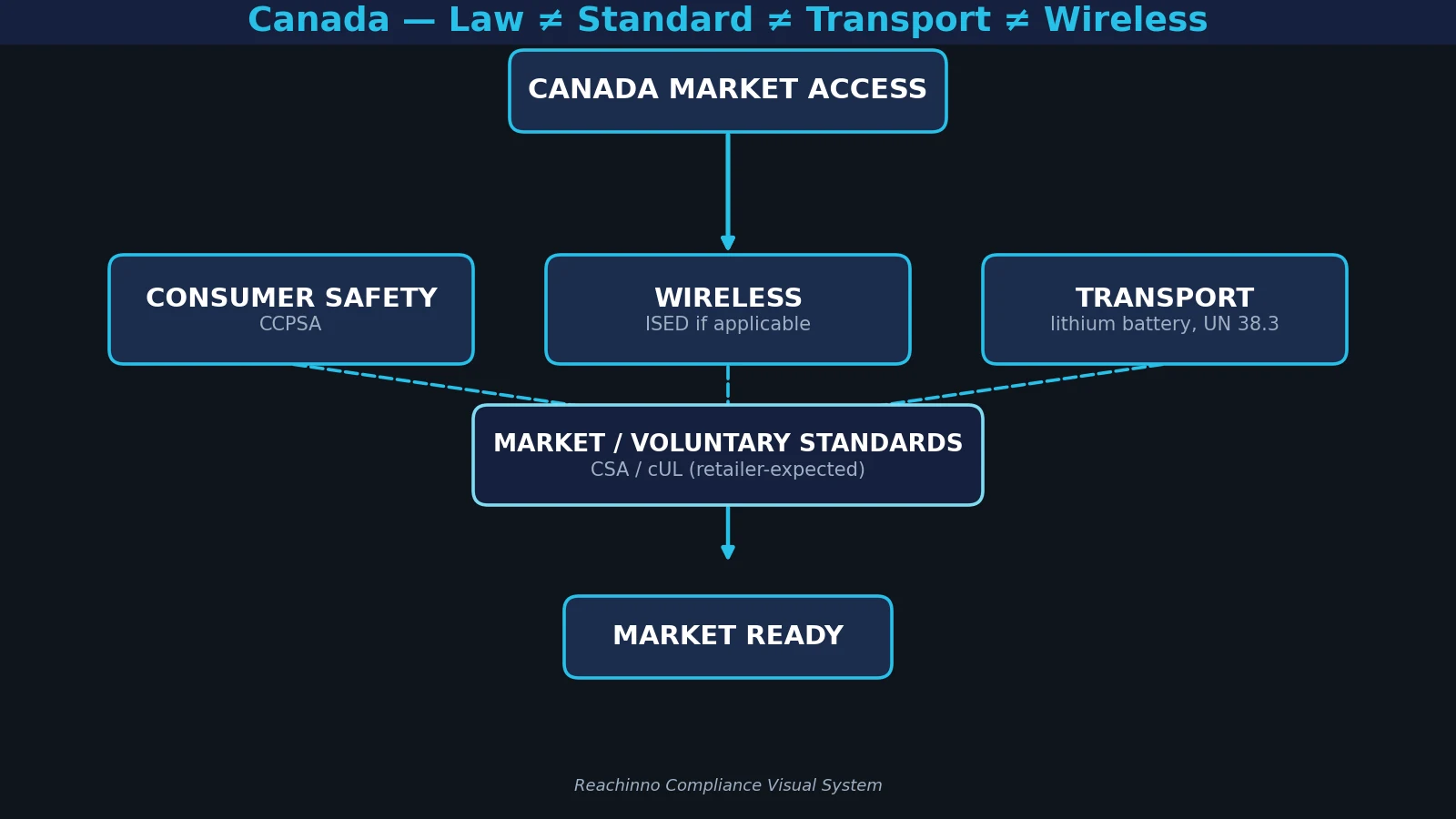
Like the United States, Canada does not operate a single mandatory power-bank safety certification comparable to China’s CCC, Korea’s KC, the UK’s UKCA or the EU’s CE. There is no federal agency that stamps one “power bank certificate” before sale. Instead, Canadian market access is built from several distinct layers: a mandatory transportation layer (UN 38.3), a mandatory wireless layer where applicable (ISED), and a safety layer that is voluntary by statute but often required by retailers (CSA / cUL). For an OEM or ODM, the right question is “which combination of proofs does my sales channel require?” — not “which certificate?”
This regional assessment follows the Reachinno Global Power Bank Compliance & Market Access Framework™ (RK-14), which connects market-entry requirements with product architecture, compliance planning and engineering validation.
Reachinno Engineering Principle™: In Canada, “voluntary standard” and “optional in practice” are not the same thing. CSA/cUL is voluntary by law but frequently mandatory by marketplace.
UN 38.3 — The Mandatory Transport Layer
The one layer that is unambiguously mandatory is transportation. Under Transport Canada’s Transportation of Dangerous Goods (TDG) Regulations, lithium cells and batteries must pass UN 38.3 testing before they move by air or sea. Power banks are Class 9 dangerous goods — typically UN3481 (equipment containing lithium batteries) or UN3480 (standalone batteries) — with required labelling, SDS and packaging. Air follows IATA DGR; sea follows IMO IMDG. Our UN3480 shipping guide covers the documentation. These are transport rules, not product certifications.
ISED — The Wireless Layer (Mandatory If Wireless)
If the power bank includes wireless functions — Qi2 wireless charging or Bluetooth — it requires certification from ISED (Innovation, Science and Economic Development Canada, formerly Industry Canada). This is the Canadian counterpart to US FCC authorization: the product must comply with applicable ISEDr RSS standards and carry the IC certification number. Wired-only units are not pulled into ISED, but every wireless unit is.
CSA / cUL — The Voluntary Safety Layer
Canada has no federal safety-certification mandate for power banks, but in practice the CSA (Canadian Standards Association) and cUL (UL’s Canadian standard) marks are widely required by retailers, marketplaces, insurers and provincial authorities. The relevant safety standard is CSA C22.2 No. 62368-1, Canada’s adoption of IEC 62368-1. Treat CSA/cUL as a de-facto market-access gate driven by the sales channel, much like UL 2056 in the US.
Health Canada — General Product Safety, Not a Certifier
Health Canada administers the Canada Consumer Product Safety Act (CCPSA), which gives broad powers to address unsafe consumer products — including recalls. However, Health Canada is not a front-line certifier for power banks; there is no specific mandatory Health Canada power-bank safety certificate. The CCPSA is a backstop of general product-safety obligations, not the mark you apply for at launch.
Energy Efficiency and EPR
- NRCan (natural-resources energy-efficiency programmes) does not generally impose a mandatory efficiency rating on power banks the way it does for some appliances — no NRCan label is required for a typical power bank.
- Battery recycling / extended producer responsibility operates at the provincial level (for example Call2Recycle-style programmes). These are lifecycle and market-entry considerations, not a product-safety certificate.
2026 Regulatory Watch — Development Stage
Canada, like several other jurisdictions, is watching lithium-battery safety closely, and regulatory development toward stricter battery safety is ongoing. As of 2026, however, there is no single unified mandatory lithium-ion product certification equivalent to CCC/BSMI/PSE. Treat Canadian battery-safety requirements as a proposal / development stage rather than settled mandatory law, and monitor federal and provincial movement so tooling is not surprised by a transition.
2026 Canada Market-Access Checklist
| Layer | Requirement | Type | Note for OEM/ODM |
|---|---|---|---|
| Transport | UN 38.3 + TDG / IATA / IMDG | Mandatory for shipping | Class 9 (UN3480 / UN3481) |
| Wireless | ISED certification (RSS) | Mandatory if wireless | IC number labelling |
| Safety | CSA C22.2 No. 62368-1 / cUL | Voluntary, de facto mandatory | Retail / marketplace driven |
| Product safety | CCPSA (Health Canada) | General obligation | Not a launch certificate |
| Efficiency | NRCan | Not applicable (typical) | No power-bank label required |
| Lifecycle | Provincial battery EPR | Market obligation | Per-province programmes |
Common Mistakes
- Assuming Canada mirrors the US UL 2056 exactly — the mark is CSA/cUL, and the standard is CSA C22.2 No. 62368-1.
- Forgetting ISED for Qi/Bluetooth units.
- Treating airline Wh limits as a product-safety threshold.
- Waiting for a hypothetical federal “power bank certificate” instead of building the UN 38.3 + ISED + CSA retail package now.
How Reachinno Supports Canada Market Access
We design to CSA C22.2 No. 62368-1 from the schematic stage, prepare UN 38.3 and Transport Canada documentation, and support ISED submission for wireless functions and CSA/cUL retail packets. The same platform evidence feeds downstream regional programs — for example, our RC804 145W platform is engineered against a multi-standard stack. For the full global picture, start from our global power bank compliance and market access guide, or see how the US model compares.
Official Sources
This guide draws on official Canadian government and standards sources.
ISED — Radio & EMC Certification
Innovation, Science and Economic Development Canada (ISED)
Health Canada — CCPSA
Health Canada: Canada Consumer Product Safety Act
Transport Canada — TDG / Lithium-Battery Transport (UN 38.3)
Transport Canada: Transportation of Dangerous Goods
CSA — CSA C22.2 No. 62368-1 (Voluntary Safety)
CSA Group: product safety standards
This guide is based primarily on official Canadian government and recognised-standards sources and is intended for product-development and market-access planning. It is not legal advice and does not replace confirmation with ISED, Health Canada, Transport Canada, an accredited testing laboratory or the applicable certification authority.
Frequently Asked Questions
Is there a mandatory power-bank safety certification in Canada?
No. As of 2026, Canada has no single unified mandatory lithium-ion product certification like CCC or UKCA. Market access is built from mandatory UN 38.3 transport compliance, mandatory ISED certification for wireless functions, and voluntary-but-retail-driven CSA/cUL safety certification.
Do I need ISED certification for a power bank?
Only if it has wireless functions such as Qi2 or Bluetooth. ISED certification (under applicable RSS standards, with IC numbering) is then mandatory; wired-only units are not pulled into ISED.
Is CSA or cUL required?
By statute it is voluntary, but in practice Canadian retailers, marketplaces and insurers commonly require a CSA or cUL mark (to CSA C22.2 No. 62368-1), so most OEM/ODM programs hold it to sell.
Does a US UL 2056 report satisfy Canada?
Not directly. The US and Canada run separate regimes. A US UL 2056 report is useful supporting evidence, but Canadian retail and transport typically expect CSA/cUL (CSA C22.2 No. 62368-1) and UN 38.3 / ISED as applicable.