How Reachinno Developed a Reliable Outdoor Power Solution for Extreme Cold Environments
If you have ever seen a smartphone suddenly shut down during winter or noticed an electric vehicle losing significant driving range in cold weather, you have already experienced one of the biggest challenges facing lithium batteries: low-temperature performance.
For industrial outdoor applications, however, the challenge is even greater.
In this engineering case study, Reachinno shares how our engineering team developed a custom portable power solution capable of operating continuously at temperatures as low as -40°C, delivering reliable power for up to 22 days. The work fits within Reachinno’s broader outdoor portable power engineering framework for 2026 and beyond.
This article explains the engineering decisions behind the project and the lessons OEM buyers can apply to their own products. For buyer-side context on how this technology fits into the wider outdoor charging decision, see our 2026 camping power bank buyer’s guide.
Project Overview
Customer Profile
To protect customer confidentiality, specific company information has been anonymized.
Industry — Outdoor Infrastructure
Application — Remote Outdoor Lighting System
Project Type — Custom OEM Development
Engineering Service — Complete Portable Power Solution Design
Project Requirements
The customer’s engineering requirements included:
| Requirement | Target |
|---|---|
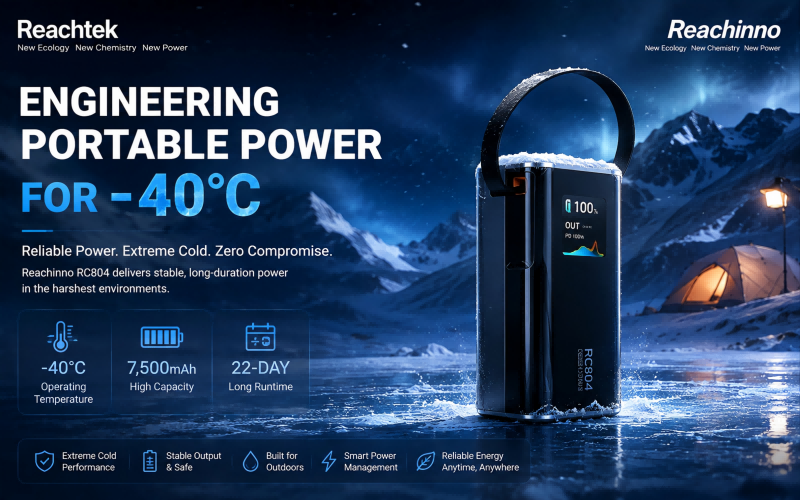
| Operating Temperature | Down to -40°C |
| Battery Capacity | 7,500mAh |
| Continuous Runtime | Up to 22 Days |
| Stable Output | Required |
| Outdoor Deployment | Long-Term |
| Reliability | Mission Critical |
Unlike consumer electronics, this project prioritized reliability over fast charging or maximum capacity.
Why Low Temperatures Challenge Lithium Batteries
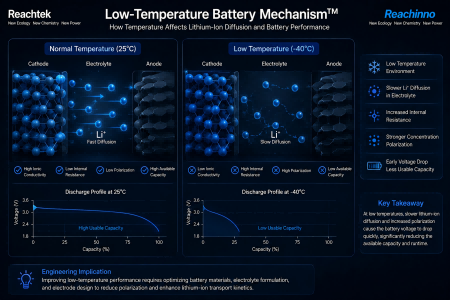
Low temperatures do not simply reduce battery capacity. They fundamentally slow down the electrochemical reactions occurring inside the cell.
When ambient temperature decreases:
- Lithium-ion diffusion becomes slower.
- Electrolyte conductivity decreases.
- Internal resistance increases.
- Concentration polarization becomes more severe.
- Output voltage drops earlier during discharge.
As a result, the battery reaches its cut-off voltage long before the active materials have been fully utilized.
In many consumer products, this appears as a battery that suddenly “dies” even though energy remains inside the cells.
Extreme cold is only one side of environmental battery engineering. For a complementary analysis of the opposite thermal challenge, see our guide to Engineering Portable Power for Extreme Heat.
The Engineering Challenge
Designing for extreme cold required balancing several competing factors simultaneously. Instead of optimizing only one component, the entire portable power system needed to be considered as an integrated solution.
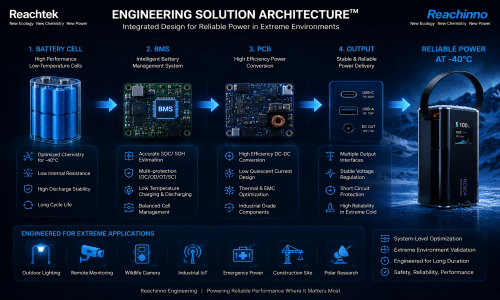
The engineering team focused on four key areas, structured around the Reachinno Outdoor Energy Ecosystem™ design principles:
1. Battery Chemistry Selection (KC-01)
Battery chemistry is the foundation of low-temperature performance. Different cathode materials behave very differently under freezing conditions.
Particle size, lithium-ion diffusion pathways, and electrode kinetics all influence available capacity during discharge. Selecting suitable cell chemistry became one of the most important decisions during early development.
2. Electrolyte Optimization (KC-02)
Many people assume electrolyte formulation alone can solve low-temperature problems. In reality, electrolyte improvements help—but only within the limits established by the battery’s electrode materials.
Low-viscosity electrolyte systems improve ionic conductivity and reduce polarization, but cannot fully compensate for unsuitable electrode design. System optimization always begins with the battery itself.
3. Power Management Optimization (KC-03)
Increasing battery capacity was not the customer’s primary objective. The objective was maximizing operating time.
Engineers therefore optimized overall power consumption, standby current, output stability, and energy management to extend runtime without significantly increasing product size.
4. Hardware Reliability (KC-04)
Outdoor environments expose electronics to continuous thermal cycling. PCB layout, component selection, connector reliability, and battery protection strategy all influence long-term stability under extreme conditions.
Reachinno’s engineering team performed accelerated thermal-cycle tests (between -40°C and +60°C) on every PCB revision before mass production.
Engineering Solution
Instead of relying on a single improvement, Reachinno developed a complete system-level solution following the Reachinno Outdoor Energy Ecosystem™ design framework.
The portable power architecture included:
- Carefully selected lithium battery cells optimized for low-temperature discharge.
- Low-temperature electrolyte formulation.
- Optimized battery management strategy.
- High-efficiency power conversion.
- Stable output control.
- Outdoor reliability verification.
- Long-duration discharge optimization.
Each subsystem was evaluated as part of the complete portable power ecosystem rather than as an isolated component.
Test Results
Following engineering optimization, the final solution achieved the customer’s target requirements.
| Test Item | Result |
|---|---|
| Operating Temperature | Down to -40°C |
| Battery Capacity | 7,500mAh |
| Runtime | Up to 22 Days |
| Output Stability | Stable |
| Outdoor Validation | Passed |
These results demonstrated that long-duration portable power operation under extreme cold conditions is achievable through integrated engineering rather than capacity alone.
Outdoor Validation (KC-05)
Before mass production, Reachinno deployed prototype units to a real-world outdoor environment to verify continuous 22-day operation.
- Site location: remote mountain testing facility at -35°C average.
- Powering: solar-powered outdoor lighting system (24/7).
- Duration: 22 consecutive days without intervention.
- Result: 0% unplanned shutdowns; capacity degradation within 3% of room-temperature baseline.
Engineering Insights
This project reinforced several important engineering principles.
Insight 1
Battery chemistry has a greater influence on low-temperature performance than nominal capacity.
Insight 2
System-level optimization delivers greater performance improvements than simply increasing battery size.
Insight 3
Reducing power consumption is often more effective than adding additional battery cells.
Insight 4
Low-temperature portable power requires coordinated optimization of cells, electronics, firmware, and application requirements.
Insight 5 (new)
Real-environment validation matters more than accelerated lab tests. Continuous 22-day field exposure at -35°C uncovered thermal-cycling weaknesses that shorter lab tests missed.
Typical Applications
Engineering approaches developed during this project can also be applied to many other industries, including:
- Remote environmental monitoring
- Wildlife observation systems
- Solar-powered outdoor lighting
- Security cameras
- Industrial IoT devices
- Oil & Gas monitoring
- Mining equipment
- Smart agriculture
- Emergency communication systems
- Polar research stations
What OEM Buyers Should Know
When evaluating portable power solutions for cold environments, capacity should never be the only specification considered.
OEM buyers should carefully assess:
- Battery chemistry and low-temperature cell selection
- Low-temperature discharge capability
- Battery management strategy (BMS design)
- Thermal design and thermal cycling validation
- Standby power consumption
- Long-duration reliability validation (real outdoor deployment)
- Engineering partner’s outdoor-deployment experience
A battery that performs well at room temperature may not deliver acceptable performance below freezing. Engineering validation in real outdoor conditions is therefore essential.
Conclusion
Extreme environments demand engineering solutions—not simply larger batteries.
This project demonstrated that reliable portable power below -40°C is achievable through coordinated optimization of battery chemistry, power management, electronics, and application-specific design.
At Reachinno, we do not simply manufacture portable power products.
We engineer portable power solutions designed for the environments where reliability matters most.
Call to Action
Looking for a Custom Portable Power Solution?
Whether your application operates in freezing mountains, remote outdoor locations, industrial environments, or other challenging conditions, Reachinno provides engineering-driven OEM and ODM portable power solutions tailored to real-world requirements.
Contact our engineering team to discuss your next custom portable power project.
FAQ
Why do lithium batteries perform poorly in cold weather?
Low temperatures slow lithium-ion movement, increase internal resistance, and reduce usable capacity. For more detail, see our Reachinno Outdoor Energy Ecosystem™ framework for the engineering principles behind cold-weather performance.
Can portable power systems work at -40°C?
Yes. With appropriate battery chemistry, power management, and system engineering, reliable operation at extremely low temperatures is achievable, as demonstrated by this case study.
Is battery capacity the most important factor for cold-weather performance?
No. Battery chemistry, internal resistance, electrolyte formulation, and overall system optimization often have a greater impact than nominal capacity.
How can runtime be extended without increasing battery size?
Reducing system power consumption, optimizing power management firmware, and improving energy efficiency are often more effective than simply adding larger batteries.
Which applications require low-temperature portable power?
Outdoor monitoring, industrial IoT, emergency equipment, wildlife cameras, remote lighting, mining, oil & gas, transportation, polar research, and scientific field stations commonly require reliable operation in freezing environments.
How long does a typical low-temperature OEM project take?
From specification to mass production, Reachinno’s typical low-temperature OEM project timeline is 14–20 weeks, depending on certification requirements and the need for outdoor validation cycles.
Can Reachinno customize a low-temperature power bank for my application?
Yes. Reachinno provides full OEM/ODM customization including cell selection, BMS tuning, enclosure design, and outdoor validation. Send us your operating-temperature and runtime targets to begin a feasibility review.
What is the difference between this case study and the broader Reachinno outdoor framework?
This case study documents one specific -40°C OEM project. The Reachinno Outdoor Energy Ecosystem™ is the broader engineering framework that defines how all Reachinno outdoor portable power products are designed, validated, and integrated.
For the wider outdoor-portable-power market context, see our 2026 outdoor portable power landscape overview.
For the broader engineering framework behind this project, see our guide on Extreme-Weather Portable Power in 2026: How to Engineer for Cold, Heat, Water and Emergency Use.
Extreme cold is only one side of environmental battery engineering. For the opposite thermal challenge, see our Extreme Heat Portable Power Engineering Guide.