Australia & New Zealand Share One Compliance Framework: RCM
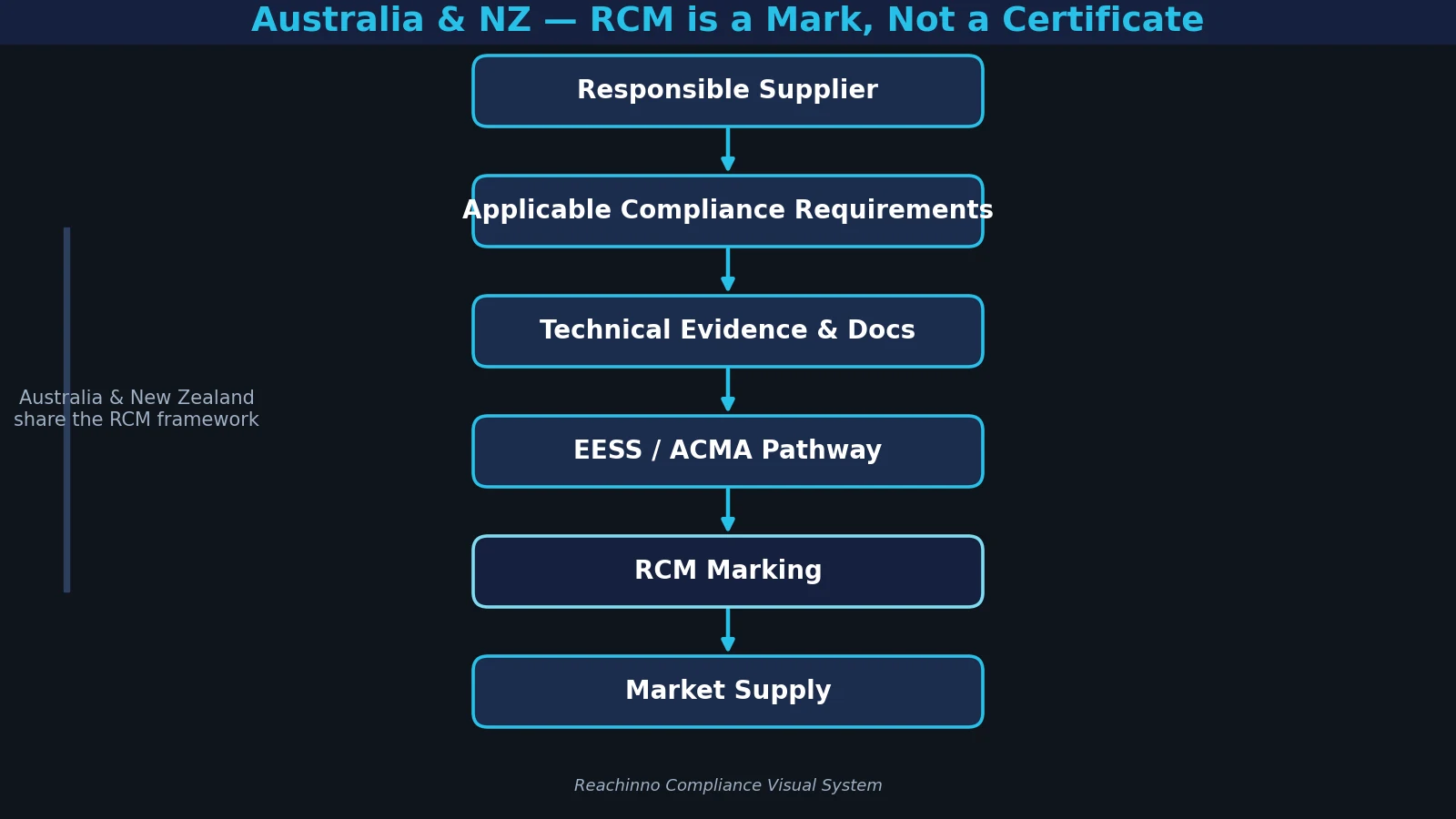
Australia and New Zealand operate a joint conformity framework centred on the RCM (Regulatory Compliance Mark). Unlike markets that issue one “power bank certificate,” the RCM is a single mark that signals compliance across two layers at once: electrical safety (administered through the EESS — Electrical Equipment Safety System) and EMC / radio (administered through ACMA). For an OEM or ODM, the practical question is not “which certificate?” but “is the product registered and marked so it can be lawfully supplied?”
This regional assessment follows the Reachinno Global Power Bank Compliance & Market Access Framework™ (RK-14), which connects market-entry requirements with product architecture, compliance planning and engineering validation.
Reachinno Engineering Principle™: In Australia and New Zealand, market access is a registration-and-marking discipline, not a one-shot stamp. Plan the EESS registration and the RCM mark together, and do not ship before both are complete.
RCM — The Mandatory Mark
The RCM is the mandatory compliance mark for electrical and electronic products supplied in both Australia and New Zealand. A power bank cannot be lawfully placed on the market without it. The mark is only permitted once the product is registered for electrical safety (EESS) and, where applicable, for EMC/radio (ACMA). Treat RCM as the visible output of a compliance process, not the process itself.
EESS — Electrical Equipment Safety System
Under the EESS, electrical equipment is classified into risk levels (Level 1, 2, 3). Lower-risk products sit at Level 1 and require a responsible supplier registration plus held evidence of compliance to the applicable standard; higher-risk products require third-party safety certification before registration.
- Portable power banks and portable energy-storage products are treated as Level 1 equipment — the responsible supplier must be registered on the national EESS database and hold compliance evidence, but the pathway is supplier-declared rather than a full third-party certificate.
- The responsible supplier (the business that places the product on the market) carries the registration and documentation obligation.
The referenced marking and level standard is AS/NZS 4417.2; in 2026 the framework’s updates continued to list portable energy-storage products within the Level 1 scope, reinforcing that registration — not a separate heavy certificate — is the gate.
AS/NZS 62368.1 — The Product-Safety Standard
The applicable product-safety standard for a power bank is AS/NZS 62368.1, the joint Australian/New Zealand adoption of IEC 62368.1 for audio/video, information-technology and communications equipment. It covers the hazard-based safety requirements that matter for a lithium-ion power product: electrical, thermal, mechanical and fire-envelope behaviour of the cells, pack and electronics.
Confirm the current adopted edition before tooling lock — design guidance for products launched from 2026 references AS/NZS 62368.1:2022, and the adopted edition can be updated. Reachinno designs to the current AS/NZS 62368.1 and keeps the evidence package aligned to the edition in force at launch.
EMC and Wireless (ACMA)
Even a wired-only power bank needs EMC conformity under ACMA (emissions and immunity, typically referenced to AS/NZS CISPR standards). If the product adds wireless functions — Qi2 wireless charging or Bluetooth — it also needs radio-equipment compliance under ACMA rules, and the RCM then bundles both the safety and radio dimensions. This is the same split you see in the FCC vs CE vs CCC comparison.
UN 38.3 and Transportation
As everywhere, UN 38.3 testing of the lithium cells/batteries is mandatory before air or sea shipment, and Australian and New Zealand inbound logistics follow IATA / IMDG transport rules (Class 9, typically UN3480 or UN3481). Our UN3480 shipping guide covers the documentation. Air-carriage limits (spare batteries in carry-on, Wh thresholds) are a transport rule, not a product-safety certificate.
Battery Stewardship and Recycling
- In Australia, battery products are pulled into product-stewardship / collection schemes (for example the B-cycle battery stewardship arrangement) — a market-access and lifecycle obligation, not a product-safety certificate.
- New Zealand generally accepts equipment that complies with the joint Australian/New Zealand framework and the RCM; confirm any New Zealand-specific electrical-safety registration expectations for the product class before launch.
2026 Regulatory Watch
The 2026 movement in this region is about edition updates and scope confirmation, not a brand-new mandatory law. Watch:
- The current adopted edition of AS/NZS 62368.1 at your launch date.
- Continued EESS Level 1 listing of portable energy-storage products under AS/NZS 4417.2.
- Any state/territory or NZ-specific battery-stewardship obligations that affect labelling and take-back.
2026 Australia & New Zealand Market-Access Checklist
| Layer | Requirement | Type | Note for OEM/ODM |
|---|---|---|---|
| Safety | AS/NZS 62368.1 | Mandatory (referenced) | Held evidence to current edition |
| Registration | EESS responsible-supplier + product registration | Mandatory | Level 1 for power banks |
| Mark | RCM | Mandatory | After EESS + ACMA registration |
| EMC / radio | ACMA (CISPR; radio if wireless) | Mandatory | Qi/Bluetooth add radio path |
| Transport | UN 38.3 + IATA/IMDG | Mandatory for shipping | Class 9 (UN3480 / UN3481) |
| Stewardship | Battery collection / EPR | Market obligation | Australia B-cycle; confirm NZ |
Common Mistakes
- Assuming the RCM is a certificate you “buy” — it is the mark you earn through EESS registration and conformance evidence.
- Forgetting the responsible-supplier registration on the EESS database before supply.
- Treating airline Wh limits as a product-safety threshold.
- Ignoring ACMA EMC/radio where wireless functions are present.
How Reachinno Supports Australia & New Zealand Market Access
We design to AS/NZS 62368.1 from the schematic stage, prepare the EESS registration evidence and UN 38.3 transport documents, and support the RCM marking and ACMA path where wireless is present. The same platform evidence feeds other regional programs — for example, our RC804 145W platform is engineered against a multi-standard stack. For the full global picture, start from our global power bank compliance and market access guide.
Official Sources
This guide draws on official Australian and New Zealand government sources.
ACMA — Radio & EMC (RCM)
Australian Communications and Media Authority (ACMA)
EESS — Electrical Equipment Safety System
EESS: registered electrical equipment database
ACCC — Consumer Law & RCM Oversight
Australian Competition and Consumer Commission (ACCC)
This guide is based primarily on official Australian and New Zealand government sources and is intended for product-development and market-access planning. It is not legal advice and does not replace confirmation with ACMA, EESS, ACCC, an accredited testing laboratory or the applicable certification authority.
Frequently Asked Questions
Is a single “power bank certificate” required in Australia and New Zealand?
No single certificate like CCC or KC is required. Market access is built from RCM marking, which in turn requires EESS registration (with held AS/NZS 62368.1 evidence) and, where applicable, ACMA EMC/radio registration.
What safety standard applies to power banks?
AS/NZS 62368.1, the joint Australian/New Zealand adoption of IEC 62368.1 for AV/ICT equipment. Confirm the current adopted edition at launch.
Are power banks Level 1 or Level 3 under EESS?
Portable power banks and portable energy-storage products are generally treated as Level 1 equipment — responsible-supplier registration plus held compliance evidence, rather than a full third-party safety certificate. Confirm the level for your exact product class.
Is a CE or CCC mark accepted?
No. Australia/New Zealand run their own RCM/EESS framework. A CE or CCC mark does not satisfy RCM requirements, though the underlying test evidence can inform your compliance file.