Taiwan is preparing to tighten the product inspection requirements for secondary lithium power banks.
This regional assessment follows the Reachinno Global Power Bank Compliance & Market Access Framework™ (RK-14), which connects market-entry requirements with product architecture, compliance planning and engineering validation.
The most important change for power bank manufacturers and OEM buyers is a proposed puncture test for secondary lithium power banks rated at 160Wh or below, together with updated references to CNS 62133-2, CNS 62619 and related product inspection requirements.
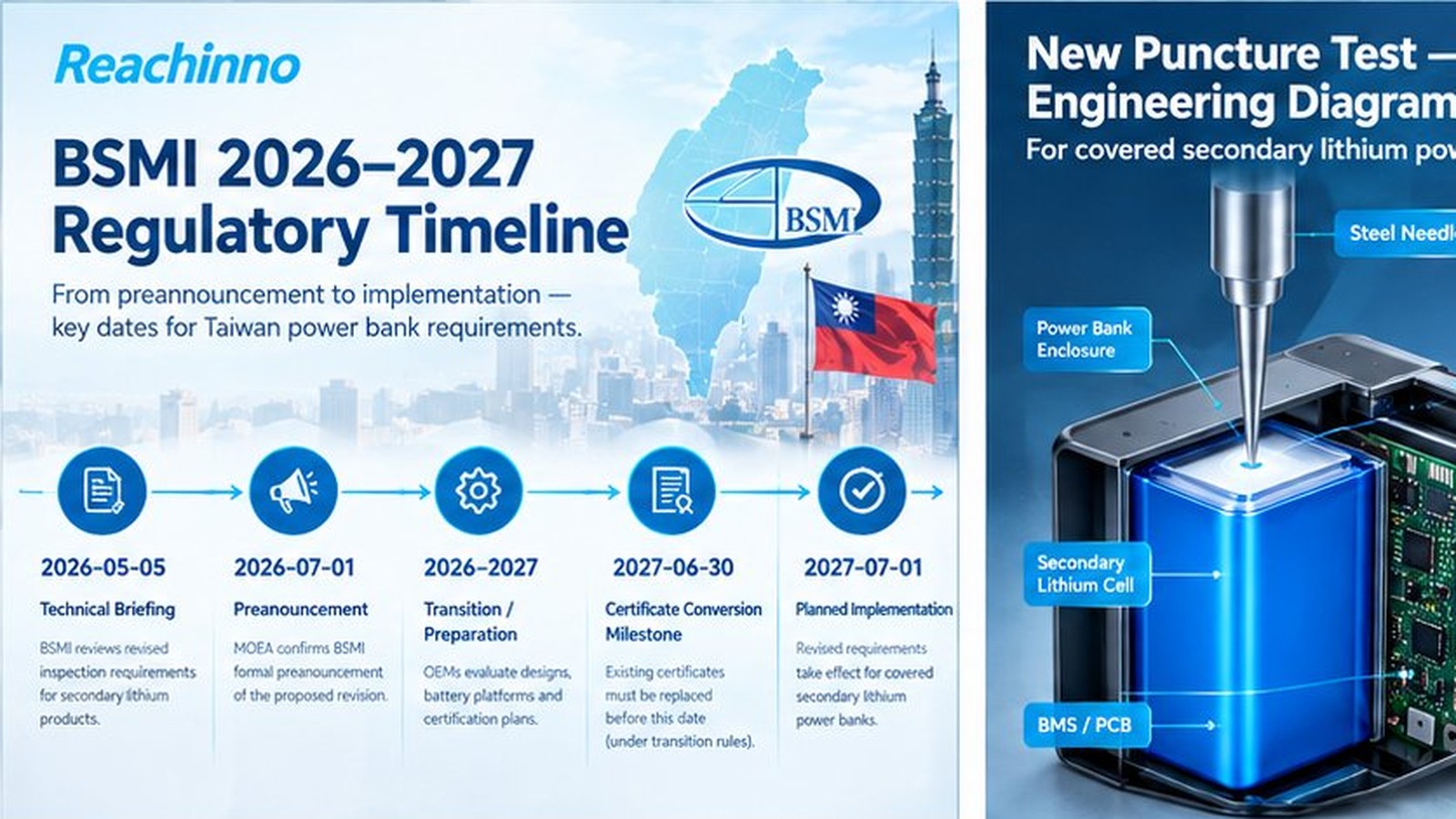
Taiwan’s Bureau of Standards, Metrology and Inspection (BSMI) formally preannounced the proposed revision on July 1, 2026. As of September 10, 2026, the revision remains a proposed / preannounced requirement, rather than a fully effective new rule. The planned implementation date for the revised requirements covering secondary lithium power banks is July 1, 2027.
For OEM teams, the important question is therefore not simply:
“Do we need BSMI?”
It is:
“Does our current battery architecture remain suitable for the 2027 Taiwan requirements?”
That distinction matters because the proposed changes reach into cell selection, battery construction, safety testing, certification documentation and product-change management.
Taiwan BSMI Power Bank Update — 2026
Taiwan’s BSMI has preannounced revised inspection requirements for secondary lithium power banks. The proposal adds a puncture test for covered power banks up to 160Wh, references CNS 62133-2 and related battery/electrical standards, and sets a planned implementation date of July 1, 2027. As of September 10, 2026, the revision remains a proposed/preannounced requirement.
This guide is part of Reachinno’s Global Power Bank Compliance & Market Access 2026 knowledge system. For a cross-market comparison and the full framework, see the pillar guide.
Quick Answer: What Is Changing for Taiwan Power Bank Compliance?
Taiwan’s BSMI is proposing updated inspection requirements for secondary lithium power banks.
For covered power banks, the proposed framework includes:
- a new puncture test for power banks up to 160Wh;
- testing based on CNS 62133-2 (2018 / ROC 107 edition), Appendix G;
- continued use of relevant electrical and battery safety standards;
- reference to CNS 62619 for applicable products;
- updated conformity-assessment procedures;
- transition arrangements for existing certificates;
- revised requirements for product marking and restricted-substance disclosure.
The proposed implementation date for the secondary lithium power-bank item is:
July 1, 2027.
The existing inspection requirements for this product category are scheduled to stop applying from that date under the proposed revision.
The key point for OEM buyers
This is not yet a “new BSMI rule already in force” story.
It is a 2026 regulatory transition story.
That makes 2026 the right time for product teams to evaluate their designs before the 2027 implementation date.
| Area | Proposed change | OEM implication |
|---|---|---|
| Scope definition | Secondary lithium power banks described by weight / mobility criteria | Confirm classification before choosing a test path |
| Puncture test | New puncture test for covered products up to 160Wh | Cell platform and pack structure become design constraints |
| Battery safety standard | CNS 62133-2 (107 edition) or applicable CNS 62619 | Verify exact cell model documentation |
| Electrical safety | CNS 15598-1 (109 edition) | Review charging and output architecture against the standard |
| Wireless charging | CNS 15936 (105 edition); CNS 13803 where applicable | Wireless charging must be architected, not added late |
| Marking / restricted substances | CNS 15663 Section 5 | Prepare marking and disclosure documentation |
| Certificate transition | Replacement documentation before June 30, 2027 | Treat as a certification-management project |
1. What Is BSMI and Why Does It Matter for Power Banks?
BSMI is Taiwan’s Bureau of Standards, Metrology and Inspection, under Taiwan’s Ministry of Economic Affairs.
For regulated products, BSMI establishes and administers product inspection requirements covering applicable safety, performance, marking and other requirements.
For secondary lithium power banks, the inspection framework applies to defined products within the regulated scope.
Under the proposed revision, the power-bank category is described as:
secondary lithium power banks meeting either of these conditions:
- total weight of 18 kg or less and non-fixed equipment, or
- equipment equipped with wheels or another mobility mechanism.
This is important because the Taiwan framework is not simply based on the marketing name “power bank.”
Product classification matters.
A product that looks like a power bank from a consumer perspective may have a different regulatory treatment depending on:
- battery architecture;
- energy capacity;
- physical configuration;
- mobility;
- charging functions;
- wireless charging functions;
- intended use;
- product category.
For OEM development, classification should therefore be completed before the certification/testing path is finalized.
2. What Changed in Taiwan in 2026?
The current regulatory development began with BSMI’s review of the inspection requirements for secondary lithium products.
In its May 2026 briefing, BSMI explained that the revision was being planned in response to the safety risks associated with power-bank products and consumer protection considerations.
The proposed revision adds a puncture test for secondary lithium power banks up to 160Wh. The proposed test references CNS 62133-2 (107 edition), Appendix G, Section G.3.1, Mode 1.
The formal proposed revision was then announced on July 1, 2026. BSMI’s public notice confirms that the proposal covers “secondary lithium power banks and other products” under the power-supply equipment category.
This creates three important dates
| Date | Event |
|---|---|
| May 5, 2026 | BSMI technical briefing on the proposed revision |
| July 1, 2026 | Formal preannouncement of the proposed revision |
| 2026–2027 | Preparation and transition period for OEMs and certificate holders |
| June 30, 2027 | Certificate conversion milestone for covered existing certificates |
| July 1, 2027 | Planned implementation of the revised power-bank requirements |
The July 1, 2027 date is the key planning milestone for power-bank OEM projects.
3. The New Puncture Test Is the Most Important Engineering Change
The most significant technical change for ordinary power-bank OEM development is the proposed puncture test.
For covered secondary lithium power banks up to 160Wh, the proposed requirement references:
CNS 62133-2 (107 edition), Appendix G, G.3.1 Mode 1
The proposed requirement specifies that the steel needle must penetrate the secondary lithium cell contained in the power bank.
The test is not simply asking whether the outer power-bank housing survives.
It targets the secondary lithium cell itself.
4. What Does the Puncture Test Require?
According to the proposed BSMI text, the applicable cell must be tested using the specified puncture method.
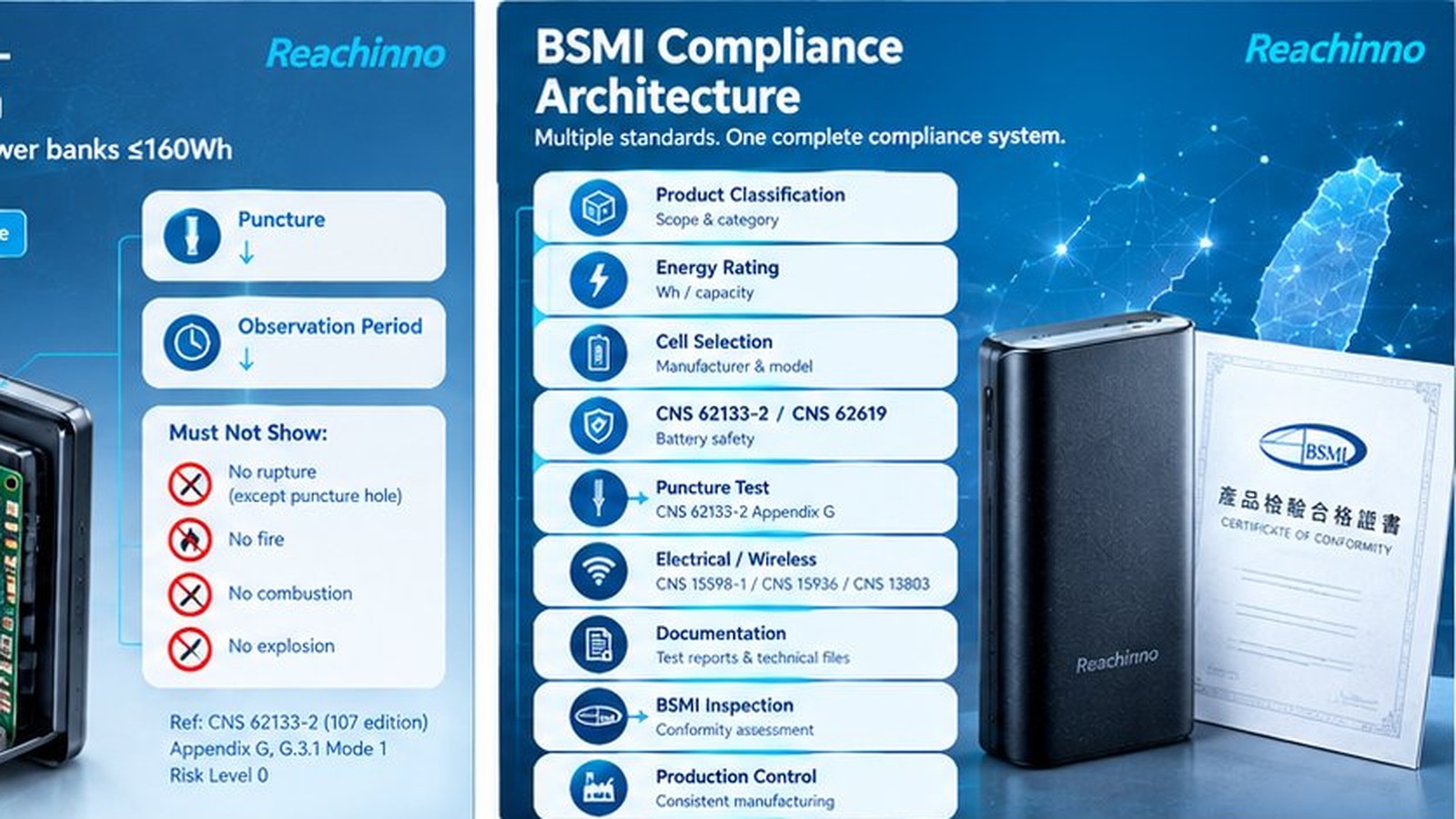
The proposed requirement references Risk Level 0 under the relevant CNS 62133-2 provision.
During the puncture and observation period, the cell should not exhibit:
- rupture other than the puncture hole;
- fire;
- combustion;
- explosion.
The proposal specifically states that the “no leakage” and “battery surface temperature not exceeding 43°C” conditions do not apply to this puncture test.
This distinction is important.
A simplified description such as:
“The battery must survive puncture.”
would be incomplete.
The actual requirement is more specific about what is observed after penetration and which failure modes are prohibited.
5. Why Does a Puncture Test Change Product Engineering?
This is where BSMI becomes much more relevant to an OEM engineering team.
A puncture result can be influenced by far more than the certification sample.
Consider the chain:
Cell construction → Electrode and separator system → Cell mechanical structure → Cell arrangement → Battery pack compression → Cell spacing → Enclosure → Assembly process → Final product
The test therefore creates a strong connection between:
battery supplier selection + mechanical architecture + manufacturing consistency.
For an OEM buyer, that means the battery cannot be treated as a commodity component.
6. Why 160Wh Matters
The proposed puncture requirement specifically applies to secondary lithium power banks up to 160Wh.
This threshold is especially relevant because many consumer and professional portable power products fall below it. For example:
- 5,000mAh power banks;
- 10,000mAh power banks;
- 20,000mAh power banks;
- 27,000mAh power banks;
- high-power laptop power banks.
A typical 20,000mAh lithium-ion power bank is well below 160Wh on a nominal-energy basis.
That means the new puncture requirement can be directly relevant to many mainstream power-bank platforms.
But do not make a capacity assumption
The exact regulatory scope should be assessed using the product’s applicable rating, architecture and classification.
Do not simply tell a client:
“Anything under 160Wh automatically needs BSMI puncture testing.”
Instead:
“Covered secondary lithium power banks rated at 160Wh or below fall within the proposed puncture-test requirement.”
That wording is much safer.
7. Which Standards Are Referenced?
The proposed revision is not replacing everything with one new standard.
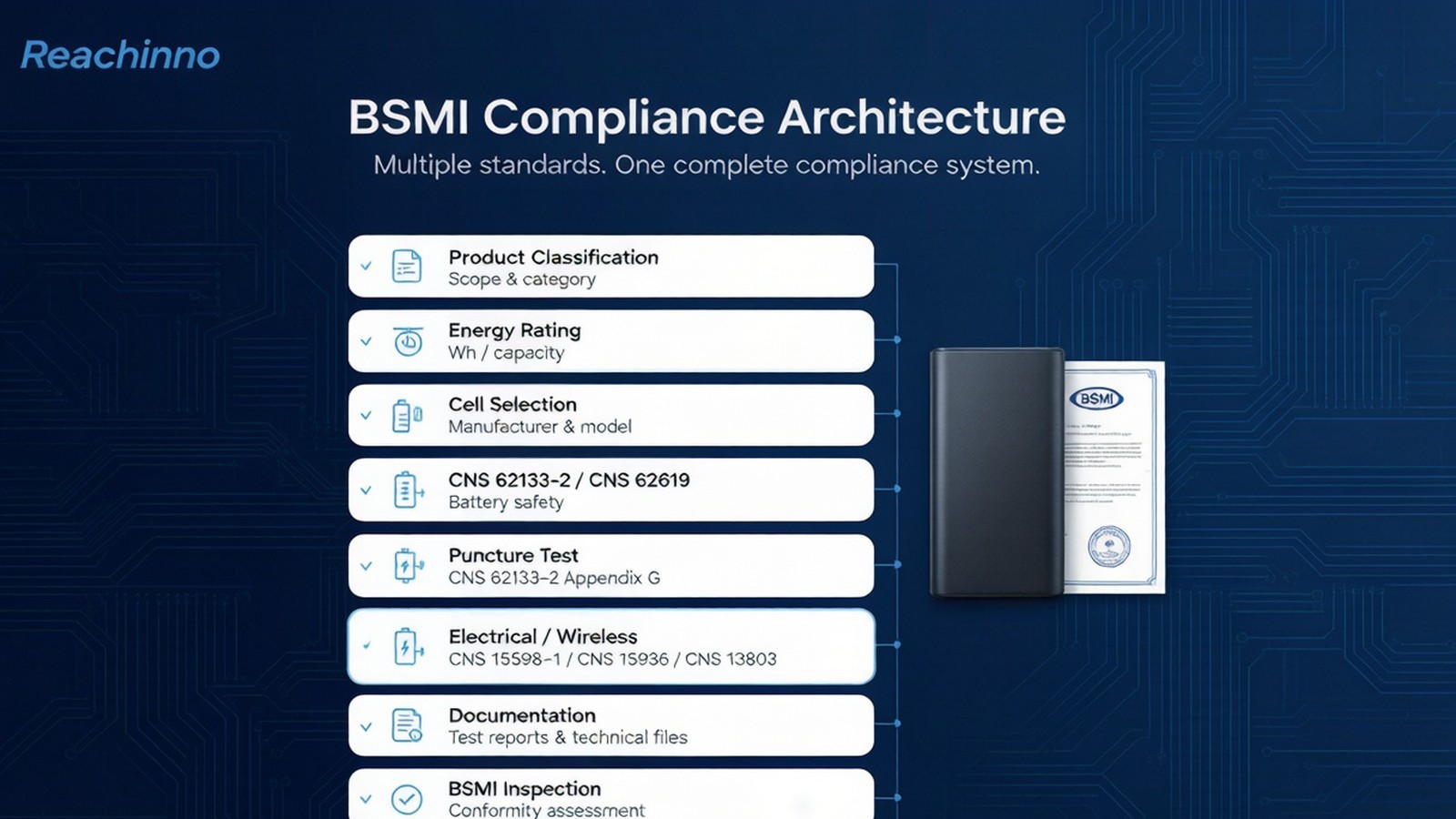
Instead, it creates a broader standards structure. For the secondary lithium power-bank category, the proposed table references:
Electrical safety
CNS 15598-1 (109 edition)
Wireless charging where applicable
CNS 15936 (105 edition) or CNS 13803 (107 edition) for applicable wireless-charging functionality.
Battery safety
CNS 62133-2 (107 edition) or applicable versions of CNS 62619.
Puncture
CNS 62133-2 Appendix G for covered products up to 160Wh.
Restricted substances / marking
CNS 15663 Section 5 for applicable marking/disclosure requirements.
This is an important point for international brands:
BSMI compliance is not a single laboratory test.
It is a product-level compliance architecture.
8. CNS 62133-2 Becomes More Important
CNS 62133-2 is particularly important because the proposed framework uses it both as a battery-safety reference and as the basis for the new puncture test.
For products using secondary lithium cells under CNS 62133-2, the proposed requirements also reference the relevant cell requirements in Appendix E.
This creates a practical engineering question:
Can the exact cell platform selected for the product support the Taiwan market-access requirement?
That question should be answered before tooling, not after the product is finished.
9. Battery Cell Selection Should Start Earlier
For a new Taiwan-bound power bank, the engineering team should not wait until the certification laboratory asks for samples.
Battery selection should already consider:
Cell manufacturer
- manufacturer qualification;
- quality consistency;
- traceability;
- documentation;
- production-change notification.
Cell model
- exact model;
- chemistry;
- dimensions;
- rated capacity;
- nominal voltage;
- maximum charging conditions;
- discharge characteristics.
Mechanical behaviour
- cell construction;
- separator behaviour;
- swelling characteristics;
- compression;
- mechanical protection.
Safety documentation
- applicable test reports;
- cell certification evidence;
- traceability documents;
- supplier quality documentation.
This becomes particularly important if a brand plans to sell the same platform across multiple markets.
10. One Battery Platform Should Not Mean One Global Compliance Assumption
This is a common mistake.
A brand may think:
“The battery passed CE/IEC/UN38.3, so the same battery should be fine for Taiwan.”
Not necessarily.
Different markets can impose different product-level requirements.
A battery platform may already have IEC-related testing, UN38.3 transport testing, CE-related documentation, UL-related testing or other market approvals.
But the Taiwan BSMI path can still require its own applicable product inspection evidence.
The new puncture requirement makes this even more obvious.
Global OEM principle
Reuse the engineering platform where possible. But: do not assume compliance evidence is automatically interchangeable across markets.
11. How Does This Affect Wireless-Charging Power Banks?
This is particularly relevant to Reachinno.
The proposed BSMI framework separately references wireless-charging requirements where applicable.
For products with wireless charging functionality, the proposed table references CNS 15936, or CNS 13803 for applicable wireless-charging functionality.
That means a modern magnetic or Qi2-style power bank can have a more complex compliance structure than a basic USB-C power bank.
The engineering stack may include:
Battery → BMS → USB-C PD → DC/DC → Wireless Power Transmitter → Coil → Thermal Management → Firmware → Mechanical Structure
Each layer can affect the final product’s compliance and thermal behaviour.
This is why wireless charging should be considered during the original product architecture rather than added at the end.
12. What About High-Capacity Camping Power Banks?
The BSMI briefing explicitly distinguishes portable power products by scope and gives examples involving larger camping-oriented products.
This is an area where OEM teams need to be especially careful.
A product marketed as a camping power bank, portable power supply, portable energy storage or emergency power supply may have a very different regulatory profile from a conventional consumer power bank.
Do not determine BSMI applicability from marketing terminology alone. Instead, review:
- total weight;
- fixed vs non-fixed configuration;
- mobility;
- battery energy;
- output architecture;
- product function;
- intended use;
- exact product classification.
For products approaching or exceeding 160Wh, the specific puncture-test scope should be checked rather than automatically applying the consumer power-bank rule.
13. What Happens to Existing BSMI Certificates?
This is one of the most important sections for existing brands.
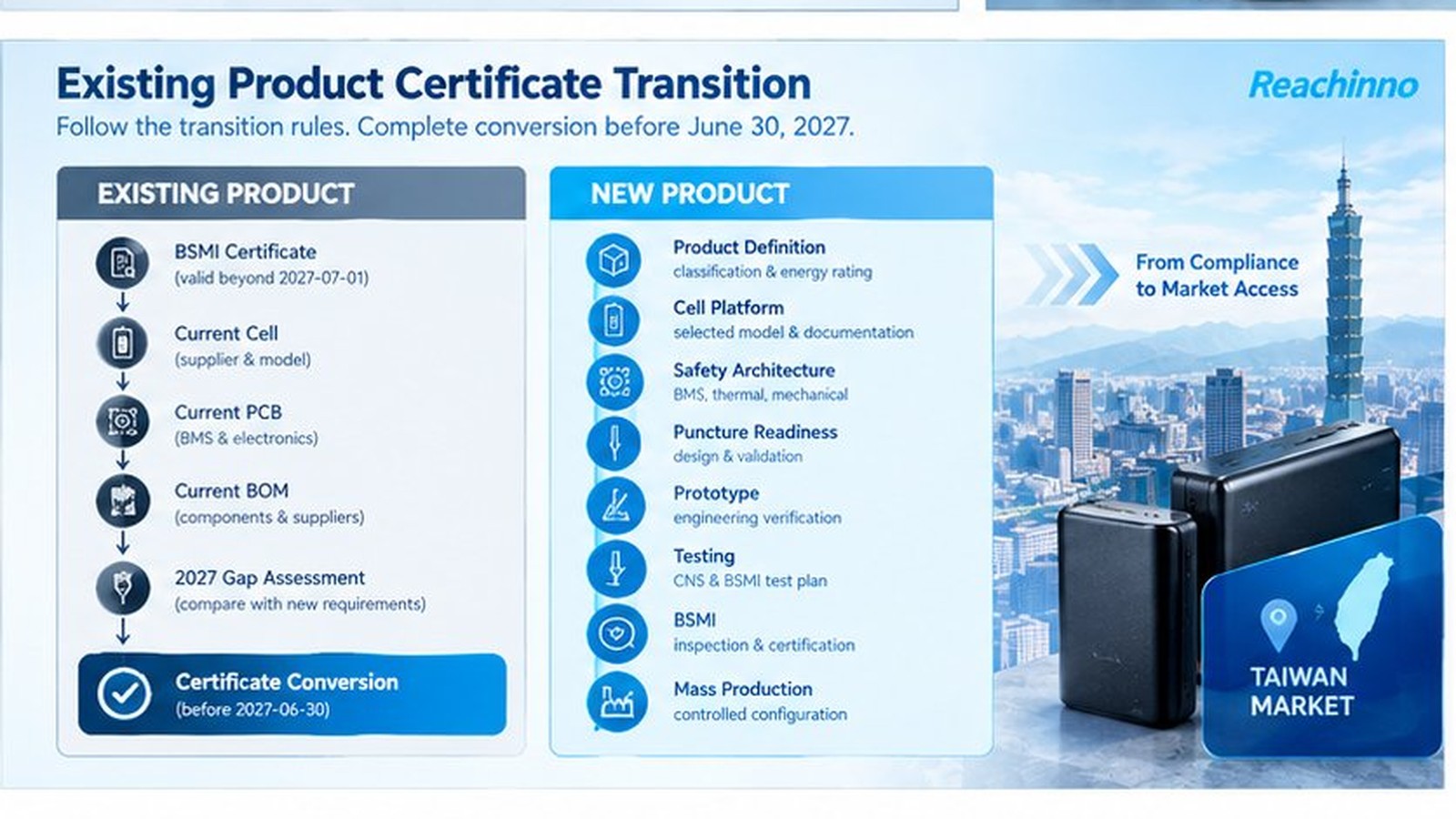
Under the proposed transition provisions for Item 1 — secondary lithium power banks, existing certificates have specific conversion requirements.
For certificates obtained under the previous inspection requirements whose validity extends beyond July 1, 2027, the certificate holder is required to provide documentation demonstrating compliance with the revised inspection methods and standards and apply for replacement before June 30, 2027. Failure to complete the required replacement can result in cancellation under the applicable regulations.
This means existing products should not wait until July 1, 2027.
The practical deadline is earlier
June 30, 2027 for the relevant existing certificates that fall under the stated transition conditions.
14. Existing Products Need a Gap Assessment
For an existing power-bank platform, we recommend creating a BSMI transition matrix.
| Engineering area | Current product | 2027 review |
|---|---|---|
| Cell manufacturer | Current supplier | Confirm unchanged |
| Cell model | Existing model | Confirm applicable CNS evidence |
| Battery structure | Existing | Review puncture implications |
| BMS | Current design | Review safety architecture |
| PCB | Existing revision | Check consistency |
| Wireless charging | If applicable | Review CNS requirements |
| Product energy | Wh | Confirm scope |
| Mechanical structure | Existing housing | Review cell protection |
| Certification | Existing BSMI | Check conversion requirement |
| Documentation | Existing | Prepare updated evidence |
| Marking | Existing | Review new requirements |
| Supplier changes | Historical / current | Document changes |
This is the kind of work that should happen months before certification renewal.
15. New Projects Have an Easier Path
Ironically, a new product can be easier to manage than an old one.
Why? Because the engineering team can design around the requirement from the beginning.
For a new Taiwan power bank project in 2026, we recommend locking:
Before prototype
- product classification;
- rated energy;
- cell platform;
- BMS;
- battery mechanical structure;
- charging architecture;
- wireless charging architecture;
- thermal strategy.
Before tooling
- target test standards;
- cell documentation;
- battery pack structure;
- safety test plan;
- product markings;
- certification documentation plan.
Before mass production
- approved BOM;
- approved cell;
- approved PCB;
- approved firmware;
- approved enclosure;
- production-control process;
- change-management procedure.
This approach dramatically reduces the risk of discovering a compliance problem after tooling.
16. The Engineering Implications of Puncture Testing
The new requirement creates several engineering questions that should be answered during development.
Cell selection
Can the selected cell architecture withstand the relevant puncture test without prohibited failure?
Cell arrangement
Does the mechanical layout create unnecessary stress concentration?
Enclosure
Does the housing provide sufficient mechanical protection without creating excessive compression?
Adhesives
Could adhesive placement influence cell deformation or mechanical stress?
Battery pack structure
Is the cell securely positioned?
Manufacturing
Can production maintain the same cell positioning and mechanical conditions as the certified sample?
These questions are not all explicit “BSMI requirements.”
They are engineering questions created by the test requirement.
That distinction should remain clear.
17. BSMI Compliance Is Also a Manufacturing-Control Problem
Certification is performed on samples. Production happens at scale.
That creates a familiar risk:
The certified sample is not necessarily identical to the mass-produced product.
For power banks, critical changes can include:
- battery supplier;
- cell model;
- BMS IC;
- charging IC;
- PCB;
- wireless charging module;
- enclosure material;
- adhesive;
- cell arrangement;
- firmware;
- manufacturing process.
A change that looks small commercially can be significant from a compliance perspective.
Therefore, a Taiwan-bound OEM project should maintain:
Certified configuration → Controlled BOM → Approved suppliers → Engineering Change Control → Mass-production verification
18. What Does This Mean for Reachinno’s High-Power Power Banks?
This is where the BSMI update connects directly with Reachinno’s product strategy.
Consider a high-power laptop power bank such as the RC804 145W Power Bank.
The engineering system may contain:
- 20,000mAh-class battery architecture;
- USB-C PD;
- 100W+ output;
- multiple DC/DC stages;
- high-current switching components;
- thermal sensors;
- BMS;
- wireless charging in some models;
- compact mechanical packaging.
Adding Taiwan market access means the team must think about the complete system.
Not simply: “Can the battery pass the test?”
But: “Can the exact production architecture be validated, documented and controlled for Taiwan?”
That is the more useful OEM question.
19. What Does This Mean for Qi2 Power Banks?
The same principle applies to Qi2 and magnetic wireless power banks.
Wireless charging adds:
- coil;
- magnetic alignment;
- transmitter electronics;
- additional conversion losses;
- additional heat;
- firmware;
- mechanical magnets;
- foreign-object detection and related functions depending on implementation.
The BSMI proposed framework explicitly includes wireless-charging standards where applicable.
Therefore, Qi2 development should not be treated as “USB-C power bank + wireless module.”
It should be treated as a new system architecture with its own thermal and compliance interactions.
20. Taiwan BSMI vs China CCC: Similar Direction, Different Rules
This is an important editorial section.
Both China and Taiwan are tightening lithium-battery-related safety requirements.
But that does not mean Taiwan is simply following China’s CCC update.
The regulatory systems are separate.
China’s 2026 update centres on GB 47372-2026 and the CCC framework, with its own transition and implementation timeline. See China CCC Power Bank Certification 2026.
Taiwan’s current development is a BSMI proposed revision using Taiwan’s own CNS standards and inspection framework.
The overlap is in the broader engineering direction:
Lithium-battery safety is receiving greater regulatory attention.
But the requirements, implementation dates, standards and conformity-assessment procedures are different.
This distinction is essential for a professional compliance knowledge base.
21. What Global Brands Should Prepare in 2026
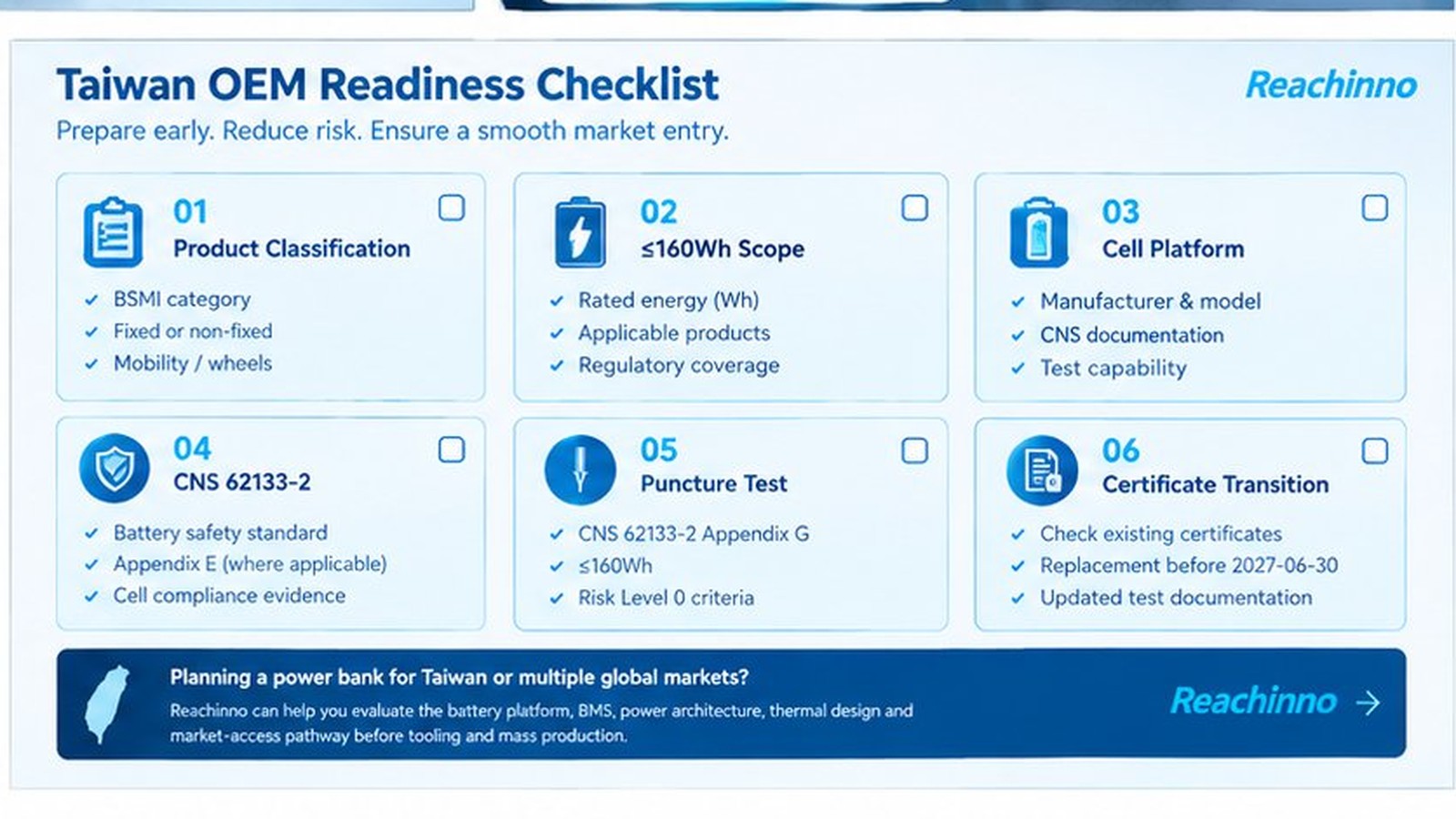
If Taiwan is one of your target markets, do not wait until Q2 2027. Start with five actions.
1. Confirm product classification
Determine whether the product falls under the secondary lithium power-bank category.
2. Confirm energy rating
Establish the product’s applicable Wh rating.
3. Review the cell platform
Confirm the exact cell model and applicable CNS documentation.
4. Review the puncture-test pathway
For covered products up to 160Wh, evaluate the proposed puncture requirement early.
5. Build the certification transition plan
For existing products, identify whether certificate replacement will be required before June 30, 2027.
22. A Practical Taiwan BSMI Readiness Checklist
Before approving a Taiwan-bound power bank, ask:
Product
- What exact BSMI category does the product fall into?
- What is the rated Wh?
- Is it fixed or non-fixed?
- Does it have wheels or another mobility mechanism?
- Does it contain wireless charging?
Battery
- What is the exact cell manufacturer?
- What is the exact cell model?
- Is the cell covered by the applicable CNS requirement?
- Can the cell support the proposed puncture test?
Electronics
- What BMS is used?
- How many temperature sensors are used?
- What charging IC is used?
- What PD controller is used?
- Is wireless charging integrated?
Mechanical
- How are cells positioned?
- How are cells restrained?
- Is there mechanical compression?
- What materials surround the battery?
Certification
- Is the product already BSMI registered?
- Does the certificate extend beyond July 1, 2027?
- Does it require conversion?
- What documentation is available?
Manufacturing
- Is the battery supplier locked?
- Is the BOM controlled?
- Are component changes documented?
- Is firmware controlled?
- Is the production configuration identical to the certified configuration?
23. What OEM Buyers Should Ask Their Supplier
A strong Taiwan compliance discussion should go beyond: “Do you have BSMI?”
Instead ask:
Battery
Which exact cell model is used in the BSMI-certified product?
Test
Has the battery platform been evaluated against the proposed CNS 62133-2 puncture requirement?
Documentation
Can you provide the relevant type-test documentation?
Changes
What happens if the cell supplier changes?
Production
How do you ensure that the mass-production battery configuration remains consistent with the tested sample?
Wireless charging
If the product has wireless charging, which CNS requirement is being applied?
Transition
If this model already has a BSMI certificate, does it require conversion before June 30, 2027?
These questions reveal much more about a supplier’s engineering capability than simply asking: “Do you have BSMI?”
24. How Reachinno Approaches Taiwan Market Access
At Reachinno, we treat market compliance as part of product development.
Our approach connects:
Product Definition → Market Classification → Battery Platform → Electrical & Mechanical Architecture → Safety Validation → Certification Preparation → Controlled Manufacturing → Market Launch
For Taiwan projects, this means considering BSMI requirements while the product is still being engineered.
The goal is not simply to obtain a document.
The goal is to build a product whose battery, BMS, PCB, wireless system, mechanical structure, firmware, BOM and manufacturing process can remain aligned with the approved configuration throughout the product lifecycle.
25. Final Takeaway
Taiwan’s 2026 BSMI development is important for power-bank manufacturers because it brings a more explicit focus on battery mechanical safety, particularly through the proposed puncture test for covered secondary lithium power banks up to 160Wh.
As of September 10, 2026, these changes remain part of a preannounced proposed revision, not a fully effective new rule. The planned implementation date for the secondary lithium power-bank requirements is July 1, 2027.
For existing products, the transition should be treated as a certification-management project.
For new products, it should be treated as an engineering-design requirement.
The most important preparation areas are:
- product classification;
- energy rating;
- cell selection;
- CNS 62133-2 compliance;
- puncture-test readiness;
- BMS and battery architecture;
- wireless-charging requirements where applicable;
- documentation;
- product consistency;
- certificate transition.
The broader lesson for global OEM development is straightforward:
Market access should be designed into the product—not added after the product is finished.
Planning a power bank for Taiwan or multiple global markets?
Reachinno can help you evaluate the battery platform, BMS, power architecture, thermal design and market-access pathway before tooling and mass production.
discuss a Taiwan market-access project with our engineering team →
Related Resources
2026 Power Bank Industry Report
For broader market, battery and regulatory trends, see the 2026 Power Bank Industry Report.
Power Bank Certifications & Global Compliance in 2026
Reachinno’s existing Power Bank Certifications & Global Compliance in 2026 will be upgraded into a broader 2026 cornerstone covering CCC, BSMI, PSE and other major markets.
China CCC Power Bank Certification 2026
See our technical guide to China CCC Power Bank Certification 2026, China’s new power-bank safety requirements and the 2027 CCC transition.
FAQ
Is BSMI certification mandatory for power banks sold in Taiwan?
For products falling within Taiwan’s mandatory inspection scope, the applicable BSMI product inspection requirements must be met before the product can be legally marketed or imported according to the relevant rules. The exact applicability depends on product classification and the current inspection catalogue.
What is changing for Taiwan power banks in 2026?
BSMI has preannounced a proposed revision that adds a puncture-test requirement for covered secondary lithium power banks up to 160Wh and updates the applicable inspection standards and conformity-assessment framework.
Is the new Taiwan BSMI power-bank requirement already mandatory?
Not yet, based on the regulatory status available as of September 10, 2026. BSMI’s July 1, 2026 notice is a preannouncement of a proposed revision. The planned implementation date for the secondary lithium power-bank item is July 1, 2027.
What is the new BSMI puncture test?
The proposed requirement references CNS 62133-2 (107 edition), Appendix G, Section G.3.1 Mode 1, for covered secondary lithium power banks up to 160Wh. The steel needle is specified to penetrate the secondary lithium cell, with Risk Level 0 failure criteria referenced in the proposal.
Does the puncture test apply to all power banks?
The proposed puncture requirement specifically applies to covered secondary lithium power banks of 160Wh or below. Product classification and the exact applicable inspection requirements should be confirmed for each product.
Which battery standard does Taiwan use for power banks?
The proposed framework references CNS 62133-2 (107 edition) or applicable CNS 62619 versions for the battery-safety portion of the secondary lithium power-bank requirements.
Does wireless charging affect BSMI requirements?
It can. The proposed framework references CNS 15936 and, where applicable, CNS 13803 for products with wireless-charging functionality.
What happens to existing BSMI certificates?
For covered secondary lithium power banks with existing certificates extending beyond July 1, 2027, the proposed transition provisions require the certificate holder to submit documentation meeting the revised requirements and apply for replacement before June 30, 2027.
Should new power-bank projects in 2026 use the new requirements?
For products intended for Taiwan beyond the transition period, it is prudent to assess the proposed 2027 requirements during product architecture and certification planning rather than waiting until final testing.
Does passing the BSMI test guarantee production compliance?
No. Certification or inspection testing evaluates defined product configurations. Production consistency, supplier changes, BOM control and engineering-change management remain important to maintaining compliance.
Official Sources
For this article, use official Taiwan government sources as the primary evidence.
BSMI — July 2026 Proposed Revision
BSMI official preannouncement: Secondary lithium power banks and related products
BSMI — Proposed Revision Document
Official BSMI proposed revision and comparison table
BSMI — May 2026 Technical Briefing
BSMI briefing on revised secondary lithium power-bank inspection requirements
Taiwan Ministry of Economic Affairs
MOEA official announcement of the July 2026 BSMI proposal
This guide is based primarily on official Taiwan BSMI and Ministry of Economic Affairs sources and is intended for product-development and market-access planning. It is not legal advice and does not replace confirmation with BSMI, an accredited testing laboratory or the applicable certification/inspection authority.