Japan has one of the more structured product-safety systems for portable lithium-ion power products.
This regional assessment follows the Reachinno Global Power Bank Compliance & Market Access Framework™ (RK-14), which connects market-entry requirements with product architecture, compliance planning and engineering validation.
For brands developing or sourcing power banks for Japan, however, one distinction is critical:
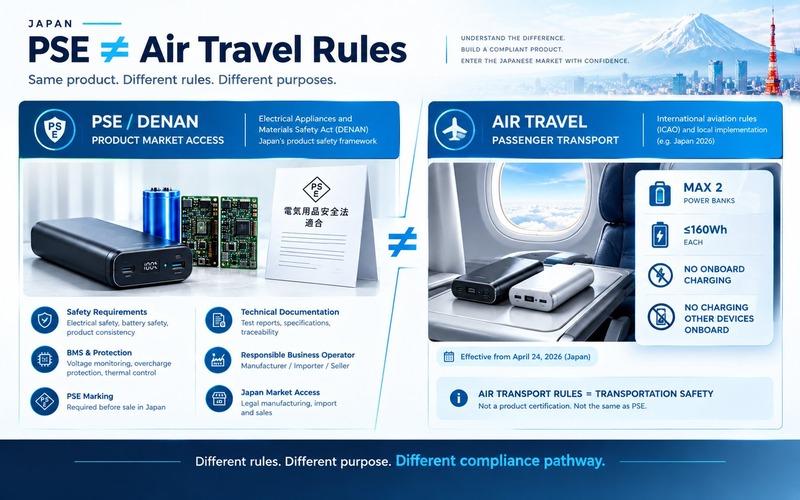
PSE market-access requirements and airline transportation restrictions are not the same thing.
A power bank may need to comply with Japan’s electrical product safety framework for sale in Japan, while separate aviation rules govern whether and how passengers may carry that power bank onto an aircraft.
These requirements have different legal purposes, different responsible parties and different compliance evidence.
This distinction becomes particularly important in 2026 because Japan introduced new aircraft rules for mobile batteries on April 24, 2026. Those rules limit the number and use of power banks carried onboard aircraft, but they do not replace or modify the fundamental PSE market-access framework.
For OEM and ODM projects, the right approach is therefore to treat Japan compliance as several connected layers:
Product classification → battery safety → PSE/DENAN → production control → documentation → market access → transportation compliance
Does a power bank need PSE certification in Japan?
Covered lithium-ion storage batteries, including mobile batteries, are regulated under Japan’s Electrical Appliances and Materials Safety Act (DENAN/PSE framework). Products within scope must meet applicable technical requirements and carry the required PSE marking before being sold in Japan. The exact regulatory treatment depends on product classification and battery characteristics, so OEM projects should confirm scope before finalizing the product architecture.
This guide is part of Reachinno’s Global Power Bank Compliance & Market Access 2026 knowledge system. For a cross-market comparison and the full framework, see the pillar guide.
Japan PSE Power Bank Requirements 2026
A power bank sold in Japan may need to satisfy both product-safety rules and transportation rules — but these are governed by different systems.
For an OEM project, that means asking two different questions at the same time:
- Product question: does this regulated product fall within the applicable PSE/DENAN scope?
- Transport question: may a passenger carry it onto an aircraft, and under what conditions?
The answer to the second question does not answer the first.
This article focuses primarily on the product-safety and market-access side, while clearly separating the 2026 aviation rules into their own framework.
What Is PSE in Japan?
PSE refers to Japan’s Electrical Appliances and Materials Safety Act, commonly known as DENAN.
The law regulates the manufacture, import and sale of designated electrical appliances and materials in Japan. METI states that secondary batteries are among the product categories covered by the Act.
Japan divides regulated electrical products into different categories according to their risk characteristics.
For lithium-ion storage batteries, the regulated category includes batteries meeting specified conditions, including a volumetric energy density threshold of 400 Wh/L or higher per cell, with certain exclusions for automotive, medical and industrial equipment.
Mobile batteries are specifically identified by METI as examples of products incorporating regulated lithium-ion storage batteries.
This is why simply saying:
“All power banks require PSE.”
is not sufficiently precise.
The correct engineering question is:
“Does this specific product fall within the regulated lithium-ion storage battery scope under DENAN?”
That classification should be confirmed before the product architecture is frozen.
Why Japan Regulates Mobile Batteries
Japan’s regulatory framework is strongly connected to product safety.
METI notes that lithium-ion battery-related incidents include overheating and fires, with causes ranging from manufacturing defects such as foreign-material contamination or electrode winding problems to misuse, impacts and high-temperature exposure.
For a power-bank OEM project, this means compliance cannot be treated as a final laboratory activity.
The battery system itself needs to be designed around:
- cell selection;
- electrical protection;
- charging control;
- overcharge protection;
- thermal monitoring;
- mechanical protection;
- PCB design;
- battery pack construction;
- production consistency;
- traceability.
A PSE project therefore begins much earlier than the moment the sample is submitted for testing.
PSE Is a Market-Access Requirement, Not an Airline Rule
This is the distinction that many online articles get wrong.
PSE answers:
Can this regulated electrical product legally be manufactured, imported or sold in Japan under the applicable safety framework?
Airline rules answer:
Can this power bank be carried onto an aircraft, in what quantity and under what conditions?
They are separate systems.
A power bank can therefore be:
PSE compliant + airline restricted
or
PSE compliant + accepted for a particular flight
depending on its capacity and transportation circumstances.
Conversely, airline acceptance does not replace product safety compliance.
What Changed in Japan in 2026?
The important point is that PSE itself should not be presented as a brand-new 2026 regulation.
Japan’s mobile-battery PSE framework was established earlier.
What has changed materially around the market is the broader safety environment.
Japan’s aviation rules changed on April 24, 2026, following international ICAO changes.
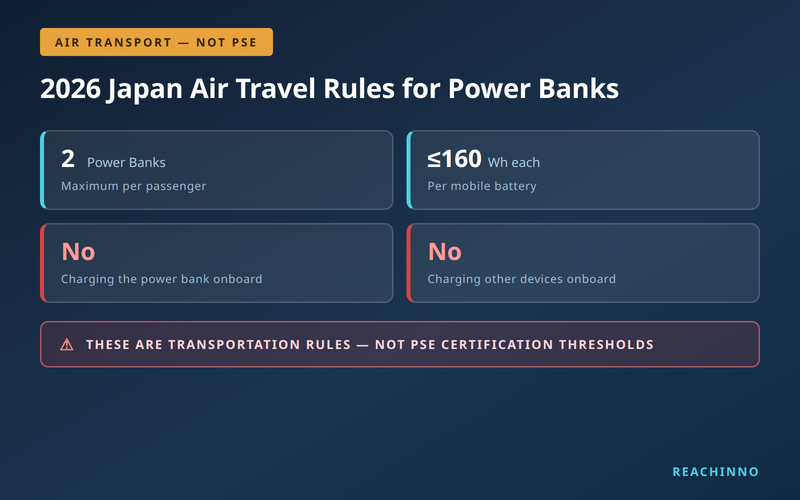
The new Japanese rules allow passengers to carry up to:
2 mobile batteries, each ≤160 Wh
and prohibit:
- charging a power bank onboard;
- using a power bank onboard to charge another electronic device.
The Japanese Ministry of Land, Infrastructure, Transport and Tourism explicitly states that these changes were made following ICAO’s emergency revision of international standards.
These are transportation rules, not PSE certification rules.
PSE and the Lithium-Ion Battery Scope
Japan’s METI framework identifies lithium-ion storage batteries as regulated electrical products when they meet the applicable scope conditions.
The current METI interpretation specifically lists:
Lithium-ion storage batteries with a cell volumetric energy density of 400 Wh/L or more, subject to exclusions.
Mobile batteries are among the products METI identifies in relation to these requirements.
For an OEM project, therefore, the first step should be a classification review.
Typical engineering inputs include:
- battery chemistry;
- cell format;
- cell manufacturer;
- cell energy density;
- number of cells;
- series/parallel configuration;
- nominal voltage;
- rated capacity;
- product Wh;
- charging architecture;
- output architecture;
- integrated wireless charging;
- AC input, if applicable;
- intended application.
The Battery Cell Is Part of the Compliance Architecture
A common mistake in OEM projects is to treat the battery cell as a replaceable commodity.
For Japan, the battery platform can influence:
- test results;
- technical documentation;
- production consistency;
- safety margins;
- thermal behavior;
- certification evidence.
That means changing from one cell supplier to another after compliance testing is not necessarily a simple purchasing decision.
A cell change can trigger a compliance review depending on the applicable technical requirements and certification configuration.
Reachinno’s recommendation
For Japan-targeted projects, freeze the following before final certification:
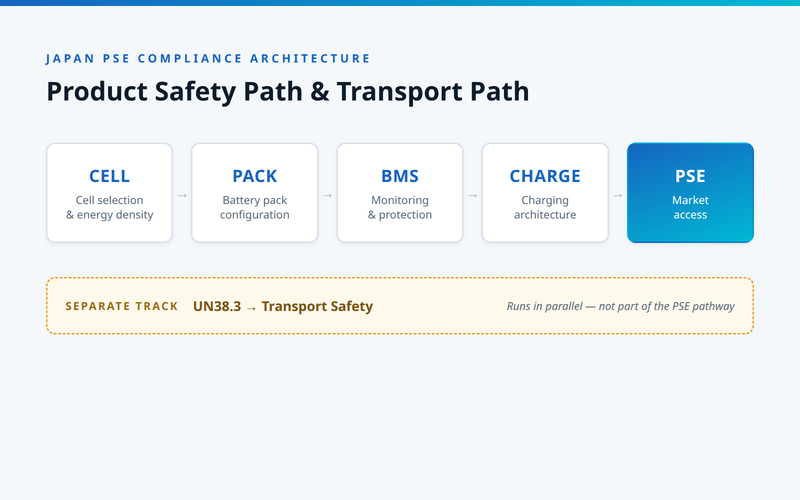
Cell manufacturer → cell model → cell specification → pack configuration → BMS → charger architecture
rather than treating these as independent purchasing decisions.
Voltage Monitoring and Overcharge Protection
One of the most important technical areas for lithium-ion battery safety is voltage monitoring.
Japan has strengthened technical requirements related to voltage monitoring to reduce the risk of fire caused by overcharging.
For OEM engineers, this means the BMS or equivalent protection architecture cannot simply be treated as a “battery accessory.”
It is part of the safety system.
A robust architecture should consider:
- cell voltage monitoring;
- overcharge detection;
- over-discharge protection;
- over-current protection;
- short-circuit protection;
- temperature monitoring;
- charging control;
- abnormal-state handling.
The exact implementation depends on the battery architecture and applicable technical requirements.
Why BMS Design Matters for PSE Projects
A power bank may look like a simple consumer electronic product.
Electrically, however, it is a controlled energy-storage system.
The BMS determines how the product responds when:
- a cell reaches an abnormal voltage;
- the charger remains connected;
- output current exceeds the design limit;
- temperature rises;
- a cell becomes imbalanced;
- a short circuit occurs;
- charging conditions become abnormal.
This is why a Japan OEM project should not begin with:
“Which PSE lab should we use?”
It should begin with:
“What battery and protection architecture are we going to certify?”
PSE Marking
Products falling within the applicable PSE scope need to satisfy the relevant requirements and display the appropriate PSE mark before sale in Japan.
METI’s consumer safety information explicitly reminds consumers to check for the PSE mark on lithium-ion battery products such as mobile batteries.
For OEM products, marking should therefore be considered during industrial design rather than added at the end.
The design team should reserve space for:
- PSE mark;
- applicable manufacturer/importer information;
- model information;
- rating information;
- required warnings;
- traceability information;
- other market-specific markings.
Who Is Responsible for PSE?
This is particularly important for overseas OEM suppliers.
PSE compliance is not simply:
“The Chinese factory gets a certificate.”
Japan’s regulatory framework places responsibilities on businesses involved in manufacturing, importing and selling regulated products.
For a global OEM project, the commercial structure therefore matters.
The Japanese importer/business operator, factory, brand owner and testing organization may have different responsibilities.
Before starting certification, define:
Commercial responsibility
Who is importing the product into Japan?
Product responsibility
Who controls the final product specification?
Manufacturing responsibility
Who manufactures the regulated battery/product?
Documentation responsibility
Who maintains the compliance evidence?
Market responsibility
Who is responsible for Japanese market access?
This prevents a common problem where the laboratory certificate exists but the commercial compliance structure is incomplete.
PSE Is Not the Same as UN38.3
Another common mistake.
PSE
Main purpose: Japanese electrical product safety / market access
UN 38.3
Main purpose: Lithium battery transport safety
UN 38.3 testing is relevant to transportation of lithium batteries.
It does not replace PSE.
Likewise:
UN38.3 ≠ PSE
and
PSE ≠ UN38.3
For international OEM programs, both may be necessary, but for different reasons.
PSE Is Also Not the Same as IEC 62133-2
IEC 62133-2 is an international battery safety standard frequently used as a technical reference in global battery compliance programs.
Japan has its own regulatory framework under DENAN and corresponding Japanese technical standards.
Therefore, an OEM should not simply assume:
“We already have IEC 62133-2, so Japan is automatically covered.”
Existing international test reports can be extremely useful, but the Japanese market-access pathway must still be reviewed against the actual product classification and applicable requirements.
What About Wireless Charging Power Banks?
This becomes more complicated when a power bank combines:
- lithium battery;
- USB-C PD;
- wireless charging;
- Qi2;
- magnetic charging;
- high-power charging;
- display;
- smart controls.
The battery itself may trigger one regulatory pathway, while other functions can introduce additional requirements.
For example, a Qi2 power bank is not simply:
“Battery + PSE.”
It is a multi-function electronic product.
Therefore, Japan compliance planning should evaluate:
Battery → charging input → DC output → wireless charging → control electronics → marking → documentation
as one system.
What About High-Power Power Banks?
This is increasingly important for products such as:
- 100W;
- 140W;
- 145W;
- 180W;
- 240W platforms.
Higher output power can introduce additional engineering complexity:
- higher current;
- higher thermal load;
- stronger connector requirements;
- more demanding PCB design;
- thermal derating;
- charging control;
- protection coordination.
For an OEM buyer, therefore, “PSE-ready” should never be interpreted as merely having a battery certificate.
The complete product architecture needs to be reviewed.
Does a 160Wh Power Bank Need a Special PSE Certificate?
This is exactly where PSE and aviation rules should not be mixed.
The 160Wh threshold that consumers increasingly see in Japanese travel information relates to air transportation rules.
Japan’s 2026 aircraft rule limits passengers to two mobile batteries of up to 160Wh each.
That does not mean:
“160Wh is the PSE certification limit.”
It isn’t the right way to describe the system.
Keep the two tables separate.
| Question | Relevant framework |
|---|---|
| Can this battery/product be sold in Japan? | PSE / DENAN |
| Does the battery fall into the regulated category? | Product classification + technical scope |
| Is the battery safe for transport? | UN 38.3 / transport regulations |
| Can a passenger carry it onto an aircraft? | Aviation / airline rules |
| How many can be carried? | Airline/aviation rules |
| Can it be charged during flight? | Airline/aviation rules |
This distinction should become a Reachinno editorial rule across all future content.
Japan’s 2026 Airline Rules for Power Banks
From April 24, 2026, Japan’s MLIT introduced new rules for mobile batteries carried onboard aircraft.
The additional requirements include:
- maximum two mobile batteries;
- each no more than 160Wh;
- no charging the mobile battery onboard;
- no using the mobile battery to charge another electronic device onboard.
These rules are particularly relevant to product brands because they affect consumer expectations.
A product designed for frequent travelers should therefore consider:
- clearly printed Wh rating;
- easy-to-read capacity information;
- durable rating labels;
- clear model identification;
- user documentation;
- travel-related warnings where appropriate.
But again:
These are transportation considerations, not PSE certification requirements.
How OEMs Should Prepare a Japan PSE Project
A good Japan OEM workflow should look like this:
Step 1 — Product Classification
Confirm: product type; battery type; cell energy density; capacity; intended use; applicable scope.
Step 2 — Battery Platform Freeze
Confirm: cell manufacturer; cell model; chemistry; configuration; battery pack design.
Step 3 — Safety Architecture
Review: BMS; charging IC; protection IC; temperature sensing; current protection; mechanical design.
Step 4 — Engineering Validation
Perform: electrical testing; thermal testing; charging validation; abnormal-condition testing; mechanical validation.
Step 5 — PSE Compliance
Confirm: applicable requirements; testing; technical documentation; marking; responsible business operator.
Step 6 — Production Control
Ensure the mass-production configuration remains consistent with the certified/tested configuration.
Step 7 — Japan Market Launch
Finalize: Japanese labeling; instructions; packaging; importer information; traceability; compliance records.
Step 8 — Transportation Review
Separately verify: UN38.3; shipping requirements; air transport; airline passenger restrictions.
Existing Global Products: Can They Be Reused for Japan?
Often yes — but not automatically.
This is where a strong OEM partner creates real value.
Suppose a power bank already has:
- IEC 62133-2;
- UN38.3;
- CE;
- RoHS;
- EMC;
- FCC;
- UL testing.
The existing technical evidence can reduce duplication.
But Japan still requires a dedicated market-access assessment.
Reachinno’s preferred approach
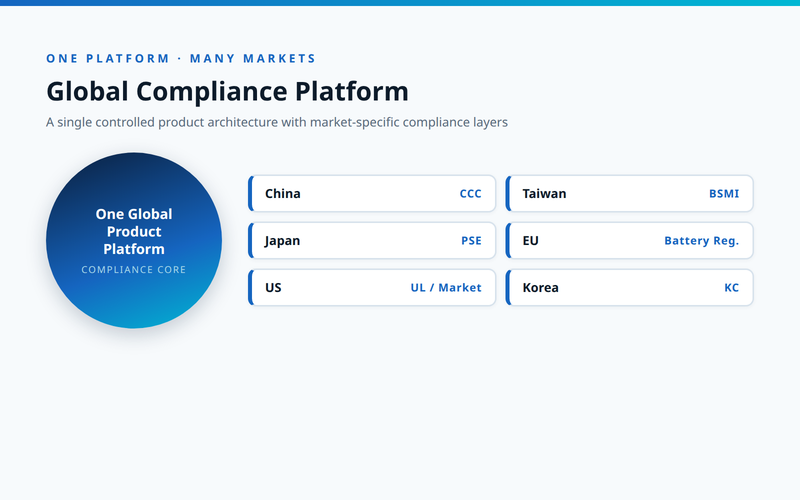
Create a Global Compliance Core:
Cell platform ↓ Battery pack ↓ BMS ↓ Mechanical platform ↓ Power architecture ↓ Global test evidence
Then create market-specific layers:
- Japan → PSE
- EU → CE + Battery Regulation + environmental obligations
- US → applicable product safety / UL / FCC depending on configuration
- China → CCC
- Taiwan → BSMI
- Korea → KC
This is much more efficient than designing each country as a completely separate product.
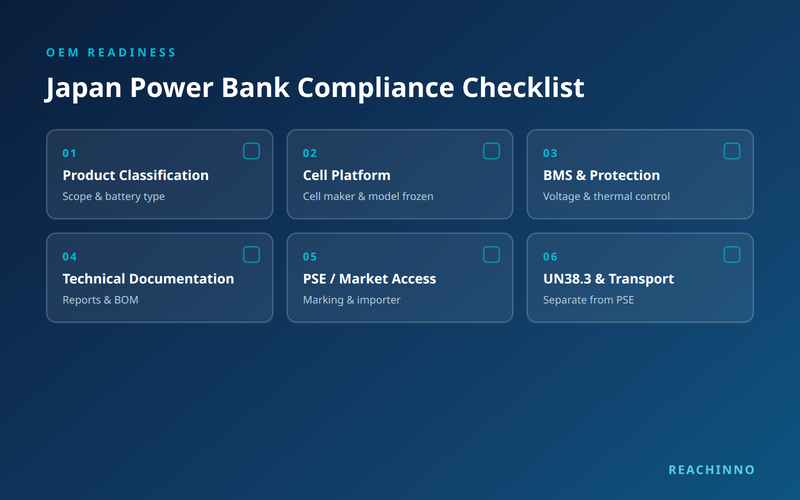
Japan PSE Compliance Checklist for OEM Buyers
Before placing a Japan power-bank project into mass production, confirm:
Product
- Product classification confirmed
- Battery type confirmed
- Cell energy density evaluated
- Rated capacity confirmed
- Wh rating confirmed
Battery
- Cell manufacturer confirmed
- Cell model frozen
- Pack configuration frozen
- BMS architecture frozen
- Protection strategy validated
Electrical
- Charging system validated
- Overcharge protection validated
- Over-discharge protection validated
- Over-current protection validated
- Short-circuit protection validated
- Temperature monitoring validated
Documentation
- Technical specification
- BOM
- Cell documentation
- PCB documentation
- Test reports
- Production information
- Marking artwork
Market Access
- Japanese business operator/importer identified
- PSE pathway confirmed
- PSE marking reviewed
- Packaging reviewed
- Japanese user information prepared
Transportation
- UN38.3 evidence available
- Shipping classification checked
- Air-travel restrictions reviewed separately
What Should OEM Buyers Ask Their Supplier?
Instead of asking:
“Do you have PSE?”
A professional buyer should ask:
- Is the exact battery platform covered by the Japanese PSE pathway?
- Which cell model was used for testing?
- Is the cell manufacturer frozen?
- What BMS/protection architecture is used?
- Can the same product configuration be maintained in mass production?
- What technical documentation is available?
- Who is responsible for Japanese market compliance?
- Is the PSE marking included in the product design?
- Does the product also have UN38.3 transport documentation?
- Has the product’s Wh rating been considered against current air-travel rules?
This is a much better procurement conversation than simply:
“PSE certificate available?”
Japan PSE vs China CCC vs Taiwan BSMI
The three markets now make a useful comparison.
| Market | Main system | Current strategic issue |
|---|---|---|
| China | CCC | GB 47372-2026 + stronger battery safety / traceability |
| Taiwan | BSMI | Proposed puncture test + CNS 62133-2 transition |
| Japan | PSE / DENAN | Established lithium-ion safety framework + evolving transport rules |
China’s new GB 47372-2026 becomes fully mandatory from April 1, 2027. See China CCC power bank requirements.
Taiwan’s proposed BSMI revision currently plans implementation from July 1, 2027. See Taiwan BSMI power bank requirements.
Japan is different.
Japan should not be described as another “2026 certification update.”
Instead, the story is:
Established PSE market access + evolving lithium-ion safety requirements + new 2026 aviation restrictions.
That distinction makes this article considerably more credible.
The Bigger Trend: Portable Power Compliance Is Becoming System-Level
The most important trend is not one individual certification.
It is that regulators increasingly look beyond:
“Does the battery pass the test?”
toward:
“Can the manufacturer demonstrate a controlled, traceable and safe product system?”
That includes:
- cell selection;
- battery architecture;
- BMS;
- manufacturing consistency;
- documentation;
- labeling;
- traceability;
- lifecycle management;
- transportation;
- environmental obligations.
This is particularly visible when comparing China, Taiwan, Japan and the EU.
For OEM buyers, compliance is therefore becoming an engineering input, rather than a paperwork activity at the end of development.
That shift is why Reachinno now frames its global power bank certification requirements around market access rather than individual certificates.
How Reachinno Approaches Japan Market Access
At Reachinno, we recommend treating compliance as part of product definition.
Instead of developing a product first and asking:
“Which certificates do we need?”
we start with:
Target Market → Product Classification → Battery Platform → Safety Architecture → Test Strategy → Production Control → Market Access
This approach allows one product platform to be engineered for multiple markets while minimizing unnecessary redesign.
For brands planning Japan, Europe, North America or multiple Asian markets simultaneously, the goal should not be to build five completely different products.
The better approach is to build:
one controlled product architecture with market-specific compliance layers.
That is where OEM/ODM engineering experience becomes much more valuable than simply sourcing a finished power bank. See our portable power OEM development and the 145W high-power power bank platform.
Final Takeaway
Japan’s power-bank compliance landscape in 2026 should be understood through three separate questions:
1. Can the product legally enter the Japanese market?
→ PSE / DENAN
2. Is the lithium-ion battery suitable for transportation?
→ UN 38.3 and applicable transport regulations
3. Can a passenger carry the product onto an aircraft?
→ Aviation and airline rules
These systems interact, but they should never be treated as the same certification.
For OEM buyers, the safest strategy is to establish the Japanese compliance pathway at the beginning of product development — particularly when selecting the cell, BMS, charging architecture and final product configuration.
FAQ
Does every power bank need PSE in Japan?
Not necessarily. The correct determination depends on whether the specific product falls within the applicable regulated lithium-ion storage battery scope. METI identifies mobile batteries among products using regulated lithium-ion storage batteries.
Is PSE the same as UN38.3?
No. PSE relates to Japan’s electrical product safety and market-access framework, while UN38.3 relates to lithium battery transportation safety.
Is 160Wh a PSE limit?
No. The 160Wh figure currently appearing in Japanese consumer guidance is associated with aircraft transportation rules, not a general PSE certification threshold. Japan’s 2026 aviation rules allow up to two mobile batteries of up to 160Wh each, subject to the applicable conditions.
Can an existing IEC 62133-2 report be used for Japan?
Existing international test evidence may be useful, but it should not automatically be treated as equivalent to Japanese market-access compliance. The actual product classification and applicable Japanese requirements must be assessed.
Can the same power bank be sold in Japan, Europe and the US?
Potentially yes, but a global product needs market-specific compliance layers. A common engineering platform can often be reused, while regulatory documentation, marking, testing and market-access obligations vary by region.
Does Japan PSE apply to portable power stations?
Not necessarily in the same way as mobile batteries. METI has separately discussed portable power stations and notes that they were outside the Electrical Appliances and Materials Safety Act scope at the time of its 2024 safety-requirements report. That is another reason not to use “PSE applies to every lithium battery product” as a blanket statement.
Official Sources
This guide draws on official Japanese government and regulatory sources.
METI — Consumer Product Safety (Lithium-Ion Batteries)
METI: lithium-ion battery product safety information
METI — Electrical Appliances and Materials Safety Act (PSE)
METI: Electrical Appliances and Materials Safety Act overview
METI — Regulated product categories
METI: list of regulated electrical products
MLIT — 2026 Aircraft Rules for Mobile Batteries
MLIT: new rules for carrying mobile batteries onboard aircraft (from April 24, 2026)
METI — Portable Power Station Safety Requirements
METI: portable power station safety requirements (interim report)
This guide is based primarily on official Japanese government sources and is intended for product-development and market-access planning. It is not legal advice and does not replace confirmation with METI, an accredited testing laboratory or the applicable certification authority.