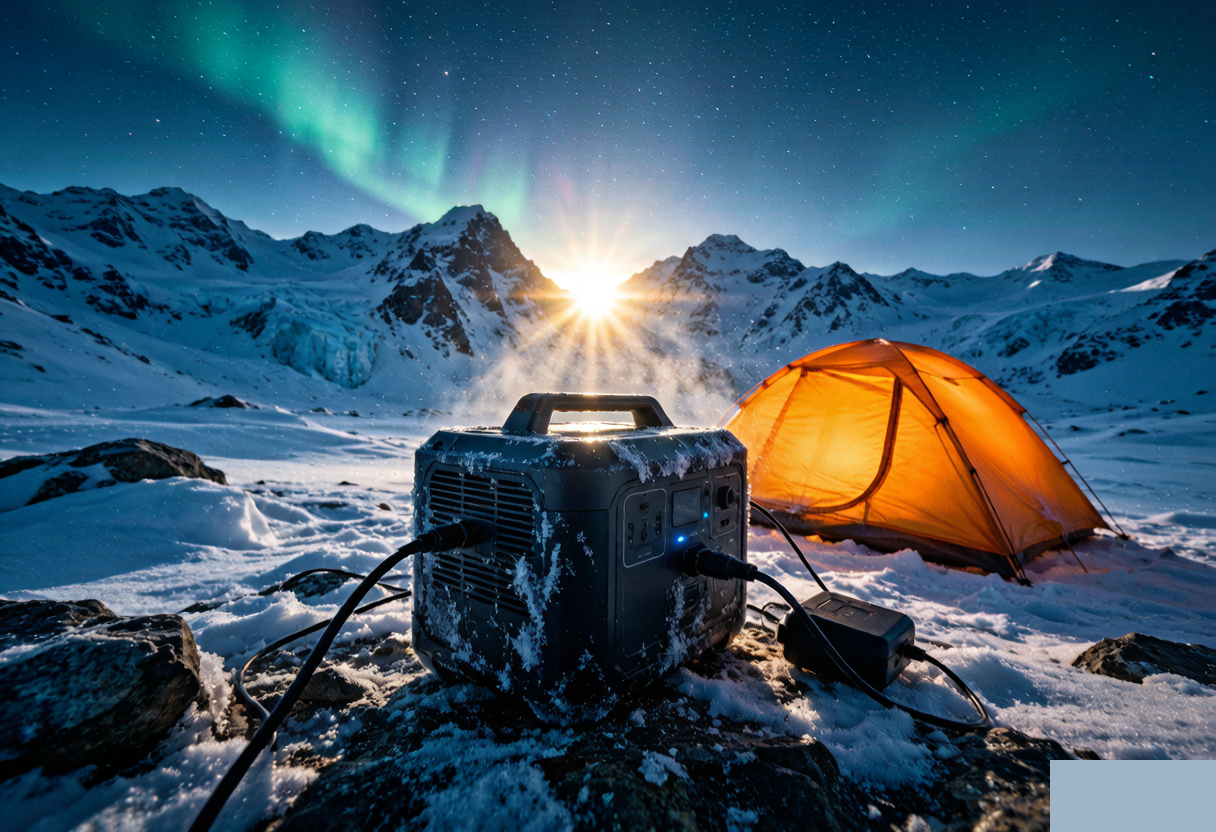
Outdoor portable power is no longer a niche category.
From expedition outfitters and campervan builders to remote construction crews and disaster-relief teams, more buyers than ever rely on portable power stations and power banks that must perform — reliably — in the field.
This article is the cornerstone overview of the outdoor portable power landscape in 2026. It connects the deeper resources in the Reachinno outdoor knowledge cluster: the 2026 camping power bank buyer’s guide, the Reachinno Outdoor Energy Ecosystem™ engineering framework, and the -40°C OEM case study.
1. The Market Is Shifting from Capacity to Reliability
For years, outdoor power products were marketed primarily on capacity — “20,000mAh,” “50,000mAh,” “a week of power.”
In 2026, the buying conversation is changing. Field users are discovering that a huge capacity rating means little if the battery loses half its usable power below freezing, if the electronics throttle under sustained load, or if the enclosure fails after a single harsh season.
The result: reliability, operating-temperature range, and documented field validation are now deciding factors for serious buyers. The Reachinno Outdoor Energy Ecosystem™ framework was built around exactly this shift.
2. Three Forces Reshaping the 2026 Market
Force 1 — Low-Temperature Demand
Buyers in alpine, polar, and high-latitude regions need batteries that genuinely operate at -20°C and below. This is no longer a niche request — it is a mainstream requirement for expedition, winter camping, and field-operations buyers.
Not all batteries can do this. Standard consumer cells can lose 50–70% of usable capacity below freezing. Engineering solutions, like the ones in our -40°C OEM case study, are required to maintain reliable performance in extreme cold.
Environmental reliability is becoming an increasingly important dimension of outdoor portable power. Extreme heat is the opposite thermal challenge to extreme cold: it accelerates battery aging, increases thermal stress and reduces safety margins. Water and dust add a third dimension, because ingress protection changes how a sealed enclosure manages heat and moisture. See our analysis of Extreme Heat Portable Power, our IP67 Portable Power Engineering guide, and our -40°C Outdoor Power Case Study for the full environmental engineering picture.
Force 2 — Multi-Source Recharging
Solar + AC + automotive DC recharging is becoming the default expectation, not a premium add-on. A power station that can be topped up from a rooftop panel during the day and a car outlet in an emergency is far more useful in the field than one with a single charging path.
Force 3 — Validation Transparency
Retailers, outfitters, and end-users increasingly ask for documented outdoor field tests — not just a lab datasheet. “How did it actually perform in a mountain camp in January?” is now a common procurement question.
3. Product Categories in Focus
The outdoor portable power category spans several product forms, each suited to different use cases:
| Product Form | Typical Capacity | Best For |
|---|---|---|
| Compact power bank | 5,000–20,000mAh | Phones, headlamps, small cameras |
| Laptop power bank | 20,000–30,000mAh | Laptops, drones, tablets |
| Portable power station | 200Wh–2,000Wh | Camping, RV, field ops |
| Rugged / solar generator | 500Wh–3,000Wh | Expedition, remote site power |
Choosing the right form factor depends on the specific devices you need to power and the environment you operate in. Our 2026 camping power bank buyer’s guide walks through this decision step by step.
4. How to Evaluate an Outdoor Power Product in 2026
When comparing outdoor power products, look beyond the headline capacity. Ask about:
- Operating temperature range and derating behavior below freezing.
- Low-temperature discharge curve (capacity retention at -20°C, -30°C).
- Standby power consumption (how much drains overnight).
- Charging paths: solar, AC, car DC — and whether the switchover is automatic.
- Real outdoor field-test documentation, not just lab reports.
- Durability rating (IP rating, drop/shock, thermal cycling).
The Reachinno Outdoor Energy Ecosystem™ framework defines the engineering standards behind each of these evaluation points.
5. For OEM and ODM Buyers
If you are an OEM or ODM buyer sourcing outdoor portable power products, the 2026 landscape demands a partner who can engineer for your specific environment — not just assemble cells and boards.
Reachinno designs and manufactures portable energy storage solutions with engineering judgment applied to every project: low-temperature cell selection, BMS tuning, thermal design, outdoor validation, and certification support. Our -40°C OEM case study (003) shows the depth of this work on a real 7,500mAh project.
6. Related Resources
This overview is the entry point to the Reachinno outdoor portable power cluster. Each article covers a different layer of the same engineering problem:
- Outdoor Portable Power in 2026 — this market overview.
- How to Choose a Power Bank for Camping in 2026 — the buyer’s decision guide.
- Reachinno Outdoor Energy Ecosystem™ — the engineering framework.
- IP67 Portable Power Engineering — waterproofing, sealing and condensation.
- Engineering Portable Power for Extreme Heat — high-temperature engineering.
- Extreme-Weather Portable Power in 2026 — the environmental engineering overview.
- Engineering Portable Power for -40°C — the OEM case study.
FAQ
What is the biggest trend in outdoor portable power in 2026?
The market is shifting from capacity-focused marketing to reliability-focused engineering. Operating-temperature range, multi-source recharging, and documented field validation are becoming the deciding factors.
Why does capacity retention matter more than raw capacity for outdoor power?
Because a battery that loses 50–70% of usable capacity below freezing may not power your devices at all, regardless of its rated mAh. Usable capacity at your operating temperature is the metric that matters. The Reachinno Outdoor Energy Ecosystem™ covers multi-source energy architecture in detail.
Can outdoor power products really work at -40°C?
Yes, with appropriate battery chemistry, BMS, power management, and outdoor validation. See our -40°C OEM case study for a documented 7,500mAh / 22-day example.
What is the difference between a power bank and a portable power station?
Power banks are compact and best for phones, laptops, and small devices. Portable power stations are larger, higher-capacity systems that can power tools, small appliances, and multiple devices over many days. The 2026 camping buyer’s guide explains how to choose.
How do I choose between solar, AC, and car charging?
Most 2026 buyers expect all three, with automatic switchover. Solar suits remote daytime use, AC suits base-camp power, and car DC suits travel. The Reachinno Outdoor Energy Ecosystem™ covers multi-source energy architecture in detail.