Korea Runs a Mandatory KC Safety Certification
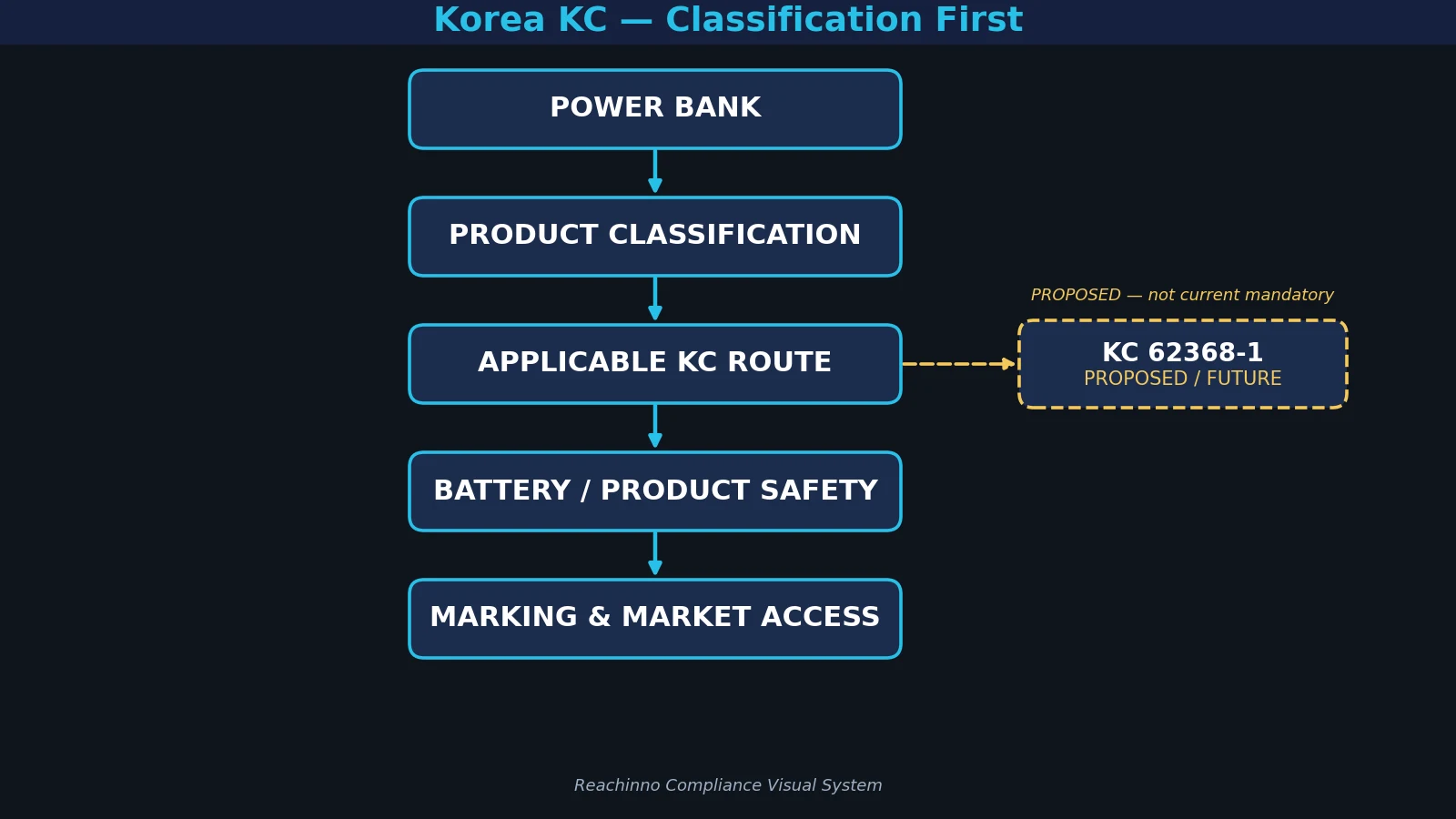
Unlike the United States, South Korea operates a mandatory safety certification for power banks. The KC mark (Korea Certification), administered by KATS (Korea Agency for Technology and Standards), is a legal market-access requirement — not a voluntary retailer standard. An OEM or ODM cannot legally place a power bank on the Korean market without KC certification, and products are listed on the national Safety Korea database.
This regional assessment follows the Reachinno Global Power Bank Compliance & Market Access Framework™ (RK-14), which connects market-entry requirements with product architecture, compliance planning and engineering validation.
Reachinno Engineering Principle™: Korea is the mirror image of the US model — here, safety certification is the gate, not a marketplace preference. Plan KC into the certification budget from day one.
KC 62133 — The Lithium Battery Standard
The core technical requirement is KC 62133, Korea’s adoption of IEC 62133 for portable sealed secondary lithium cells and batteries. It covers the cell and pack safety tests that matter for a power bank: electrical, thermal abuse, external short, overcharge, forced discharge, and mechanical abuse. For most programs, KC 62133 for the battery system is the primary certificate an importer must hold.
Safety Certification vs Self-Regulatory Safety Confirmation
Korea’s product safety framework splits into tracks, and the distinction matters for lead time:
- Safety Certification (안전인증) — the stricter track, with factory inspection and periodic follow-up. Power banks are pulled into Safety Certification because of lithium-ion fire risk, rather than the lighter Self-Regulatory Safety Confirmation (자율안전확인) track used for lower-risk items.
- Self-Regulatory Safety Confirmation — supplier declaration, faster, but not where high-energy lithium products land.
Assume the Safety Certification track for a power bank program, and budget for KC factory inspection.
EMC and Wireless (Radio Waves Act)
If the power bank includes wireless functions (Qi, Bluetooth), it also falls under Korea’s Radio Waves Act and EMC requirements, separate from the KC safety certificate. Wired-only units still need EMC conformity, but the radio module adds a distinct approval path. This is the same split you see in the FCC vs CE vs CCC comparison.
UN 38.3 and Transportation
As everywhere, UN 38.3 testing of the lithium cells/batteries is mandatory before air or sea shipment, and Korea inbound logistics follow DOT / IATA / IMDG transport rules. Our UN3480 shipping guide covers the documentation.
Labeling and Marking
- The KC mark plus the certification number must appear on the product and packaging.
- Rated capacity (mAh/Wh), input/output ratings, and manufacturer/importer identity must be legible.
- Korean-language safety markings are expected for consumer-facing products.
2026 Regulatory Watch — KC 62368-1 Proposal
In 2026, KATS proposed extending power-bank safety requirements to include KC 62368-1 (audio/video and information-technology equipment safety), alongside the existing KC 62133 battery standard. This is a proposal, not yet in force — treat it as a watch item and confirm the official effective date before tooling lock. Reachinno tracks KATS announcements so programs are not surprised by the transition.
2026 Korea Market-Access Checklist
| Layer | Requirement | Type | Note for OEM/ODM |
|---|---|---|---|
| Safety | KC 62133 (battery) | Mandatory | Safety Certification track |
| Safety (proposed) | KC 62368-1 (electronics) | Proposed 2026 | Monitor effective date |
| EMC / wireless | Radio Waves Act | Mandatory if wireless | Separate from KC safety |
| Transport | UN 38.3 + IATA/IMDG | Mandatory for shipping | Class 9 (UN3480 / UN3481) |
| Marking | KC mark + Korean labels | Mandatory | On product and packaging |
Common Mistakes
- Assuming Korea is like the US (voluntary UL 2056) — KC is mandatory.
- Planning for the lighter Self-Regulatory track instead of Safety Certification.
- Forgetting EMC/wireless approval for Qi or Bluetooth units.
- Ignoring the 2026 KC 62368-1 proposal until it is already in force.
How Reachinno Supports Korea Market Access
We design to KC 62133 + the Safety Certification track from the schematic stage, prepare UN 38.3 and transport documents, and support KATS submission and Korean labeling. The same platform evidence feeds other regional programs — for example, our RC804 145W platform is engineered against a multi-standard stack. For the full global picture, start from our global power bank compliance and market access guide.
Official Sources
This guide draws on official Korean government sources.
KATS — KC Marking Authority
Korean Agency for Technology and Standards (KATS)
RRA — Radio Equipment Approval
National Radio Research Agency (RRA): radio equipment approval
Safety Korea — KC Database
Safety Korea: KC certification database
This guide is based primarily on official Korean government sources and is intended for product-development and market-access planning. It is not legal advice and does not replace confirmation with KATS, RRA, an accredited testing laboratory or the applicable certification authority.
Frequently Asked Questions
Is KC certification mandatory for power banks in Korea?
Yes. The KC mark under KATS is a legal requirement, and power banks are placed on the Safety Certification track because of lithium-ion fire risk.
What standard covers the battery?
KC 62133, Korea’s adoption of IEC 62133, covering cell and pack safety tests for portable sealed lithium batteries.
Is KC 62368-1 already required?
Not yet — KATS proposed adding KC 62368-1 to the power-bank scope in 2026. Treat it as a proposed change and confirm the official effective date.
Does a CE or CCC mark satisfy Korean requirements?
No. Korea, the EU, and China run separate certification regimes. Korean market access requires KC (mandatory) plus, where applicable, Radio Waves Act approval for wireless functions.