Emergency Portable Power: Engineering Reliable Energy for Disaster Preparedness
Emergency portable power refers to battery-powered energy systems designed to maintain critical devices when normal infrastructure fails. Depending on the application, an emergency portable power solution may support communication devices, emergency lighting, cameras, medical equipment, navigation systems and other essential electronics during grid outages, natural disasters and extreme weather events.
Engineering a reliable emergency power solution requires more than selecting a large battery capacity. Battery chemistry, temperature performance, protection systems, output architecture, charging strategy, environmental resistance and realistic runtime requirements must all be evaluated together.
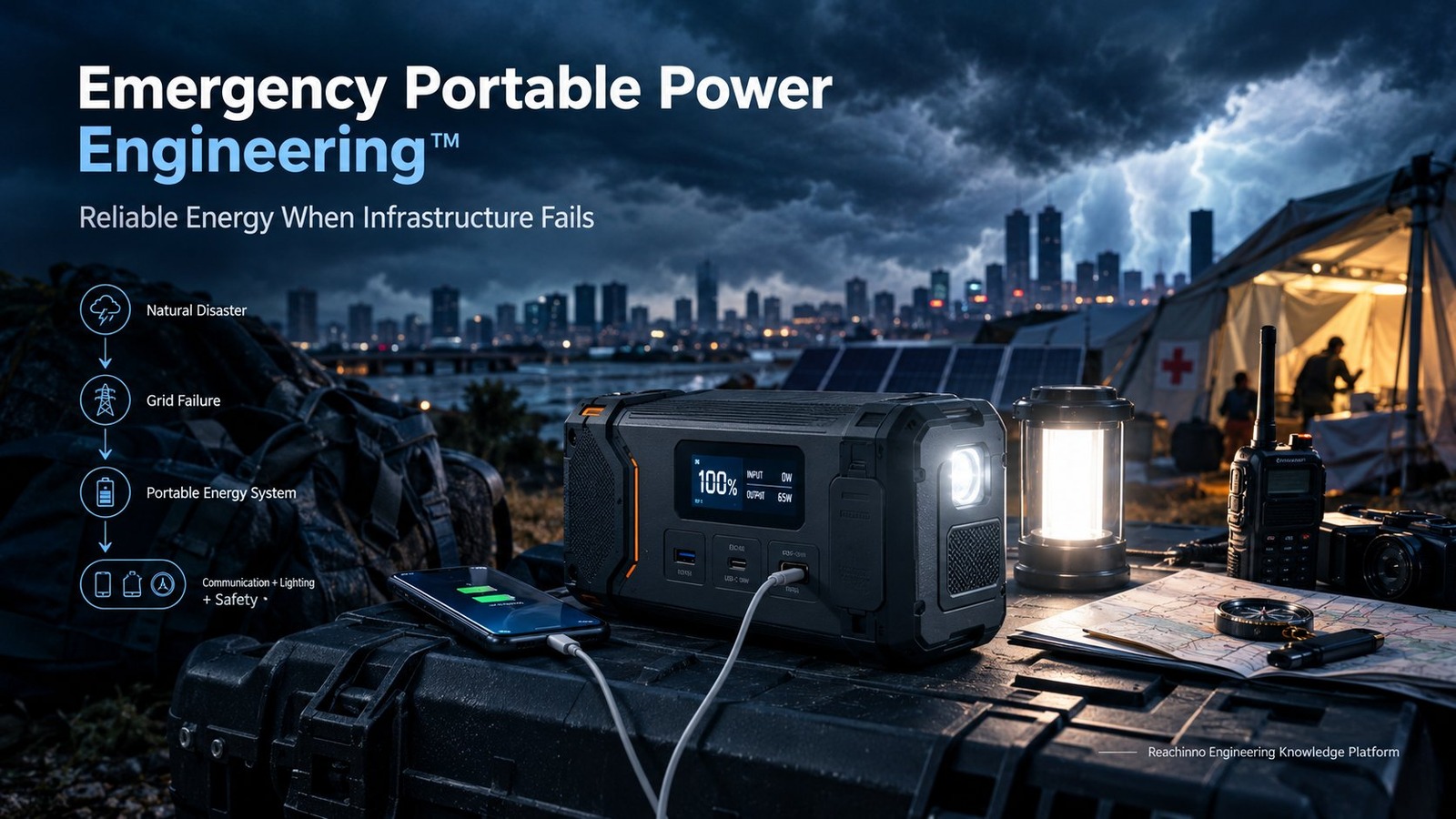
When a disaster disrupts normal infrastructure, electricity often becomes one of the first critical resources to disappear.
A power outage may initially seem like an inconvenience. But when it lasts for hours or days, the consequences quickly expand.
Smartphones lose communication capability. Emergency lighting becomes unavailable. Navigation systems cannot be recharged. Security cameras stop operating. Medical devices may lose their backup energy source.
For this reason, emergency portable power should not be viewed simply as a larger power bank. It is part of a broader resilience system.
The engineering challenge is not simply:
How much battery capacity can we put inside?
The real question is:
How can portable energy remain reliable when the environment and infrastructure are no longer reliable?
This distinction changes how emergency portable power should be designed. For disaster preparedness applications, engineers must consider:
- Runtime
- Battery temperature
- Charging availability
- Environmental exposure
- Output stability
- Device compatibility
- Safety
- Storage life
- Recovery after long periods of inactivity
Emergency power is therefore a systems engineering problem rather than a capacity problem.
1. Why Emergency Portable Power Has Become an Engineering Category
Portable power products were traditionally designed around convenience. Consumers needed additional energy for smartphones, tablets, cameras and laptops.
Emergency applications are different. The product may be required precisely when normal infrastructure is unavailable. This creates a fundamentally different engineering requirement.
Normal Portable Power:
Convenience
  → Daily charging
  → Predictable environment
  → Easy access to electricity
Emergency Portable Power:
Infrastructure failure
→ Unpredictable environment
→ Limited charging opportunities
→ Critical device operationThe consequence is simple: reliability becomes more important than convenience.
A power bank that performs perfectly in an office environment may not necessarily perform reliably during flooding, extreme heat, freezing temperatures, long-duration outages, outdoor evacuation or transportation disruption.
This is why emergency portable power deserves its own engineering framework.
2. The Emergency Energy Chain™
Emergency power should be understood as a complete energy chain.
Reachinno Emergency Energy Chain™
Energy Storage → Battery Protection → Power Conversion → Output Distribution → Critical DevicesFailure at any stage can interrupt the entire system.
A high-capacity battery is not useful if:
- The battery cannot operate at the ambient temperature.
- The BMS shuts down incorrectly.
- The USB output cannot support the required device.
- The available runtime was calculated unrealistically.
This is why emergency power engineering requires a system-level approach.
3. Disaster Scenarios Create Different Power Requirements
Not all emergencies are the same. A critical mistake is designing one generic “emergency power bank” for every disaster scenario. Different environments create different engineering priorities.
3.1 Hurricane and Severe Storm
Key risks: grid outage, flooding, high humidity, communication disruption.
Priority: long runtime, reliable charging, environmental protection.
3.2 Extreme Cold
Key risks: reduced battery capacity, increased internal resistance, lithium plating during charging, slow charging performance.
Priority: low-temperature battery engineering, thermal protection, realistic runtime validation.
For a deeper look at this scenario, see our engineering analysis of engineering portable power for extreme low temperatures.
3.3 Extreme Heat
Key risks: battery degradation, high internal temperature, thermal shutdown, accelerated aging.
Priority: thermal design, temperature monitoring, heat dissipation.
For related engineering analysis, see how portable power systems behave in extreme heat.
3.4 Flooding
Key risks: water ingress, corrosion, connector failure.
Priority: ingress protection, sealing architecture, port protection.
Engineering guidance for this scenario can be found in our analysis of IP67 protection for portable power products.
3.5 Earthquake
Key risks: infrastructure failure, communication interruption, long periods without electricity.
Priority: energy storage, emergency lighting, communication, long shelf life.
4. Capacity Alone Does Not Define Emergency Runtime
One of the most common mistakes in emergency power planning is focusing only on mAh. But mAh does not directly tell the user how long the system will operate.
Real runtime depends on battery voltage, conversion efficiency, output voltage, load power, temperature and battery aging.
Reachinno Emergency Runtime Model™
Available Battery Energy × System Efficiency ÷ Actual Load = Estimated RuntimeFor emergency applications, the load must be clearly defined:
Device          | Typical Emergency Role
--------------- | ----------------------
Smartphone      | Communication
LED Light       | Emergency lighting
Camera          | Security
GPS             | Navigation
Radio           | Emergency information
Medical device  | Critical support
A power bank designed to charge a smartphone five times is not necessarily equivalent to a system capable of supporting an emergency communication setup for several days.
5. Battery Temperature Can Become the Limiting Factor
Ambient temperature is not the same as battery temperature.
A product may operate outdoors at 40°C while internal temperatures become significantly higher because of solar radiation, charging, DC/DC conversion, internal resistance and continuous output load.
Ambient vs Internal Temperature Engineering Model™
Ambient Temperature + Solar Exposure + Charging Heat + Power Conversion + Load Heat → Internal System TemperatureThis is particularly important for outdoor emergency kits, solar charging, disaster preparedness systems, camping and vehicle storage.
For a complete overview of related engineering considerations, see our extreme weather portable power engineering guide.
6. Charging During a Disaster Is a Different Problem
During a normal day, a power bank can simply be recharged from the wall. During an emergency, the grid may not be available.
Potential charging sources include grid power, vehicle power, solar charging and generator power. Each has limitations.
Solar Charging
Solar power can be valuable during extended outages. However, solar panel rating does not equal actual charging power. Actual solar performance depends on solar irradiance, panel angle, temperature, weather, MPPT architecture and conversion efficiency.
This is why emergency solar systems must be evaluated as a complete energy ecosystem. For the broader system view, see the Reachinno Outdoor Energy Ecosystem™ framework.
7. Environmental Protection Is Not a Single Rating
Emergency products are frequently marketed with terms such as waterproof, outdoor or rugged. These descriptions are often too vague.
Engineering should instead ask: what environmental exposure is the product actually expected to survive?
Rain exposure does not equal submersion. Dust protection does not equal impact protection. Water resistance does not equal long-term corrosion resistance.
For deeper engineering analysis, see our guide on how IP67 protection is engineered in portable power products.
8. Output Architecture Matters During Emergencies
Emergency users may need to power multiple devices simultaneously: smartphone, LED light, radio, camera and GPS device. This means output architecture becomes important.
Engineers must evaluate total output power, port allocation, simultaneous charging, thermal behavior and power sharing.
A product rated at 100W does not necessarily provide 100W × every port. The output architecture must clearly define:
Total System Power → Port Distribution → Priority Management9. Emergency Products Must Be Designed for Storage
A daily-use product may be charged and discharged constantly. An emergency product may remain stored for weeks, months or a year.
This introduces additional considerations: self-discharge, battery aging, storage temperature, BMS standby current and long-term reliability.
Emergency engineering therefore requires storage reliability.
10. The Emergency Portable Power Decision Matrix™
When selecting an emergency portable power solution, evaluate six dimensions:
Engineering Factor        | Why It Matters
------------------------- | ---------------------------------------
Runtime                   | Determines mission duration
Temperature               | Determines real battery performance
Output Power              | Determines device compatibility
Environmental Protection  | Determines survival in harsh conditions
Charging Recovery         | Determines long-term sustainability
Storage Reliability       | Determines readiness
Instead of asking which power bank has the largest capacity, ask: which portable energy system is engineered for the actual emergency scenario?
11. Portable Power Is Becoming Part of Emergency Infrastructure
The future of emergency energy is unlikely to be based on one product. Instead, systems will increasingly connect:
Solar + Battery Storage + Portable Power + Emergency Lighting + Communication + MobilityThis is already visible in outdoor disaster kits, emergency shelters, vehicle preparedness systems, remote infrastructure and off-grid communication systems.
Portable power is therefore evolving from consumer accessory toward distributed energy infrastructure.
12. Where Emergency Power Fits in the Outdoor Energy Ecosystem
Emergency portable power is not an isolated category. It connects directly with camping, outdoor travel, extreme weather, solar energy, disaster preparedness and emergency communication.
This is why Reachinno approaches portable power through an ecosystem model rather than a single-product model.
For the foundational overview, see our cornerstone guide Outdoor Portable Power in 2026.
Conclusion
Emergency portable power is not defined by capacity alone.
Reliable emergency energy requires engineering across battery chemistry, temperature performance, BMS protection, power conversion, output architecture, environmental protection, charging recovery and storage reliability.
The more critical the application becomes, the less useful generic specifications become.
Emergency systems must be designed around the actual conditions in which they may be required to operate.
For OEM brands developing disaster preparedness, outdoor energy or emergency electronics, the product definition should begin with:
Scenario → Environment → Critical Load → Runtime Requirement → Energy Architecture → Engineering ValidationNot simply: Capacity → Price → Product.
That difference is where reliable portable power engineering begins.
Frequently Asked Questions
What is emergency portable power?
Emergency portable power refers to battery-powered energy systems designed to maintain essential electronic devices when normal electricity infrastructure is unavailable.
How much capacity is needed for emergency power?
The required capacity depends on the actual devices, power consumption and required runtime. Capacity should be calculated using energy requirements rather than mAh alone.
Can power banks work during extreme cold?
Battery performance decreases significantly at low temperatures. Low-temperature applications may require optimized battery materials, thermal engineering and specialized validation.
Can portable power systems be charged by solar panels?
Yes, depending on the product architecture. However, actual charging performance depends on solar conditions, panel output and conversion efficiency.
Is IP67 necessary for emergency portable power?
Not always. The required protection level should be determined by the actual environmental exposure rather than selecting the highest rating by default.
How long can emergency portable power be stored?
Storage performance depends on battery chemistry, BMS standby current, storage temperature and battery aging.
What devices should emergency portable power support?
Typical devices include smartphones, communication equipment, emergency lighting, radios, GPS devices and other essential electronics.
Related Engineering Resources
Industry & Outdoor Energy
Outdoor Portable Power in 2026 — cornerstone guide to outdoor portable energy systems. Read the guide →
Framework
Reachinno Outdoor Energy Ecosystem™ — a systems framework connecting portable power, solar energy, environment and real-world applications. Read the framework →
Engineering Case Study
Engineering Portable Power for -40°C — Case Study 003: developing a portable power solution for extreme low-temperature outdoor operation. Read the case study →
Technical Guide
Extreme Weather Portable Power Engineering Guide — how temperature, solar exposure and environmental conditions influence portable power performance. Read the guide →
Technical Guide
IP67 Portable Power Engineering Guide — understanding environmental protection and sealing architecture for portable power products. Read the guide →
Camping & Outdoor Travel
How to Choose a Power Bank for Camping in 2026 — practical selection framework for outdoor and emergency portable power. Read the guide →