Extreme-weather portable power is not simply a high-capacity power bank. It is a complete energy system engineered around the operating environment, load profile, runtime, battery chemistry, BMS, power electronics, thermal management, enclosure protection, and environmental validation.
For applications exposed to temperatures as low as -40°C, high heat, rain, dust, solar variability, or long-duration outdoor deployment, product requirements should be defined by environment + load + runtime + reliability, rather than battery capacity alone.
Introduction: Portable Power Is Leaving the Office
Portable power was once designed primarily around everyday consumer scenarios.
A smartphone needed a quick top-up. A laptop needed another few hours of battery life. A traveler wanted a compact power bank. A camper wanted enough energy to charge a phone and a camera.
But the outdoor portable power market is changing. The broader context for this shift is documented in the 2026 Power Bank Industry Report, which tracks how application-specific engineering is replacing the generic-capacity model.
Today, portable energy products are increasingly being deployed in environments where conventional consumer electronics were never designed to operate reliably.
These environments include:
- freezing mountains
- deserts and high-temperature regions
- rain and snow
- remote outdoor lighting
- hiking and camping
- cycling and adventure travel
- emergency communication
- disaster recovery
- security monitoring
- industrial IoT
- agriculture
- remote infrastructure
- wildlife monitoring
- solar-powered equipment
The engineering challenge is therefore no longer simply how much energy can the battery store? The more important question is can the complete power system reliably deliver usable energy under the environmental conditions where the product will actually operate?
A conventional 20,000mAh power bank may perform extremely well at room temperature but become unsuitable in freezing weather. A high-capacity battery may provide excellent runtime but fail to manage heat effectively. A waterproof enclosure may protect the electronics from water while creating additional thermal-management problems. A solar panel may generate energy during the day but provide insufficient power during cloudy, snowy, shaded, or short-day conditions.
In other words:
Extreme-weather portable power is a system-engineering problem, not a capacity problem.
This article explains how engineering teams should approach portable power for cold, heat, water, solar exposure, and emergency applications.
Extreme-weather portable power is a system-engineering problem, not a capacity problem.
Environment → Load → Runtime → Battery → BMS → Power Electronics → Protection → Validation
Part 1 — Understanding Extreme-Weather Portable Power
1. What Makes Extreme-Weather Portable Power Different?
A conventional power bank typically optimizes five basic parameters:
- Capacity
- Output power
- Charging speed
- Size
- Cost
Outdoor and extreme-environment products require a much broader engineering matrix.
| Engineering Factor | Conventional Power Bank | Extreme-Weather Solution |
|---|---|---|
| Battery capacity | Important | Important |
| Output power | Important | Important |
| Battery chemistry | Important | Critical |
| Low-temperature performance | Usually secondary | Critical |
| High-temperature performance | Important | Critical |
| Thermal management | Important | Critical |
| Water protection | Often optional | Application dependent |
| Dust protection | Limited | Application dependent |
| BMS strategy | Standard | Application specific |
| Standby power | Important | Critical for long runtime |
| Solar input | Optional | Often important |
| Mechanical protection | Moderate | High |
| Connector reliability | Standard | High |
| Outdoor validation | Limited | Essential |
| Long-duration testing | Limited | Essential |
This is why simply taking an existing consumer power bank and adding a rubber shell rarely produces a genuinely rugged outdoor product. The enclosure is only one part of the system.
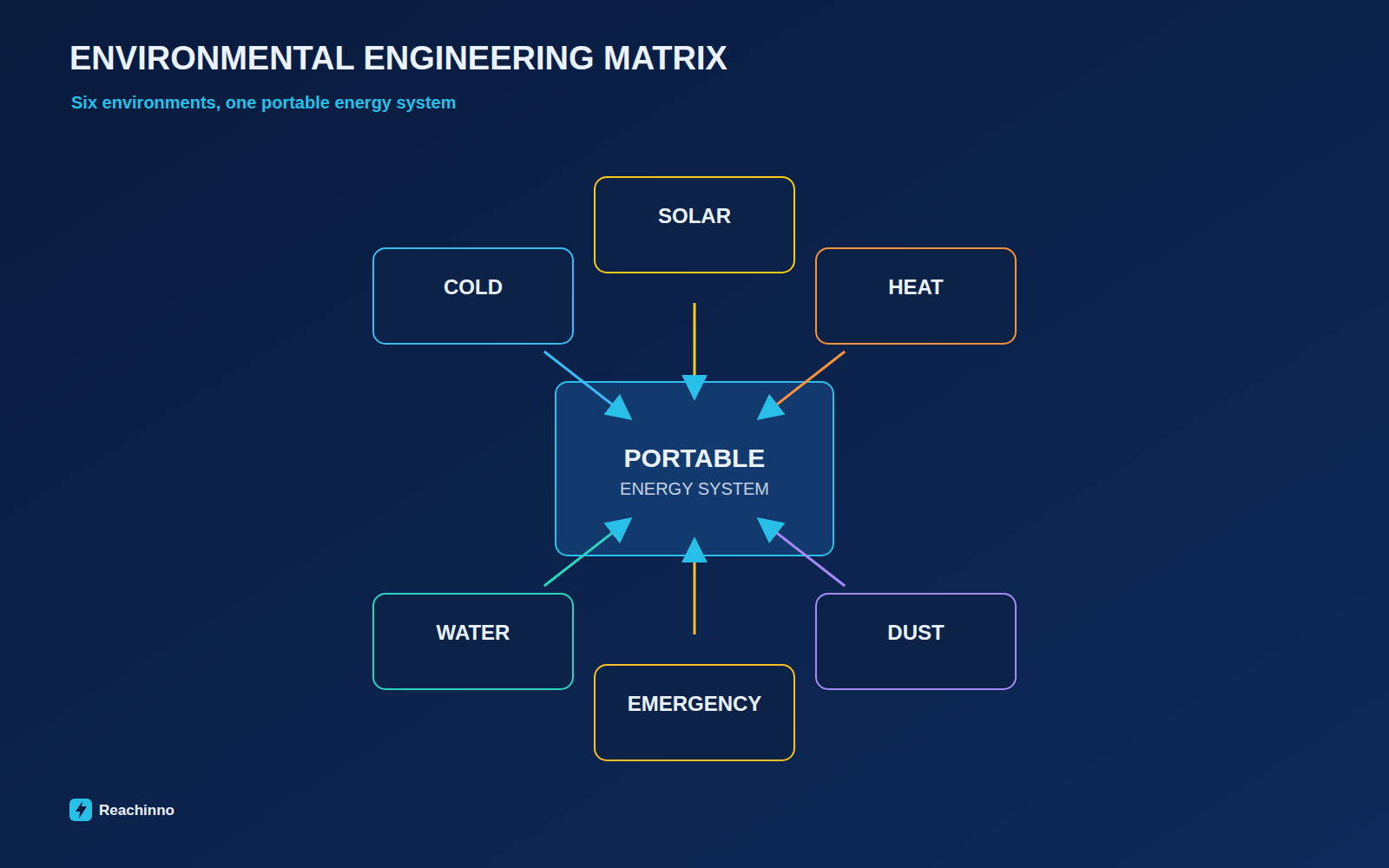
2. The Four Environmental Challenges
For outdoor portable power, four environmental factors deserve particular attention:
2.1 Cold
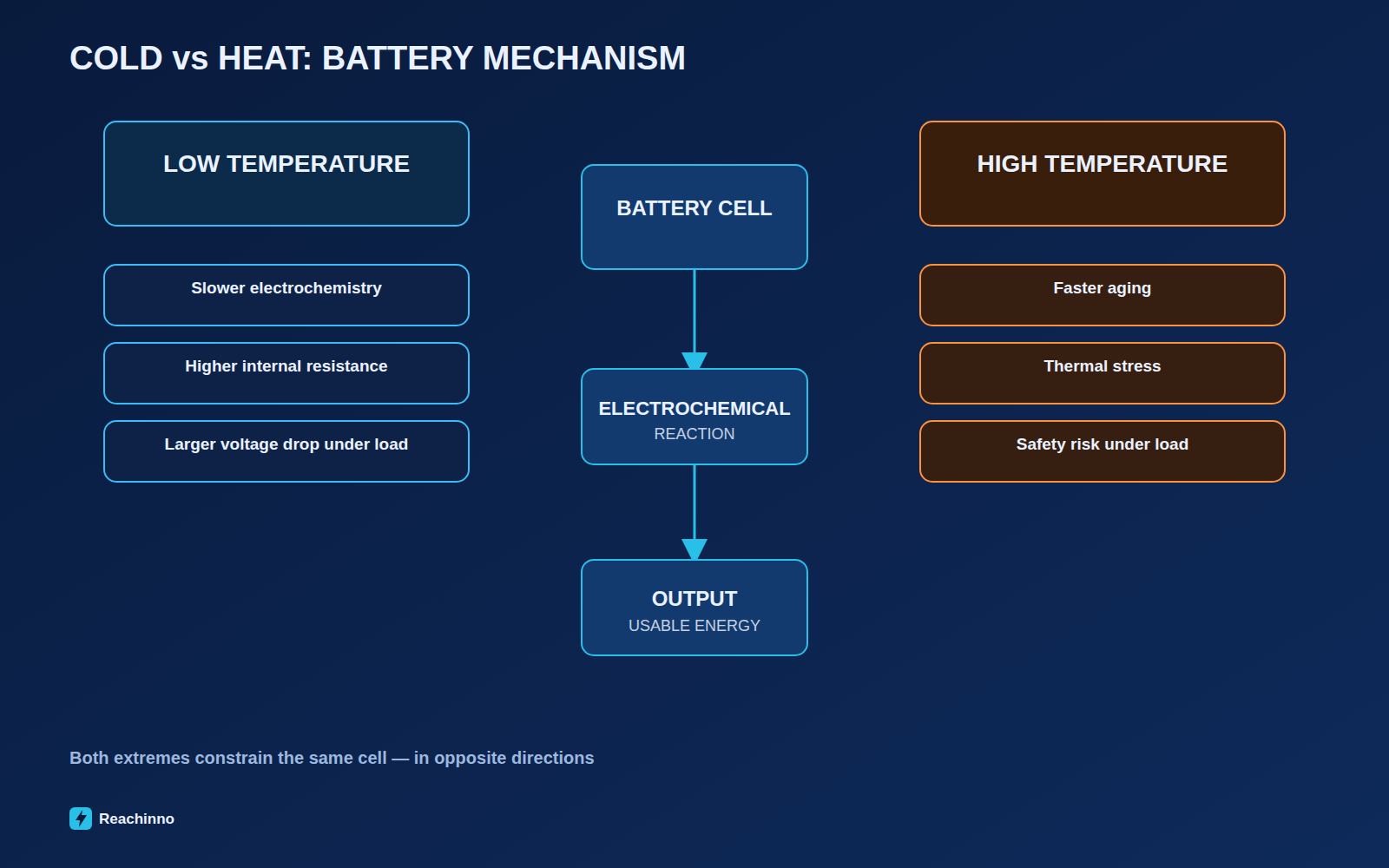
Low temperatures reduce battery performance through slower electrochemical reactions, reduced ionic conductivity, increased internal resistance, and stronger polarization.
2.2 Heat
High temperature accelerates battery aging and can create thermal-management and safety challenges, particularly during high-power charging and discharging.
2.3 Water and Humidity
Outdoor electronics can be exposed to rain, snow, condensation, humidity, splashing, and temporary immersion. Water protection therefore needs to be considered at the enclosure, connector, PCB, button, display, and assembly levels.
2.4 Long-Duration Outdoor Operation
A product that operates for several hours is very different from one expected to operate continuously for several days or weeks. Standby current, conversion efficiency, battery self-discharge, environmental temperature, and load profile become increasingly important.
Part 2 — Battery and System Engineering
3. Why Lithium Batteries Lose Performance in Cold Weather
Why does cold weather reduce lithium-ion battery performance?
Cold temperatures reduce lithium-ion battery performance because lower temperatures slow electrochemical reactions, reduce electrolyte conductivity, increase internal resistance, and increase polarization. The resulting voltage drop can cause the system to reach its cutoff voltage before the cell’s stored energy is fully accessible.
Engineering implication: the battery is not necessarily empty. The system simply cannot access enough of its stored energy at that temperature and load condition.
Apple provides a useful consumer example. Apple states that iPhone and iPad devices are designed for use between 0°C and 35°C, and charging may slow or temporarily stop when the device becomes too cold or too hot (Apple Support). This illustrates an important engineering principle: a battery system can contain energy without being able to deliver that energy at the required power and temperature.
For outdoor products, this becomes much more important. The first engineering decision is cell selection. Different lithium battery chemistries and cell constructions behave differently at low temperatures. For a deeper review of cathode materials and trade-offs, see the Battery Technology guide.
Important cell-selection parameters include: cathode chemistry, anode material, particle size, electrolyte formulation, electrode loading, internal resistance, cell construction, separator characteristics, and current density.
4. Low-Temperature Performance Is a System Problem
A common mistake is to assume that changing the electrolyte alone can solve low-temperature performance. It usually cannot. Battery performance is determined by multiple interacting factors:
Cell chemistry → Electrode kinetics → Electrolyte → BMS → Power conversion → Load
A cell with excellent low-temperature chemistry may still perform poorly if the BMS cutoff voltage is too conservative, the DC/DC converter becomes inefficient, standby current is too high, the output load is excessive, the PCB cannot tolerate thermal cycling, or connectors become unreliable. This is why Reachinno approaches extreme-temperature portable power as an integrated engineering system.
5. Case Study: 7,500mAh Portable Power at -40°C
Reachinno has developed a custom portable power solution for an outdoor lighting application requiring operation in extreme cold. To protect customer confidentiality, the customer information has been anonymized.
| Requirement | Target |
|---|---|
| Operating temperature | Down to -40°C |
| Battery capacity | 7,500mAh |
| Runtime | Up to 22 days |
| Application | Outdoor lighting |
| Deployment | Remote outdoor environment |
| Output | Stable continuous supply |
The engineering challenge was not simply increasing capacity. The goal was to maintain reliable energy delivery for an extended period under extreme environmental conditions — through optimization of cell selection, low-temperature performance, electrolyte characteristics, BMS behavior, power conversion, standby consumption, output control, thermal-cycle reliability, and long-duration outdoor validation. The full engineering breakdown is documented in the Reachinno case study on Engineering Portable Power for -40°C.
6. High-Temperature Battery Performance
Cold reduces electrochemical activity; heat accelerates it. High temperature can increase the rate of battery aging and create additional thermal stress. Apple warns that exposure to temperatures above 35°C can permanently reduce battery capacity, while charging at elevated temperatures can cause additional damage (Apple Batteries).
For outdoor products, the situation is more complicated because ambient temperature is not necessarily the same as battery temperature. A black enclosure under direct sunlight can reach an internal temperature significantly higher than ambient, and adding battery charging, DC/DC conversion, high output current, processor activity, solar charging, and limited airflow creates a thermal system that must be engineered rather than assumed.
7. Thermal Management for Outdoor Portable Power
Heat generation originates from battery internal resistance, charging IC, boost converter, MOSFETs, USB-C PD controller, wireless charging coil, display, and MCU. Heat spreading moves through PCB copper, thermal pads, aluminum structures, graphite sheets, internal brackets, and the enclosure. Heat rejection happens through natural convection, conduction, enclosure radiation, and controlled airflow. Thermal protection may reduce output power, reduce charging current, pause charging, shut down selected functions, disconnect the battery, or recover automatically after temperature returns to an acceptable range. Thermal management should be designed at the beginning of a project rather than added after the PCB is completed.
8. BMS and Power Electronics
The Battery Management System is more than a safety switch. For extreme-environment products, BMS behavior can influence over-charge, over-discharge, over-current, short-circuit, temperature monitoring, cell balancing, charge current, discharge current, and recovery behavior. A BMS designed for a standard consumer power bank may not be appropriate for -40°C operation, long-duration outdoor lighting, industrial monitoring, high-current applications, solar charging, or repeated thermal cycling. The BMS and power architecture should be designed around the battery and application rather than selected as generic modules.
Part 3 — Outdoor Energy Architecture
9. Waterproof and Rugged Design
Another common misconception is IP rating = outdoor reliability. It does not. For a real example, see the Reachinno IP67 Rugged Power Solution delivered to a leading French mobile brand. A genuinely rugged outdoor product requires enclosure structure, gasket compression, connector sealing, button sealing, display bonding, USB port protection, cable entry, pressure equalization, condensation management, thermal expansion tolerance, repeated opening and closing, and mechanical shock resistance. The correct protection level should be determined from the application rather than selected because a higher number sounds better.
10. The Hidden Problem: Condensation
One of the most overlooked outdoor battery risks is condensation. A product operating at -20°C brought into a warm environment can condense moisture inside or around electronic components — a very different failure mechanism from direct water ingress. Environmental testing should include cold → cold and also cold → warm → cold with repeated thermal cycles, especially for outdoor cameras, lighting systems, camping electronics, vehicle accessories, industrial IoT, and scientific instruments.
11. Solar Power Changes the Architecture
Solar charging is one of the most promising additions to outdoor portable power, but it should not be treated simply as Solar Panel + Battery. A useful outdoor system is closer to Solar → MPPT / Power Conversion → Battery → BMS → DC/DC → Load. Solar output depends on sunlight intensity, panel orientation, cloud cover, shadows, temperature, snow, dust, panel efficiency, and time of day. The U.S. Department of Energy notes that solar generation varies with sunlight, clouds, dust, haze, shadows, rain, snow, and dirt, and that storage allows generated electricity to be used when solar generation is unavailable (Department of Energy). The Reachinno Outdoor Energy Ecosystem™ framework maps how solar, storage, and load integrate into a single architecture.
12. Solar + Battery Is More Powerful Than Solar Alone
Solar panels generate electricity when conditions allow; batteries provide energy when conditions do not. This creates Generation → Storage → Load. During daylight: Solar → Load and/or Solar → Battery. At night: Battery → Load. During cloudy periods: Solar + Battery → Load. During emergencies: Battery → Critical Load. The U.S. Department of Energy describes solar plus storage as a mechanism for maintaining power during outages and improving resilience (Department of Energy).
13. Emergency Portable Power and Disaster Scenarios
Outdoor portable power and emergency power are increasingly converging — the same architecture supports camping, hiking, remote work, emergency communication, power outages, disaster response, outdoor lighting, security monitoring, medical support, and temporary infrastructure. Ready.gov recommends alternative charging methods during outages, and FEMA emergency-preparedness materials include portable charging devices among useful emergency-kit equipment (Ready.gov). Different disasters create different requirements:
| Scenario | Typical Challenge | Preferred Power Architecture |
|---|---|---|
| Earthquake | Grid unavailable | Battery + solar |
| Typhoon | Rain + power outage | Waterproof battery |
| Hurricane | Long outage | Battery + solar |
| Wildfire | Heat + smoke + evacuation | Rugged portable power |
| Winter storm | Freezing temperatures | Low-temperature battery |
| Flood | Water exposure | Waterproof enclosure |
| Heat wave | High ambient temperature | Thermal-managed system |
| Remote camping | No grid | Battery + solar |
| Long-distance cycling | Weight | Compact high-efficiency battery |
| Remote monitoring | Long duration | Low-power battery system |
The product architecture should therefore start from the failure scenario, not the product category.
Part 4 — Application Engineering
14. Outdoor Power Should Be Designed Around the Load
This is one of the most important principles for OEM buyers. Do not start with “We want a 10,000mAh power bank.” Start with “What does the product need to power?” When the use case is weekend camping, the right starting point is a structured buyer guide such as Reachinno’s guide on how to choose a power bank for camping.
Scenario A — Smartphone: compact size, fast charging, USB-C, low weight. Scenario B — Outdoor lighting: low standby current, long runtime, low-temperature performance, stable output. Scenario C — Security camera: continuous power, stable voltage, weather resistance, long-duration operation. Scenario D — Drone equipment: high power, high energy density, thermal management, fast recharge. Scenario E — Emergency communication: reliability, multiple outputs, long standby time, solar recharge, ruggedness. The same battery capacity can therefore produce completely different product architectures.
15. Runtime Is More Than Battery Capacity
A simplified calculation is Runtime ≈ Usable Battery Energy ÷ Average System Load. Actual outdoor runtime also depends on battery temperature, conversion efficiency, battery aging, discharge rate, standby current, output voltage, load profile, solar contribution, and protection thresholds. For long-duration outdoor applications, reducing power consumption can sometimes provide more value than adding additional cells. This principle was demonstrated in Reachinno’s -40°C outdoor power project, where system-level power optimization was part of the strategy used to achieve long-duration operation.
16. The Importance of Standby Current
For a smartphone power bank, standby current may appear insignificant; for a remote monitoring product expected to operate for weeks, it becomes critical. Imagine a system operating for 22 days × 24 hours = 528 hours — even a small amount of unnecessary standby consumption accumulates. Engineers should measure sleep current, MCU current, BMS quiescent current, LED current, display current, leakage current, and converter idle consumption. Long-duration outdoor products should be optimized for the entire energy budget, not just active output power.
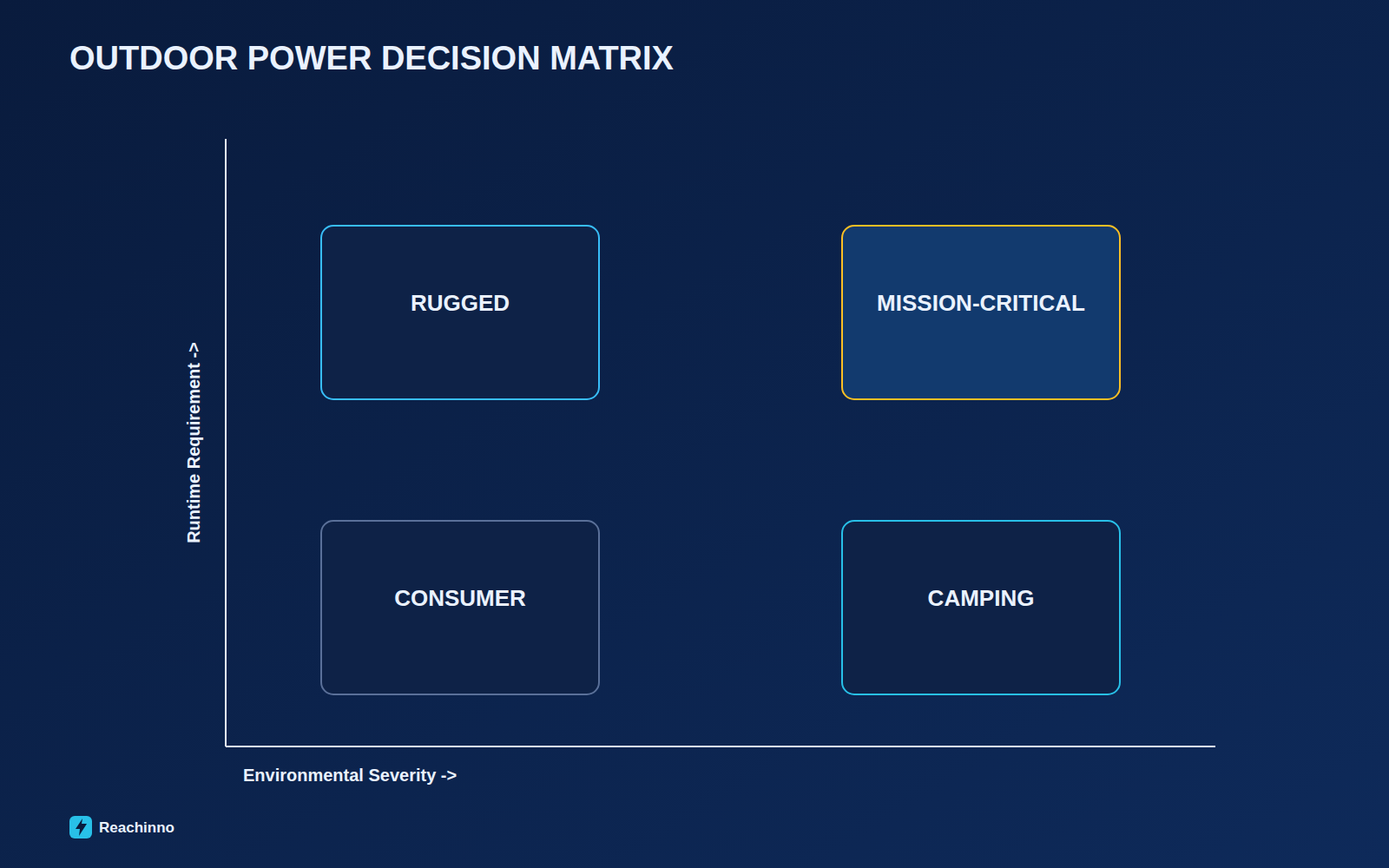
17. A Practical Outdoor Power Decision Matrix
For OEM product planning, the following matrix provides a useful starting point.
| Application | Temperature | Water Protection | Runtime | Solar | Priority |
|---|---|---|---|---|---|
| Camping | Medium | Medium | 1–3 days | Optional | Portability |
| Hiking | Medium | Medium | 1–2 days | Optional | Weight |
| Cycling | Medium | Medium/High | 1–3 days | Optional | Compactness |
| Outdoor Lighting | Low/High | High | 7–30 days | Recommended | Efficiency |
| Security Camera | Low/High | High | 7–30 days | Recommended | Reliability |
| Industrial IoT | Application-specific | High | Weeks/months | Optional | Reliability |
| Emergency Kit | Variable | Medium | 1–7 days | Recommended | Resilience |
| Disaster Response | Variable | High | Multi-day | Recommended | System resilience |
| Remote Monitoring | Extreme | High | Weeks/months | Recommended | Low standby |
| Adventure Equipment | Variable | Medium/High | Multi-day | Optional | Portability |
This is where capacity stops being the only product specification.
Part 5 — Validation and OEM Development
18. Engineering Validation Should Match the Real Environment
One of the biggest mistakes in product development is testing only at room temperature. A validation matrix may include: low-temperature operation (-20°C / -30°C / -40°C), high-temperature operation (+45°C / +55°C), thermal cycling (cold → warm → cold), humidity, water ingress (IP requirement), dust, drop, vibration, long-duration discharge (24h / 7d / 22d), charging validation, connector reliability, battery aging, solar input (variable irradiance), and output stability. The objective is to identify failure modes before the customer encounters them.
19. Laboratory Validation vs Field Validation
Laboratory testing is essential but cannot replace real-world validation. A laboratory can control temperature, humidity, current, voltage, and load. Real environments introduce wind, sunlight, snow, rain, condensation, dust, vibration, human operation, and irregular load profiles. A mature outdoor product development process should include both controlled laboratory validation and real-environment field validation. Reachinno’s -40°C case study provides an example of this approach, with long-duration outdoor validation used alongside engineering testing.
20. The OEM Outdoor Power Development Process
OEM buyers should evaluate outdoor portable power using a structured decision process:
- Step 1 — Define the environment: minimum temperature, maximum temperature, humidity, rain exposure, dust, sunlight, altitude, mechanical conditions
- Step 2 — Define the load: device type, voltage, current, peak power, average power, standby power, duty cycle
- Step 3 — Define runtime: specify required runtime under actual conditions, e.g. 72 hours at -20°C with a 5W average load — not simply 10,000mAh
- Step 4 — Define charging strategy: USB-C, AC adapter, solar, vehicle, wireless, proprietary DC input
- Step 5 — Select battery technology: energy density, safety, low-temperature behavior, high-temperature stability, cycle life, cost, availability
- Step 6 — Design BMS and power electronics around the battery and application
- Step 7 — Design enclosure protection: IP rating, mechanical strength, connector protection, thermal path, condensation management
- Step 8 — Validate Cell → Pack → PCB → Product → Field, not only the individual components
21. What OEM Buyers Should Ask Before Starting an Outdoor Power Project
Before requesting a quotation, ask your engineering partner:
- Battery: What cell chemistry is recommended? What is the verified operating temperature? What is the usable capacity at the target temperature? What happens during low-temperature charging?
- Electronics: What is the BMS strategy? What is the converter efficiency? What is the standby current? How does the system behave during thermal extremes?
- Mechanical: What IP rating is required? How are connectors protected? How is condensation handled?
- Validation: Has the product been tested at the actual operating temperature? Has it undergone thermal cycling? Has it been field tested? Has long-duration runtime been validated?
- Supply Chain: Are the cells traceable? Can the battery supplier support long-term production? Are critical ICs multi-sourced? Can the design be maintained for several years?
- Compliance: Which certifications are required for the target market?
This checklist can significantly improve the quality of an OEM development project before tooling begins.
Part 6 — Future of Outdoor Portable Power
22. The Future of Outdoor Portable Power
The future product is unlikely to be simply Battery + USB port. Instead, it will increasingly become Energy Storage + Power Management + Environmental Intelligence + Renewable Input + Application-Specific Control. Contributing technologies include improved lithium-ion, LFP, semi-solid-state, silicon-enhanced anodes, and future solid-state chemistries; smarter BMS; solar integration; better thermal management; lower standby consumption; rugged industrial design; and connected energy systems (sensors, IoT, cloud, remote monitoring, predictive maintenance). The Reachinno 2026 Power Bank Industry Report similarly identifies application-specific battery selection, thermal management, safety, and engineering collaboration as increasingly important.
23. Extreme-Weather Portable Power Is an Engineering Category
The biggest opportunity is not another generic 20,000mAh power bank, but products that solve specific environmental problems. A product designed for -40°C outdoor lighting should not use the same engineering assumptions as summer camping. A product designed for disaster recovery should not use the same architecture as daily smartphone charging. And a product designed for remote industrial monitoring should not be evaluated only by its mAh rating. The correct approach is Application → Environment → Load → Battery → Electronics → Protection → Validation, not Capacity → Price → Product.
24. Reachinno Outdoor Energy Engineering Approach
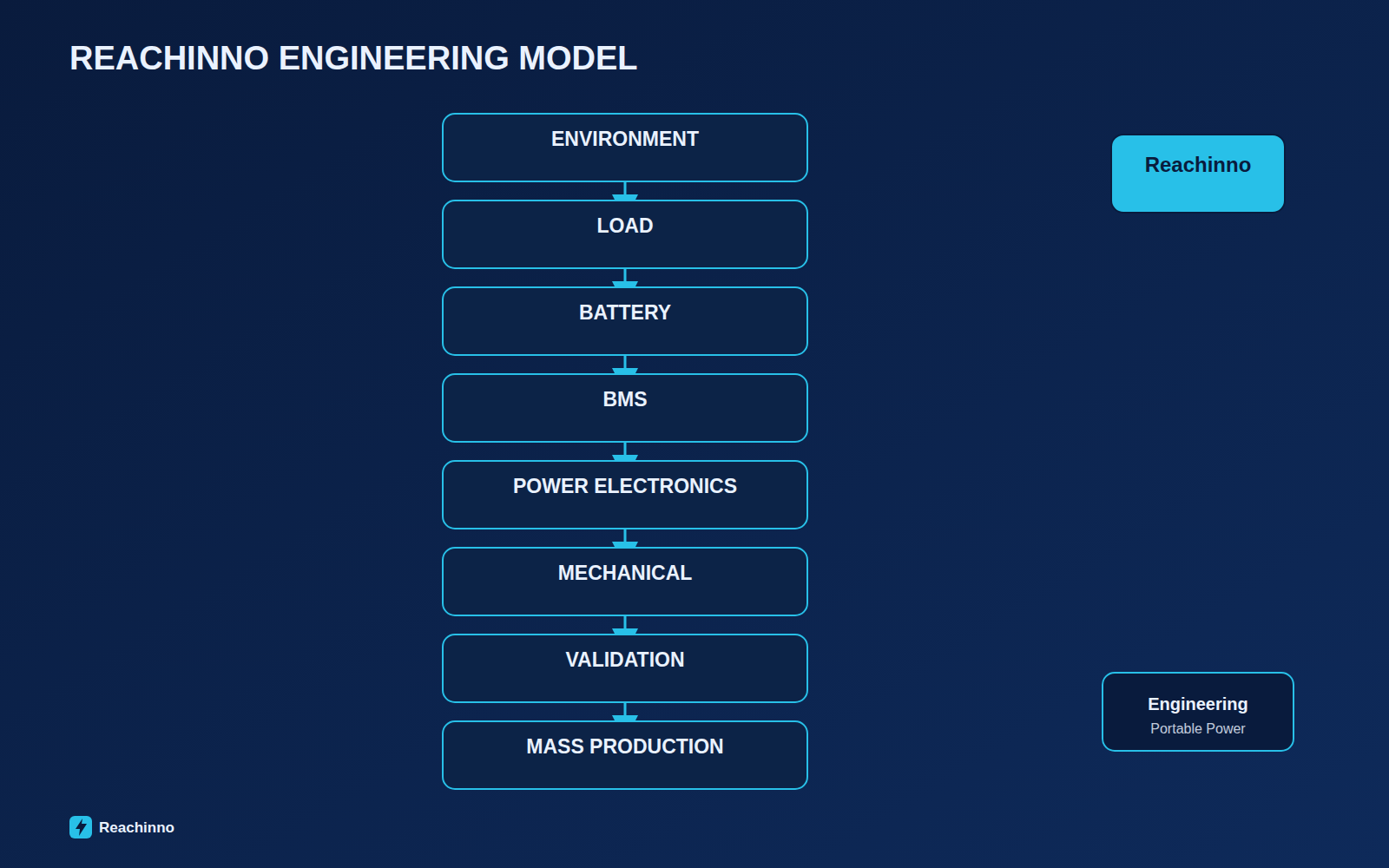
At Reachinno, outdoor portable power is treated as a complete engineering system — integrating battery chemistry, battery pack, BMS, power electronics, thermal management, mechanical protection, charging architecture, application load, environmental validation, and mass production. This allows brands to develop products for very different outdoor requirements, from compact camping power banks to extreme-temperature and rugged industrial applications. Explore the full line of Reachinno Outdoor Power Solutions on the product page.
25. Conclusion
Extreme-weather portable power is becoming a distinct engineering category. The real challenge is delivering usable, safe, stable energy under real environmental conditions. Cold affects electrochemical kinetics; heat accelerates battery aging and increases thermal stress; water and humidity challenge enclosure and connector design; solar introduces variable energy input; long-duration applications expose weaknesses in standby consumption and power-management architecture; emergency applications require resilience rather than simply capacity.
The solution is system-level engineering: battery chemistry + BMS + power electronics + thermal management + enclosure + energy efficiency + environmental validation must work together. And for OEM buyers, this leads to one simple rule:
Do not specify an outdoor power product by capacity alone. Specify the environment, load, runtime, and reliability requirement first.
Frequently Asked Questions
What is extreme-weather portable power?
Extreme-weather portable power is a battery-based energy system engineered to operate reliably under challenging environmental conditions such as extreme cold, heat, rain, humidity, dust, or prolonged outdoor exposure.
Can lithium batteries work at -40°C?
Some lithium battery systems can be engineered for operation at extremely low temperatures, but standard consumer lithium batteries should not automatically be assumed to provide reliable performance at -40°C. Cell chemistry, electrolyte, electrode design, BMS strategy, power electronics, and application load all influence actual performance.
Why do batteries lose capacity in cold weather?
Low temperatures slow electrochemical reactions, reduce ionic conductivity, increase internal resistance, and increase polarization. The battery may therefore reach its voltage cutoff before all stored energy can be practically accessed.
Can a power bank charge devices in freezing temperatures?
It depends on both the battery system and the device being charged. Some consumer devices automatically slow or pause charging under extreme temperatures. Apple, for example, states that iPhone charging can slow or temporarily stop when the device is too cold or too hot.
Is IP67 enough for outdoor portable power?
Not necessarily. IP67 addresses specific ingress protection conditions, but outdoor reliability also depends on thermal cycling, condensation, mechanical shock, connectors, seals, PCB protection, and long-term environmental exposure.
Is solar charging useful for outdoor power banks?
Yes, especially for long-duration deployments. Solar can replenish stored energy during daylight while the battery supplies power when sunlight is unavailable. The system must be designed around variable solar generation and storage requirements.
What battery capacity is best for outdoor portable power?
There is no universal capacity. The correct capacity depends on the application load, required runtime, operating temperature, conversion efficiency, charging strategy, and physical size constraints.
What is more important: battery capacity or energy efficiency?
For long-duration applications, energy efficiency can be extremely important. Reducing standby consumption and conversion losses can sometimes extend runtime more effectively than simply adding additional battery cells.
Can Reachinno develop extreme-weather portable power products?
Yes. Reachinno develops customized portable power solutions based on application requirements, including battery selection, BMS, power electronics, mechanical design, environmental validation, and OEM/ODM production.
What should OEM buyers specify for an extreme-weather power product?
OEM buyers should specify the operating environment (minimum/maximum temperature, humidity, water, dust, sunlight), the load (voltage, current, peak and average power, standby, duty cycle), the required runtime under actual conditions, the charging strategy, and the target reliability — not simply a battery capacity.
How should a battery be tested at -40°C?
Testing at -40°C should cover low-temperature discharge at the target current, usable capacity at temperature, charging behavior (many cells should not be charged at extreme low temperature), thermal cycling (cold → warm → cold), long-duration discharge, connector reliability, and field validation in the actual deployment environment.
What is the difference between battery operating temperature and charging temperature?
Operating (discharge) temperature and charging temperature are different limits. A cell may deliver energy at a low temperature where charging would be unsafe or ineffective. Charging at extreme low or high temperature can cause lithium plating, accelerated aging, or thermal events, so the BMS should enforce separate charge-temperature windows.
Can a standard power bank be modified for extreme outdoor use?
Usually not by simply changing the enclosure or battery. Extreme-weather performance often requires coordinated changes to cell selection, electrolyte, BMS behavior, power conversion, thermal design, mechanical protection, and validation. A rubber shell alone does not make a product rugged.
Planning an Outdoor Portable Power Product?
Send us these five parameters, and our engineering team can translate them into a complete battery, BMS, power electronics, mechanical and validation architecture.
| Requirement | Example |
|---|---|
| Operating temperature | -40°C to +45°C |
| Load | Outdoor lighting |
| Runtime | 22 days |
| Charging | USB-C / Solar |
| Environment | Snow / rain / dust |
Reachinno can translate these requirements into a battery, BMS, power electronics, mechanical and validation architecture.
Talk to Reachinno about a custom portable power solution
For a deeper engineering analysis of high-temperature portable power, see our Engineering Guide.