Table of Contents

Reachinno Outdoor Energy Ecosystem™

Can I see a real OEM execution under this framework?

Yes. Case Study 003 documents a complete 7,500mAh / -40°C / 22-day OEM project executed under this framework for a remote outdoor lighting customer. Read it at Engineering Portable Power for -40°C.

Yes. The ecosystem is the baseline; every OEM project is customized on top of it — capacity, ports, enclosure, branding, firmware, and certifications. Reachinno’s OEM MOQ typically starts at 1,000 units, with engineering samples available from prototype A onward.

How does this framework relate to the broader Reachinno outdoor portable power landscape?

It is one of four connected articles. For the market-level view, see the 2026 outdoor portable power landscape overview. For the buyer-side decision process, see the 2026 camping power bank buyer’s guide. For a specific OEM execution, see the -40°C OEM case study.

Can I see a real OEM execution under this framework?

Yes. Case Study 003 documents a complete 7,500mAh / -40°C / 22-day OEM project executed under this framework for a remote outdoor lighting customer. Read it at Engineering Portable Power for -40°C.

Does Reachinno customize products under this framework?

Yes. The ecosystem is the baseline; every OEM project is customized on top of it — capacity, ports, enclosure, branding, firmware, and certifications. Reachinno’s OEM MOQ typically starts at 1,000 units, with engineering samples available from prototype A onward.

How does this framework relate to the broader Reachinno outdoor portable power landscape?

It is one of four connected articles. For the market-level view, see the 2026 outdoor portable power landscape overview. For the buyer-side decision process, see the 2026 camping power bank buyer’s guide. For a specific OEM execution, see the -40°C OEM case study.

Can I see a real OEM execution under this framework?

Yes. Case Study 003 documents a complete 7,500mAh / -40°C / 22-day OEM project executed under this framework for a remote outdoor lighting customer. Read it at Engineering Portable Power for -40°C.

The design target is -40°C to +60°C operating range, with full capacity retention above -20°C and graceful derating below that. The -40°C case study documents the validation methodology for the cold-weather end of that range.

Does Reachinno customize products under this framework?

Yes. The ecosystem is the baseline; every OEM project is customized on top of it — capacity, ports, enclosure, branding, firmware, and certifications. Reachinno’s OEM MOQ typically starts at 1,000 units, with engineering samples available from prototype A onward.

How does this framework relate to the broader Reachinno outdoor portable power landscape?

It is one of four connected articles. For the market-level view, see the 2026 outdoor portable power landscape overview. For the buyer-side decision process, see the 2026 camping power bank buyer’s guide. For a specific OEM execution, see the -40°C OEM case study.

Can I see a real OEM execution under this framework?

Yes. Case Study 003 documents a complete 7,500mAh / -40°C / 22-day OEM project executed under this framework for a remote outdoor lighting customer. Read it at Engineering Portable Power for -40°C.

What temperature range does the framework cover?

The design target is -40°C to +60°C operating range, with full capacity retention above -20°C and graceful derating below that. The -40°C case study documents the validation methodology for the cold-weather end of that range.

Does Reachinno customize products under this framework?

Yes. The ecosystem is the baseline; every OEM project is customized on top of it — capacity, ports, enclosure, branding, firmware, and certifications. Reachinno’s OEM MOQ typically starts at 1,000 units, with engineering samples available from prototype A onward.

How does this framework relate to the broader Reachinno outdoor portable power landscape?

It is one of four connected articles. For the market-level view, see the 2026 outdoor portable power landscape overview. For the buyer-side decision process, see the 2026 camping power bank buyer’s guide. For a specific OEM execution, see the -40°C OEM case study.

Can I see a real OEM execution under this framework?

Yes. Case Study 003 documents a complete 7,500mAh / -40°C / 22-day OEM project executed under this framework for a remote outdoor lighting customer. Read it at Engineering Portable Power for -40°C.

What temperature range does the framework cover?

The design target is -40°C to +60°C operating range, with full capacity retention above -20°C and graceful derating below that. The -40°C case study documents the validation methodology for the cold-weather end of that range.

Does Reachinno customize products under this framework?

Yes. The ecosystem is the baseline; every OEM project is customized on top of it — capacity, ports, enclosure, branding, firmware, and certifications. Reachinno’s OEM MOQ typically starts at 1,000 units, with engineering samples available from prototype A onward.

How does this framework relate to the broader Reachinno outdoor portable power landscape?

It is one of four connected articles. For the market-level view, see the 2026 outdoor portable power landscape overview. For the buyer-side decision process, see the 2026 camping power bank buyer’s guide. For a specific OEM execution, see the -40°C OEM case study.

Can I see a real OEM execution under this framework?

Yes. Case Study 003 documents a complete 7,500mAh / -40°C / 22-day OEM project executed under this framework for a remote outdoor lighting customer. Read it at Engineering Portable Power for -40°C.

Who should use this framework?

OEM and ODM buyers who need portable power products that operate reliably in outdoor environments — including cold, hot, wet, or dusty conditions. The framework is most relevant when the buyer’s product must operate for many consecutive days in field conditions, not just in occasional weekend use.

What temperature range does the framework cover?

The design target is -40°C to +60°C operating range, with full capacity retention above -20°C and graceful derating below that. The -40°C case study documents the validation methodology for the cold-weather end of that range.

Does Reachinno customize products under this framework?

Yes. The ecosystem is the baseline; every OEM project is customized on top of it — capacity, ports, enclosure, branding, firmware, and certifications. Reachinno’s OEM MOQ typically starts at 1,000 units, with engineering samples available from prototype A onward.

How does this framework relate to the broader Reachinno outdoor portable power landscape?

It is one of four connected articles. For the market-level view, see the 2026 outdoor portable power landscape overview. For the buyer-side decision process, see the 2026 camping power bank buyer’s guide. For a specific OEM execution, see the -40°C OEM case study.

Can I see a real OEM execution under this framework?

Yes. Case Study 003 documents a complete 7,500mAh / -40°C / 22-day OEM project executed under this framework for a remote outdoor lighting customer. Read it at Engineering Portable Power for -40°C.

The 2026 outdoor portable power market is being reshaped by three forces:

  • Low-temperature demand. More buyers in alpine, polar, and high-latitude regions need batteries that survive -20°C and below.
  • Multi-source recharging. Solar + AC + car DC is becoming the default expectation, not a premium feature.
  • Validation transparency. Retailers and end-users increasingly ask for documented outdoor field tests, not just lab reports.

The Reachinno Outdoor Energy Ecosystem™ is our response to all three. For a deeper look at how these forces shape buying decisions, see our 2026 camping power bank buyer’s guide, and for the market-wide view, the 2026 outdoor portable power landscape overview.


FAQ

What is the Reachinno Outdoor Energy Ecosystem™?

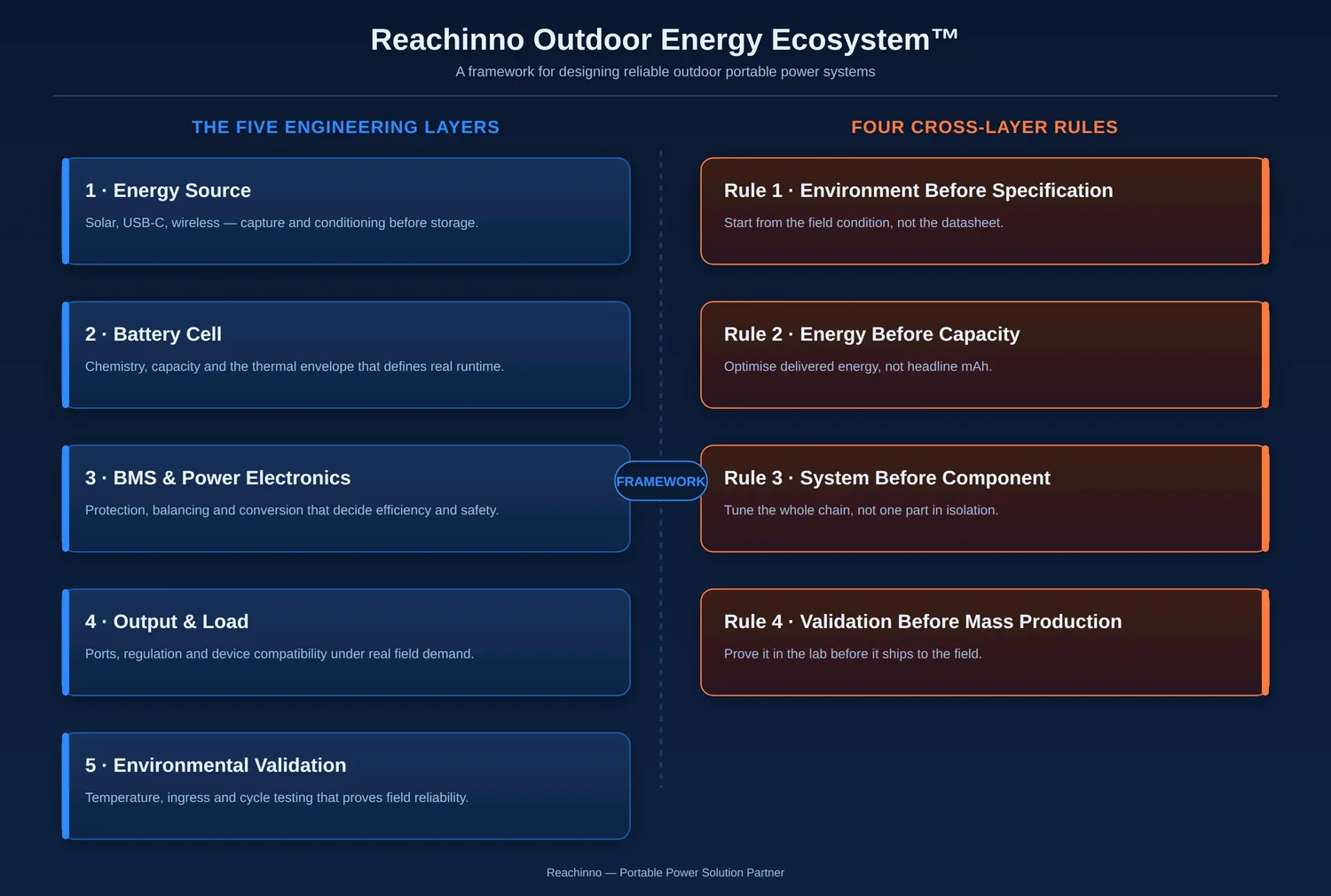
It is the engineering framework Reachinno uses to design, validate, and deliver portable power products for outdoor OEM and ODM customers. The framework defines five layers (energy source, battery cell, BMS / power electronics, output, validation) and the cross-layer integration rules between them.

Who should use this framework?

OEM and ODM buyers who need portable power products that operate reliably in outdoor environments — including cold, hot, wet, or dusty conditions. The framework is most relevant when the buyer’s product must operate for many consecutive days in field conditions, not just in occasional weekend use.

What temperature range does the framework cover?

The design target is -40°C to +60°C operating range, with full capacity retention above -20°C and graceful derating below that. The -40°C case study documents the validation methodology for the cold-weather end of that range.

Does Reachinno customize products under this framework?

Yes. The ecosystem is the baseline; every OEM project is customized on top of it — capacity, ports, enclosure, branding, firmware, and certifications. Reachinno’s OEM MOQ typically starts at 1,000 units, with engineering samples available from prototype A onward.

How does this framework relate to the broader Reachinno outdoor portable power landscape?

It is one of four connected articles. For the market-level view, see the 2026 outdoor portable power landscape overview. For the buyer-side decision process, see the 2026 camping power bank buyer’s guide. For a specific OEM execution, see the -40°C OEM case study.

Can I see a real OEM execution under this framework?

Yes. Case Study 003 documents a complete 7,500mAh / -40°C / 22-day OEM project executed under this framework for a remote outdoor lighting customer. Read it at Engineering Portable Power for -40°C.

4. Where the Ecosystem Fits in the 2026 Outdoor Market

The 2026 outdoor portable power market is being reshaped by three forces:

  • Low-temperature demand. More buyers in alpine, polar, and high-latitude regions need batteries that survive -20°C and below.
  • Multi-source recharging. Solar + AC + car DC is becoming the default expectation, not a premium feature.
  • Validation transparency. Retailers and end-users increasingly ask for documented outdoor field tests, not just lab reports.

The Reachinno Outdoor Energy Ecosystem™ is our response to all three. For a deeper look at how these forces shape buying decisions, see our 2026 camping power bank buyer’s guide, and for the market-wide view, the 2026 outdoor portable power landscape overview.


FAQ

What is the Reachinno Outdoor Energy Ecosystem™?

It is the engineering framework Reachinno uses to design, validate, and deliver portable power products for outdoor OEM and ODM customers. The framework defines five layers (energy source, battery cell, BMS / power electronics, output, validation) and the cross-layer integration rules between them.

Who should use this framework?

OEM and ODM buyers who need portable power products that operate reliably in outdoor environments — including cold, hot, wet, or dusty conditions. The framework is most relevant when the buyer’s product must operate for many consecutive days in field conditions, not just in occasional weekend use.

What temperature range does the framework cover?

The design target is -40°C to +60°C operating range, with full capacity retention above -20°C and graceful derating below that. The -40°C case study documents the validation methodology for the cold-weather end of that range.

Does Reachinno customize products under this framework?

Yes. The ecosystem is the baseline; every OEM project is customized on top of it — capacity, ports, enclosure, branding, firmware, and certifications. Reachinno’s OEM MOQ typically starts at 1,000 units, with engineering samples available from prototype A onward.

How does this framework relate to the broader Reachinno outdoor portable power landscape?

It is one of four connected articles. For the market-level view, see the 2026 outdoor portable power landscape overview. For the buyer-side decision process, see the 2026 camping power bank buyer’s guide. For a specific OEM execution, see the -40°C OEM case study.

Can I see a real OEM execution under this framework?

Yes. Case Study 003 documents a complete 7,500mAh / -40°C / 22-day OEM project executed under this framework for a remote outdoor lighting customer. Read it at Engineering Portable Power for -40°C.

4. Where the Ecosystem Fits in the 2026 Outdoor Market

The 2026 outdoor portable power market is being reshaped by three forces:

  • Low-temperature demand. More buyers in alpine, polar, and high-latitude regions need batteries that survive -20°C and below.
  • Multi-source recharging. Solar + AC + car DC is becoming the default expectation, not a premium feature.
  • Validation transparency. Retailers and end-users increasingly ask for documented outdoor field tests, not just lab reports.

The Reachinno Outdoor Energy Ecosystem™ is our response to all three. For a deeper look at how these forces shape buying decisions, see our 2026 camping power bank buyer’s guide, and for the market-wide view, the 2026 outdoor portable power landscape overview.


FAQ

What is the Reachinno Outdoor Energy Ecosystem™?

It is the engineering framework Reachinno uses to design, validate, and deliver portable power products for outdoor OEM and ODM customers. The framework defines five layers (energy source, battery cell, BMS / power electronics, output, validation) and the cross-layer integration rules between them.

Who should use this framework?

OEM and ODM buyers who need portable power products that operate reliably in outdoor environments — including cold, hot, wet, or dusty conditions. The framework is most relevant when the buyer’s product must operate for many consecutive days in field conditions, not just in occasional weekend use.

What temperature range does the framework cover?

The design target is -40°C to +60°C operating range, with full capacity retention above -20°C and graceful derating below that. The -40°C case study documents the validation methodology for the cold-weather end of that range.

Does Reachinno customize products under this framework?

Yes. The ecosystem is the baseline; every OEM project is customized on top of it — capacity, ports, enclosure, branding, firmware, and certifications. Reachinno’s OEM MOQ typically starts at 1,000 units, with engineering samples available from prototype A onward.

How does this framework relate to the broader Reachinno outdoor portable power landscape?

It is one of four connected articles. For the market-level view, see the 2026 outdoor portable power landscape overview. For the buyer-side decision process, see the 2026 camping power bank buyer’s guide. For a specific OEM execution, see the -40°C OEM case study.

Can I see a real OEM execution under this framework?

Yes. Case Study 003 documents a complete 7,500mAh / -40°C / 22-day OEM project executed under this framework for a remote outdoor lighting customer. Read it at Engineering Portable Power for -40°C.

For an in-depth look at one execution of this flow, read the -40°C OEM case study (003). The same flow governs all Reachinno outdoor OEM work — from a 5,000mAh retail unit to a 100,000mAh expedition station.


4. Where the Ecosystem Fits in the 2026 Outdoor Market

The 2026 outdoor portable power market is being reshaped by three forces:

  • Low-temperature demand. More buyers in alpine, polar, and high-latitude regions need batteries that survive -20°C and below.
  • Multi-source recharging. Solar + AC + car DC is becoming the default expectation, not a premium feature.
  • Validation transparency. Retailers and end-users increasingly ask for documented outdoor field tests, not just lab reports.

The Reachinno Outdoor Energy Ecosystem™ is our response to all three. For a deeper look at how these forces shape buying decisions, see our 2026 camping power bank buyer’s guide, and for the market-wide view, the 2026 outdoor portable power landscape overview.


FAQ

What is the Reachinno Outdoor Energy Ecosystem™?

It is the engineering framework Reachinno uses to design, validate, and deliver portable power products for outdoor OEM and ODM customers. The framework defines five layers (energy source, battery cell, BMS / power electronics, output, validation) and the cross-layer integration rules between them.

Who should use this framework?

OEM and ODM buyers who need portable power products that operate reliably in outdoor environments — including cold, hot, wet, or dusty conditions. The framework is most relevant when the buyer’s product must operate for many consecutive days in field conditions, not just in occasional weekend use.

What temperature range does the framework cover?

The design target is -40°C to +60°C operating range, with full capacity retention above -20°C and graceful derating below that. The -40°C case study documents the validation methodology for the cold-weather end of that range.

Does Reachinno customize products under this framework?

Yes. The ecosystem is the baseline; every OEM project is customized on top of it — capacity, ports, enclosure, branding, firmware, and certifications. Reachinno’s OEM MOQ typically starts at 1,000 units, with engineering samples available from prototype A onward.

How does this framework relate to the broader Reachinno outdoor portable power landscape?

It is one of four connected articles. For the market-level view, see the 2026 outdoor portable power landscape overview. For the buyer-side decision process, see the 2026 camping power bank buyer’s guide. For a specific OEM execution, see the -40°C OEM case study.

Can I see a real OEM execution under this framework?

Yes. Case Study 003 documents a complete 7,500mAh / -40°C / 22-day OEM project executed under this framework for a remote outdoor lighting customer. Read it at Engineering Portable Power for -40°C.

The framework drives how we scope, design, and deliver OEM portable power projects. The typical OEM flow under the ecosystem is:

  1. Specification lock. Operating-temperature window, capacity target, output ports, runtime target, certifications.
  2. Architecture selection. Choose cell chemistry, BMS topology, and enclosure concept from the ecosystem library.
  3. Prototype A. Engineering samples for internal validation and partner feedback.
  4. Outdoor validation cycle. Real-environment deployment (typically 2–4 weeks) for cold, hot, wet, or dusty conditions.
  5. Prototype B & tooling. Final design lock, tooling kick-off.
  6. Mass production. Inline QC + batch aging test before shipment.

For an in-depth look at one execution of this flow, read the -40°C OEM case study (003). The same flow governs all Reachinno outdoor OEM work — from a 5,000mAh retail unit to a 100,000mAh expedition station.


4. Where the Ecosystem Fits in the 2026 Outdoor Market

The 2026 outdoor portable power market is being reshaped by three forces:

  • Low-temperature demand. More buyers in alpine, polar, and high-latitude regions need batteries that survive -20°C and below.
  • Multi-source recharging. Solar + AC + car DC is becoming the default expectation, not a premium feature.
  • Validation transparency. Retailers and end-users increasingly ask for documented outdoor field tests, not just lab reports.

The Reachinno Outdoor Energy Ecosystem™ is our response to all three. For a deeper look at how these forces shape buying decisions, see our 2026 camping power bank buyer’s guide, and for the market-wide view, the 2026 outdoor portable power landscape overview.


FAQ

What is the Reachinno Outdoor Energy Ecosystem™?

It is the engineering framework Reachinno uses to design, validate, and deliver portable power products for outdoor OEM and ODM customers. The framework defines five layers (energy source, battery cell, BMS / power electronics, output, validation) and the cross-layer integration rules between them.

Who should use this framework?

OEM and ODM buyers who need portable power products that operate reliably in outdoor environments — including cold, hot, wet, or dusty conditions. The framework is most relevant when the buyer’s product must operate for many consecutive days in field conditions, not just in occasional weekend use.

What temperature range does the framework cover?

The design target is -40°C to +60°C operating range, with full capacity retention above -20°C and graceful derating below that. The -40°C case study documents the validation methodology for the cold-weather end of that range.

Does Reachinno customize products under this framework?

Yes. The ecosystem is the baseline; every OEM project is customized on top of it — capacity, ports, enclosure, branding, firmware, and certifications. Reachinno’s OEM MOQ typically starts at 1,000 units, with engineering samples available from prototype A onward.

How does this framework relate to the broader Reachinno outdoor portable power landscape?

It is one of four connected articles. For the market-level view, see the 2026 outdoor portable power landscape overview. For the buyer-side decision process, see the 2026 camping power bank buyer’s guide. For a specific OEM execution, see the -40°C OEM case study.

Can I see a real OEM execution under this framework?

Yes. Case Study 003 documents a complete 7,500mAh / -40°C / 22-day OEM project executed under this framework for a remote outdoor lighting customer. Read it at Engineering Portable Power for -40°C.

Layer 5 — Outdoor Validation

Validation is the layer most often skipped. The ecosystem requires:

  • Thermal-cycling validation (-40°C to +60°C, 200+ cycles).
  • Continuous-discharge outdoor field testing (multiple days).
  • Mechanical shock and vibration testing.
  • IP rating validation (IP65 / IP67 where applicable).
  • Real-world partner co-validation (e.g., expedition outfitters).

3. How Reachinno Applies the Ecosystem in OEM Projects

The framework drives how we scope, design, and deliver OEM portable power projects. The typical OEM flow under the ecosystem is:

  1. Specification lock. Operating-temperature window, capacity target, output ports, runtime target, certifications.
  2. Architecture selection. Choose cell chemistry, BMS topology, and enclosure concept from the ecosystem library.
  3. Prototype A. Engineering samples for internal validation and partner feedback.
  4. Outdoor validation cycle. Real-environment deployment (typically 2–4 weeks) for cold, hot, wet, or dusty conditions.
  5. Prototype B & tooling. Final design lock, tooling kick-off.
  6. Mass production. Inline QC + batch aging test before shipment.

For an in-depth look at one execution of this flow, read the -40°C OEM case study (003). The same flow governs all Reachinno outdoor OEM work — from a 5,000mAh retail unit to a 100,000mAh expedition station.


4. Where the Ecosystem Fits in the 2026 Outdoor Market

The 2026 outdoor portable power market is being reshaped by three forces:

  • Low-temperature demand. More buyers in alpine, polar, and high-latitude regions need batteries that survive -20°C and below.
  • Multi-source recharging. Solar + AC + car DC is becoming the default expectation, not a premium feature.
  • Validation transparency. Retailers and end-users increasingly ask for documented outdoor field tests, not just lab reports.

The Reachinno Outdoor Energy Ecosystem™ is our response to all three. For a deeper look at how these forces shape buying decisions, see our 2026 camping power bank buyer’s guide, and for the market-wide view, the 2026 outdoor portable power landscape overview.


FAQ

What is the Reachinno Outdoor Energy Ecosystem™?

It is the engineering framework Reachinno uses to design, validate, and deliver portable power products for outdoor OEM and ODM customers. The framework defines five layers (energy source, battery cell, BMS / power electronics, output, validation) and the cross-layer integration rules between them.

Who should use this framework?

OEM and ODM buyers who need portable power products that operate reliably in outdoor environments — including cold, hot, wet, or dusty conditions. The framework is most relevant when the buyer’s product must operate for many consecutive days in field conditions, not just in occasional weekend use.

What temperature range does the framework cover?

The design target is -40°C to +60°C operating range, with full capacity retention above -20°C and graceful derating below that. The -40°C case study documents the validation methodology for the cold-weather end of that range.

Does Reachinno customize products under this framework?

Yes. The ecosystem is the baseline; every OEM project is customized on top of it — capacity, ports, enclosure, branding, firmware, and certifications. Reachinno’s OEM MOQ typically starts at 1,000 units, with engineering samples available from prototype A onward.

How does this framework relate to the broader Reachinno outdoor portable power landscape?

It is one of four connected articles. For the market-level view, see the 2026 outdoor portable power landscape overview. For the buyer-side decision process, see the 2026 camping power bank buyer’s guide. For a specific OEM execution, see the -40°C OEM case study.

Can I see a real OEM execution under this framework?

Yes. Case Study 003 documents a complete 7,500mAh / -40°C / 22-day OEM project executed under this framework for a remote outdoor lighting customer. Read it at Engineering Portable Power for -40°C.

Layer 5 — Outdoor Validation

Validation is the layer most often skipped. The ecosystem requires:

  • Thermal-cycling validation (-40°C to +60°C, 200+ cycles).
  • Continuous-discharge outdoor field testing (multiple days).
  • Mechanical shock and vibration testing.
  • IP rating validation (IP65 / IP67 where applicable).
  • Real-world partner co-validation (e.g., expedition outfitters).

3. How Reachinno Applies the Ecosystem in OEM Projects

The framework drives how we scope, design, and deliver OEM portable power projects. The typical OEM flow under the ecosystem is:

  1. Specification lock. Operating-temperature window, capacity target, output ports, runtime target, certifications.
  2. Architecture selection. Choose cell chemistry, BMS topology, and enclosure concept from the ecosystem library.
  3. Prototype A. Engineering samples for internal validation and partner feedback.
  4. Outdoor validation cycle. Real-environment deployment (typically 2–4 weeks) for cold, hot, wet, or dusty conditions.
  5. Prototype B & tooling. Final design lock, tooling kick-off.
  6. Mass production. Inline QC + batch aging test before shipment.

For an in-depth look at one execution of this flow, read the -40°C OEM case study (003). The same flow governs all Reachinno outdoor OEM work — from a 5,000mAh retail unit to a 100,000mAh expedition station.


4. Where the Ecosystem Fits in the 2026 Outdoor Market

The 2026 outdoor portable power market is being reshaped by three forces:

  • Low-temperature demand. More buyers in alpine, polar, and high-latitude regions need batteries that survive -20°C and below.
  • Multi-source recharging. Solar + AC + car DC is becoming the default expectation, not a premium feature.
  • Validation transparency. Retailers and end-users increasingly ask for documented outdoor field tests, not just lab reports.

The Reachinno Outdoor Energy Ecosystem™ is our response to all three. For a deeper look at how these forces shape buying decisions, see our 2026 camping power bank buyer’s guide, and for the market-wide view, the 2026 outdoor portable power landscape overview.


FAQ

What is the Reachinno Outdoor Energy Ecosystem™?

It is the engineering framework Reachinno uses to design, validate, and deliver portable power products for outdoor OEM and ODM customers. The framework defines five layers (energy source, battery cell, BMS / power electronics, output, validation) and the cross-layer integration rules between them.

Who should use this framework?

OEM and ODM buyers who need portable power products that operate reliably in outdoor environments — including cold, hot, wet, or dusty conditions. The framework is most relevant when the buyer’s product must operate for many consecutive days in field conditions, not just in occasional weekend use.

What temperature range does the framework cover?

The design target is -40°C to +60°C operating range, with full capacity retention above -20°C and graceful derating below that. The -40°C case study documents the validation methodology for the cold-weather end of that range.

Does Reachinno customize products under this framework?

Yes. The ecosystem is the baseline; every OEM project is customized on top of it — capacity, ports, enclosure, branding, firmware, and certifications. Reachinno’s OEM MOQ typically starts at 1,000 units, with engineering samples available from prototype A onward.

How does this framework relate to the broader Reachinno outdoor portable power landscape?

It is one of four connected articles. For the market-level view, see the 2026 outdoor portable power landscape overview. For the buyer-side decision process, see the 2026 camping power bank buyer’s guide. For a specific OEM execution, see the -40°C OEM case study.

Can I see a real OEM execution under this framework?

Yes. Case Study 003 documents a complete 7,500mAh / -40°C / 22-day OEM project executed under this framework for a remote outdoor lighting customer. Read it at Engineering Portable Power for -40°C.

The output layer must match the real devices used in outdoor scenarios. The ecosystem covers:

  • USB-C 100W / 140W for laptops and tablets.
  • USB-A 18W legacy support.
  • DC5521 / Anderson for cameras, drones, lighting.
  • Wireless Qi 15W for phones.
  • AC inverter (pure sine wave) for tools and small appliances.

Layer 5 — Outdoor Validation

Validation is the layer most often skipped. The ecosystem requires:

  • Thermal-cycling validation (-40°C to +60°C, 200+ cycles).
  • Continuous-discharge outdoor field testing (multiple days).
  • Mechanical shock and vibration testing.
  • IP rating validation (IP65 / IP67 where applicable).
  • Real-world partner co-validation (e.g., expedition outfitters).

3. How Reachinno Applies the Ecosystem in OEM Projects

The framework drives how we scope, design, and deliver OEM portable power projects. The typical OEM flow under the ecosystem is:

  1. Specification lock. Operating-temperature window, capacity target, output ports, runtime target, certifications.
  2. Architecture selection. Choose cell chemistry, BMS topology, and enclosure concept from the ecosystem library.
  3. Prototype A. Engineering samples for internal validation and partner feedback.
  4. Outdoor validation cycle. Real-environment deployment (typically 2–4 weeks) for cold, hot, wet, or dusty conditions.
  5. Prototype B & tooling. Final design lock, tooling kick-off.
  6. Mass production. Inline QC + batch aging test before shipment.

For an in-depth look at one execution of this flow, read the -40°C OEM case study (003). The same flow governs all Reachinno outdoor OEM work — from a 5,000mAh retail unit to a 100,000mAh expedition station.


4. Where the Ecosystem Fits in the 2026 Outdoor Market

The 2026 outdoor portable power market is being reshaped by three forces:

  • Low-temperature demand. More buyers in alpine, polar, and high-latitude regions need batteries that survive -20°C and below.
  • Multi-source recharging. Solar + AC + car DC is becoming the default expectation, not a premium feature.
  • Validation transparency. Retailers and end-users increasingly ask for documented outdoor field tests, not just lab reports.

The Reachinno Outdoor Energy Ecosystem™ is our response to all three. For a deeper look at how these forces shape buying decisions, see our 2026 camping power bank buyer’s guide, and for the market-wide view, the 2026 outdoor portable power landscape overview.


FAQ

What is the Reachinno Outdoor Energy Ecosystem™?

It is the engineering framework Reachinno uses to design, validate, and deliver portable power products for outdoor OEM and ODM customers. The framework defines five layers (energy source, battery cell, BMS / power electronics, output, validation) and the cross-layer integration rules between them.

Who should use this framework?

OEM and ODM buyers who need portable power products that operate reliably in outdoor environments — including cold, hot, wet, or dusty conditions. The framework is most relevant when the buyer’s product must operate for many consecutive days in field conditions, not just in occasional weekend use.

What temperature range does the framework cover?

The design target is -40°C to +60°C operating range, with full capacity retention above -20°C and graceful derating below that. The -40°C case study documents the validation methodology for the cold-weather end of that range.

Does Reachinno customize products under this framework?

Yes. The ecosystem is the baseline; every OEM project is customized on top of it — capacity, ports, enclosure, branding, firmware, and certifications. Reachinno’s OEM MOQ typically starts at 1,000 units, with engineering samples available from prototype A onward.

How does this framework relate to the broader Reachinno outdoor portable power landscape?

It is one of four connected articles. For the market-level view, see the 2026 outdoor portable power landscape overview. For the buyer-side decision process, see the 2026 camping power bank buyer’s guide. For a specific OEM execution, see the -40°C OEM case study.

Can I see a real OEM execution under this framework?

Yes. Case Study 003 documents a complete 7,500mAh / -40°C / 22-day OEM project executed under this framework for a remote outdoor lighting customer. Read it at Engineering Portable Power for -40°C.

Layer 4 — Output & Device Compatibility

The output layer must match the real devices used in outdoor scenarios. The ecosystem covers:

  • USB-C 100W / 140W for laptops and tablets.
  • USB-A 18W legacy support.
  • DC5521 / Anderson for cameras, drones, lighting.
  • Wireless Qi 15W for phones.
  • AC inverter (pure sine wave) for tools and small appliances.

Layer 5 — Outdoor Validation

Validation is the layer most often skipped. The ecosystem requires:

  • Thermal-cycling validation (-40°C to +60°C, 200+ cycles).
  • Continuous-discharge outdoor field testing (multiple days).
  • Mechanical shock and vibration testing.
  • IP rating validation (IP65 / IP67 where applicable).
  • Real-world partner co-validation (e.g., expedition outfitters).

3. How Reachinno Applies the Ecosystem in OEM Projects

The framework drives how we scope, design, and deliver OEM portable power projects. The typical OEM flow under the ecosystem is:

  1. Specification lock. Operating-temperature window, capacity target, output ports, runtime target, certifications.
  2. Architecture selection. Choose cell chemistry, BMS topology, and enclosure concept from the ecosystem library.
  3. Prototype A. Engineering samples for internal validation and partner feedback.
  4. Outdoor validation cycle. Real-environment deployment (typically 2–4 weeks) for cold, hot, wet, or dusty conditions.
  5. Prototype B & tooling. Final design lock, tooling kick-off.
  6. Mass production. Inline QC + batch aging test before shipment.

For an in-depth look at one execution of this flow, read the -40°C OEM case study (003). The same flow governs all Reachinno outdoor OEM work — from a 5,000mAh retail unit to a 100,000mAh expedition station.


4. Where the Ecosystem Fits in the 2026 Outdoor Market

The 2026 outdoor portable power market is being reshaped by three forces:

  • Low-temperature demand. More buyers in alpine, polar, and high-latitude regions need batteries that survive -20°C and below.
  • Multi-source recharging. Solar + AC + car DC is becoming the default expectation, not a premium feature.
  • Validation transparency. Retailers and end-users increasingly ask for documented outdoor field tests, not just lab reports.

The Reachinno Outdoor Energy Ecosystem™ is our response to all three. For a deeper look at how these forces shape buying decisions, see our 2026 camping power bank buyer’s guide, and for the market-wide view, the 2026 outdoor portable power landscape overview.


FAQ

What is the Reachinno Outdoor Energy Ecosystem™?

It is the engineering framework Reachinno uses to design, validate, and deliver portable power products for outdoor OEM and ODM customers. The framework defines five layers (energy source, battery cell, BMS / power electronics, output, validation) and the cross-layer integration rules between them.

Who should use this framework?

OEM and ODM buyers who need portable power products that operate reliably in outdoor environments — including cold, hot, wet, or dusty conditions. The framework is most relevant when the buyer’s product must operate for many consecutive days in field conditions, not just in occasional weekend use.

What temperature range does the framework cover?

The design target is -40°C to +60°C operating range, with full capacity retention above -20°C and graceful derating below that. The -40°C case study documents the validation methodology for the cold-weather end of that range.

Does Reachinno customize products under this framework?

Yes. The ecosystem is the baseline; every OEM project is customized on top of it — capacity, ports, enclosure, branding, firmware, and certifications. Reachinno’s OEM MOQ typically starts at 1,000 units, with engineering samples available from prototype A onward.

How does this framework relate to the broader Reachinno outdoor portable power landscape?

It is one of four connected articles. For the market-level view, see the 2026 outdoor portable power landscape overview. For the buyer-side decision process, see the 2026 camping power bank buyer’s guide. For a specific OEM execution, see the -40°C OEM case study.

Can I see a real OEM execution under this framework?

Yes. Case Study 003 documents a complete 7,500mAh / -40°C / 22-day OEM project executed under this framework for a remote outdoor lighting customer. Read it at Engineering Portable Power for -40°C.

Layer 4 — Output & Device Compatibility

The output layer must match the real devices used in outdoor scenarios. The ecosystem covers:

  • USB-C 100W / 140W for laptops and tablets.
  • USB-A 18W legacy support.
  • DC5521 / Anderson for cameras, drones, lighting.
  • Wireless Qi 15W for phones.
  • AC inverter (pure sine wave) for tools and small appliances.

Layer 5 — Outdoor Validation

Validation is the layer most often skipped. The ecosystem requires:

  • Thermal-cycling validation (-40°C to +60°C, 200+ cycles).
  • Continuous-discharge outdoor field testing (multiple days).
  • Mechanical shock and vibration testing.
  • IP rating validation (IP65 / IP67 where applicable).
  • Real-world partner co-validation (e.g., expedition outfitters).

3. How Reachinno Applies the Ecosystem in OEM Projects

The framework drives how we scope, design, and deliver OEM portable power projects. The typical OEM flow under the ecosystem is:

  1. Specification lock. Operating-temperature window, capacity target, output ports, runtime target, certifications.
  2. Architecture selection. Choose cell chemistry, BMS topology, and enclosure concept from the ecosystem library.
  3. Prototype A. Engineering samples for internal validation and partner feedback.
  4. Outdoor validation cycle. Real-environment deployment (typically 2–4 weeks) for cold, hot, wet, or dusty conditions.
  5. Prototype B & tooling. Final design lock, tooling kick-off.
  6. Mass production. Inline QC + batch aging test before shipment.

For an in-depth look at one execution of this flow, read the -40°C OEM case study (003). The same flow governs all Reachinno outdoor OEM work — from a 5,000mAh retail unit to a 100,000mAh expedition station.


4. Where the Ecosystem Fits in the 2026 Outdoor Market

The 2026 outdoor portable power market is being reshaped by three forces:

  • Low-temperature demand. More buyers in alpine, polar, and high-latitude regions need batteries that survive -20°C and below.
  • Multi-source recharging. Solar + AC + car DC is becoming the default expectation, not a premium feature.
  • Validation transparency. Retailers and end-users increasingly ask for documented outdoor field tests, not just lab reports.

The Reachinno Outdoor Energy Ecosystem™ is our response to all three. For a deeper look at how these forces shape buying decisions, see our 2026 camping power bank buyer’s guide, and for the market-wide view, the 2026 outdoor portable power landscape overview.


FAQ

What is the Reachinno Outdoor Energy Ecosystem™?

It is the engineering framework Reachinno uses to design, validate, and deliver portable power products for outdoor OEM and ODM customers. The framework defines five layers (energy source, battery cell, BMS / power electronics, output, validation) and the cross-layer integration rules between them.

Who should use this framework?

OEM and ODM buyers who need portable power products that operate reliably in outdoor environments — including cold, hot, wet, or dusty conditions. The framework is most relevant when the buyer’s product must operate for many consecutive days in field conditions, not just in occasional weekend use.

What temperature range does the framework cover?

The design target is -40°C to +60°C operating range, with full capacity retention above -20°C and graceful derating below that. The -40°C case study documents the validation methodology for the cold-weather end of that range.

Does Reachinno customize products under this framework?

Yes. The ecosystem is the baseline; every OEM project is customized on top of it — capacity, ports, enclosure, branding, firmware, and certifications. Reachinno’s OEM MOQ typically starts at 1,000 units, with engineering samples available from prototype A onward.

How does this framework relate to the broader Reachinno outdoor portable power landscape?

It is one of four connected articles. For the market-level view, see the 2026 outdoor portable power landscape overview. For the buyer-side decision process, see the 2026 camping power bank buyer’s guide. For a specific OEM execution, see the -40°C OEM case study.

Can I see a real OEM execution under this framework?

Yes. Case Study 003 documents a complete 7,500mAh / -40°C / 22-day OEM project executed under this framework for a remote outdoor lighting customer. Read it at Engineering Portable Power for -40°C.

Layer 3 — BMS & Power Electronics

The Battery Management System (BMS) protects the cell stack and optimizes power conversion. The ecosystem requires:

  • Multi-layer protection (OVP, UVP, OCP, SCP, thermal).
  • Active balancing for series cell stacks.
  • USB-C PD 3.1 / QC 5.0 / PPS protocol support.
  • Low quiescent current for long-duration standby.
  • Thermal management adaptive to ambient temperature.

Layer 4 — Output & Device Compatibility

The output layer must match the real devices used in outdoor scenarios. The ecosystem covers:

  • USB-C 100W / 140W for laptops and tablets.
  • USB-A 18W legacy support.
  • DC5521 / Anderson for cameras, drones, lighting.
  • Wireless Qi 15W for phones.
  • AC inverter (pure sine wave) for tools and small appliances.

Layer 5 — Outdoor Validation

Validation is the layer most often skipped. The ecosystem requires:

  • Thermal-cycling validation (-40°C to +60°C, 200+ cycles).
  • Continuous-discharge outdoor field testing (multiple days).
  • Mechanical shock and vibration testing.
  • IP rating validation (IP65 / IP67 where applicable).
  • Real-world partner co-validation (e.g., expedition outfitters).

3. How Reachinno Applies the Ecosystem in OEM Projects

The framework drives how we scope, design, and deliver OEM portable power projects. The typical OEM flow under the ecosystem is:

  1. Specification lock. Operating-temperature window, capacity target, output ports, runtime target, certifications.
  2. Architecture selection. Choose cell chemistry, BMS topology, and enclosure concept from the ecosystem library.
  3. Prototype A. Engineering samples for internal validation and partner feedback.
  4. Outdoor validation cycle. Real-environment deployment (typically 2–4 weeks) for cold, hot, wet, or dusty conditions.
  5. Prototype B & tooling. Final design lock, tooling kick-off.
  6. Mass production. Inline QC + batch aging test before shipment.

For an in-depth look at one execution of this flow, read the -40°C OEM case study (003). The same flow governs all Reachinno outdoor OEM work — from a 5,000mAh retail unit to a 100,000mAh expedition station.


4. Where the Ecosystem Fits in the 2026 Outdoor Market

The 2026 outdoor portable power market is being reshaped by three forces:

  • Low-temperature demand. More buyers in alpine, polar, and high-latitude regions need batteries that survive -20°C and below.
  • Multi-source recharging. Solar + AC + car DC is becoming the default expectation, not a premium feature.
  • Validation transparency. Retailers and end-users increasingly ask for documented outdoor field tests, not just lab reports.

The Reachinno Outdoor Energy Ecosystem™ is our response to all three. For a deeper look at how these forces shape buying decisions, see our 2026 camping power bank buyer’s guide, and for the market-wide view, the 2026 outdoor portable power landscape overview.


FAQ

What is the Reachinno Outdoor Energy Ecosystem™?

It is the engineering framework Reachinno uses to design, validate, and deliver portable power products for outdoor OEM and ODM customers. The framework defines five layers (energy source, battery cell, BMS / power electronics, output, validation) and the cross-layer integration rules between them.

Who should use this framework?

OEM and ODM buyers who need portable power products that operate reliably in outdoor environments — including cold, hot, wet, or dusty conditions. The framework is most relevant when the buyer’s product must operate for many consecutive days in field conditions, not just in occasional weekend use.

What temperature range does the framework cover?

The design target is -40°C to +60°C operating range, with full capacity retention above -20°C and graceful derating below that. The -40°C case study documents the validation methodology for the cold-weather end of that range.

Does Reachinno customize products under this framework?

Yes. The ecosystem is the baseline; every OEM project is customized on top of it — capacity, ports, enclosure, branding, firmware, and certifications. Reachinno’s OEM MOQ typically starts at 1,000 units, with engineering samples available from prototype A onward.

How does this framework relate to the broader Reachinno outdoor portable power landscape?

It is one of four connected articles. For the market-level view, see the 2026 outdoor portable power landscape overview. For the buyer-side decision process, see the 2026 camping power bank buyer’s guide. For a specific OEM execution, see the -40°C OEM case study.

Can I see a real OEM execution under this framework?

Yes. Case Study 003 documents a complete 7,500mAh / -40°C / 22-day OEM project executed under this framework for a remote outdoor lighting customer. Read it at Engineering Portable Power for -40°C.

Layer 3 — BMS & Power Electronics

The Battery Management System (BMS) protects the cell stack and optimizes power conversion. The ecosystem requires:

  • Multi-layer protection (OVP, UVP, OCP, SCP, thermal).
  • Active balancing for series cell stacks.
  • USB-C PD 3.1 / QC 5.0 / PPS protocol support.
  • Low quiescent current for long-duration standby.
  • Thermal management adaptive to ambient temperature.

Layer 4 — Output & Device Compatibility

The output layer must match the real devices used in outdoor scenarios. The ecosystem covers:

  • USB-C 100W / 140W for laptops and tablets.
  • USB-A 18W legacy support.
  • DC5521 / Anderson for cameras, drones, lighting.
  • Wireless Qi 15W for phones.
  • AC inverter (pure sine wave) for tools and small appliances.

Layer 5 — Outdoor Validation

Validation is the layer most often skipped. The ecosystem requires:

  • Thermal-cycling validation (-40°C to +60°C, 200+ cycles).
  • Continuous-discharge outdoor field testing (multiple days).
  • Mechanical shock and vibration testing.
  • IP rating validation (IP65 / IP67 where applicable).
  • Real-world partner co-validation (e.g., expedition outfitters).

3. How Reachinno Applies the Ecosystem in OEM Projects

The framework drives how we scope, design, and deliver OEM portable power projects. The typical OEM flow under the ecosystem is:

  1. Specification lock. Operating-temperature window, capacity target, output ports, runtime target, certifications.
  2. Architecture selection. Choose cell chemistry, BMS topology, and enclosure concept from the ecosystem library.
  3. Prototype A. Engineering samples for internal validation and partner feedback.
  4. Outdoor validation cycle. Real-environment deployment (typically 2–4 weeks) for cold, hot, wet, or dusty conditions.
  5. Prototype B & tooling. Final design lock, tooling kick-off.
  6. Mass production. Inline QC + batch aging test before shipment.

For an in-depth look at one execution of this flow, read the -40°C OEM case study (003). The same flow governs all Reachinno outdoor OEM work — from a 5,000mAh retail unit to a 100,000mAh expedition station.


4. Where the Ecosystem Fits in the 2026 Outdoor Market

The 2026 outdoor portable power market is being reshaped by three forces:

  • Low-temperature demand. More buyers in alpine, polar, and high-latitude regions need batteries that survive -20°C and below.
  • Multi-source recharging. Solar + AC + car DC is becoming the default expectation, not a premium feature.
  • Validation transparency. Retailers and end-users increasingly ask for documented outdoor field tests, not just lab reports.

The Reachinno Outdoor Energy Ecosystem™ is our response to all three. For a deeper look at how these forces shape buying decisions, see our 2026 camping power bank buyer’s guide, and for the market-wide view, the 2026 outdoor portable power landscape overview.


FAQ

What is the Reachinno Outdoor Energy Ecosystem™?

It is the engineering framework Reachinno uses to design, validate, and deliver portable power products for outdoor OEM and ODM customers. The framework defines five layers (energy source, battery cell, BMS / power electronics, output, validation) and the cross-layer integration rules between them.

Who should use this framework?

OEM and ODM buyers who need portable power products that operate reliably in outdoor environments — including cold, hot, wet, or dusty conditions. The framework is most relevant when the buyer’s product must operate for many consecutive days in field conditions, not just in occasional weekend use.

What temperature range does the framework cover?

The design target is -40°C to +60°C operating range, with full capacity retention above -20°C and graceful derating below that. The -40°C case study documents the validation methodology for the cold-weather end of that range.

Does Reachinno customize products under this framework?

Yes. The ecosystem is the baseline; every OEM project is customized on top of it — capacity, ports, enclosure, branding, firmware, and certifications. Reachinno’s OEM MOQ typically starts at 1,000 units, with engineering samples available from prototype A onward.

How does this framework relate to the broader Reachinno outdoor portable power landscape?

It is one of four connected articles. For the market-level view, see the 2026 outdoor portable power landscape overview. For the buyer-side decision process, see the 2026 camping power bank buyer’s guide. For a specific OEM execution, see the -40°C OEM case study.

Can I see a real OEM execution under this framework?

Yes. Case Study 003 documents a complete 7,500mAh / -40°C / 22-day OEM project executed under this framework for a remote outdoor lighting customer. Read it at Engineering Portable Power for -40°C.

The Engineering Framework Behind Reliable Outdoor Portable Power

Outdoor environments do not forgive weak engineering.

A portable power system that performs well in an office lab can fail within hours in a mountain camp, a polar research station, or a remote construction site. The Reachinno Outdoor Energy Ecosystem™ is the engineering framework we use to make sure our OEM and ODM products survive those real-world conditions.

This framework connects four articles — our 2026 outdoor portable power landscape overview, our 2026 camping power bank buyer’s guide, this framework, and our -40°C OEM case study (003) — into one engineering story.

Reachinno Outdoor Energy Ecosystem — portable power station at center with solar panel, AC wall outlet, car charger and devices connected via glowing concentric rings
Figure 1. The Reachinno Outdoor Energy Ecosystem™ — a portable power station connected to solar, AC, automotive, and device endpoints.

1. Why Outdoor Portable Power Needs a Framework, Not a Product Spec

Most portable power products are sold on headline specifications: capacity, output wattage, port count.

But outdoor buyers — whether they are OEMs, retailers, expedition outfitters, or field operators — rarely fail because of a missing port. They fail because of:

  • Battery chemistry that cannot deliver below 0°C
  • Thermal design that throttles output after 30 minutes
  • Enclosures that fail after one winter in the field
  • Power management firmware that drains standby overnight
  • Validation that only happened in a 25°C lab

The Reachinno Outdoor Energy Ecosystem™ is our answer to those failure modes. It is not a single product spec — it is an engineering framework that defines how every subsystem must be designed, integrated, and validated for outdoor use.


2. The Ecosystem Layers

The ecosystem is organized in five layers. Each layer must satisfy its own requirements before the system is ready for outdoor deployment.

Layer 1 — Energy Source

Outdoor power begins with the energy source: AC wall, 12V car outlet, solar panel, or grid generator.

The ecosystem supports all four, because outdoor operators rarely have only one source available. MPPT charging from solar panels, fast rebalancing between AC and DC sources, and graceful handover when one source disappears are all part of the framework.

Layer 2 — Battery Cell & Chemistry

Cell selection is the foundation of the ecosystem. Reachinno evaluates each project on:

  • Operating temperature window (-40°C to +60°C as the design target).
  • Energy density vs. cycle life trade-off.
  • Low-temperature discharge curve (capacity retention at -20°C, -30°C, -40°C).
  • Safety certification (UN38.3, IEC62133, UL1642).

For OEM projects requiring cold-weather operation, we typically specify a chemistry that maintains 70%+ capacity at -20°C — not a generic 18650 cell. The -40°C case study documents the selection process we followed on a real 7,500mAh OEM project.

Layer 3 — BMS & Power Electronics

The Battery Management System (BMS) protects the cell stack and optimizes power conversion. The ecosystem requires:

  • Multi-layer protection (OVP, UVP, OCP, SCP, thermal).
  • Active balancing for series cell stacks.
  • USB-C PD 3.1 / QC 5.0 / PPS protocol support.
  • Low quiescent current for long-duration standby.
  • Thermal management adaptive to ambient temperature.

Layer 4 — Output & Device Compatibility

The output layer must match the real devices used in outdoor scenarios. The ecosystem covers:

  • USB-C 100W / 140W for laptops and tablets.
  • USB-A 18W legacy support.
  • DC5521 / Anderson for cameras, drones, lighting.
  • Wireless Qi 15W for phones.
  • AC inverter (pure sine wave) for tools and small appliances.

Layer 5 — Outdoor Validation

Validation is the layer most often skipped. The ecosystem requires:

  • Thermal-cycling validation (-40°C to +60°C, 200+ cycles).
  • Continuous-discharge outdoor field testing (multiple days).
  • Mechanical shock and vibration testing.
  • IP rating validation (IP65 / IP67 where applicable).
  • Real-world partner co-validation (e.g., expedition outfitters).

3. How Reachinno Applies the Ecosystem in OEM Projects

The framework drives how we scope, design, and deliver OEM portable power projects. The typical OEM flow under the ecosystem is:

  1. Specification lock. Operating-temperature window, capacity target, output ports, runtime target, certifications.
  2. Architecture selection. Choose cell chemistry, BMS topology, and enclosure concept from the ecosystem library.
  3. Prototype A. Engineering samples for internal validation and partner feedback.
  4. Outdoor validation cycle. Real-environment deployment (typically 2–4 weeks) for cold, hot, wet, or dusty conditions.
  5. Prototype B & tooling. Final design lock, tooling kick-off.
  6. Mass production. Inline QC + batch aging test before shipment.

For an in-depth look at one execution of this flow, read the -40°C OEM case study (003). The same flow governs all Reachinno outdoor OEM work — from a 5,000mAh retail unit to a 100,000mAh expedition station.


4. Where the Ecosystem Fits in the 2026 Outdoor Market

The 2026 outdoor portable power market is being reshaped by three forces:

  • Low-temperature demand. More buyers in alpine, polar, and high-latitude regions need batteries that survive -20°C and below.
  • Multi-source recharging. Solar + AC + car DC is becoming the default expectation, not a premium feature.
  • Validation transparency. Retailers and end-users increasingly ask for documented outdoor field tests, not just lab reports.

The Reachinno Outdoor Energy Ecosystem™ is our response to all three. For a deeper look at how these forces shape buying decisions, see our 2026 camping power bank buyer’s guide, and for the market-wide view, the 2026 outdoor portable power landscape overview.


FAQ

What is the Reachinno Outdoor Energy Ecosystem™?

It is the engineering framework Reachinno uses to design, validate, and deliver portable power products for outdoor OEM and ODM customers. The framework defines five layers (energy source, battery cell, BMS / power electronics, output, validation) and the cross-layer integration rules between them.

Who should use this framework?

OEM and ODM buyers who need portable power products that operate reliably in outdoor environments — including cold, hot, wet, or dusty conditions. The framework is most relevant when the buyer’s product must operate for many consecutive days in field conditions, not just in occasional weekend use.

What temperature range does the framework cover?

The design target is -40°C to +60°C operating range, with full capacity retention above -20°C and graceful derating below that. The -40°C case study documents the validation methodology for the cold-weather end of that range.

Does Reachinno customize products under this framework?

Yes. The ecosystem is the baseline; every OEM project is customized on top of it — capacity, ports, enclosure, branding, firmware, and certifications. Reachinno’s OEM MOQ typically starts at 1,000 units, with engineering samples available from prototype A onward.

How does this framework relate to the broader Reachinno outdoor portable power landscape?

It is one of four connected articles. For the market-level view, see the 2026 outdoor portable power landscape overview. For the buyer-side decision process, see the 2026 camping power bank buyer’s guide. For a specific OEM execution, see the -40°C OEM case study.

Can I see a real OEM execution under this framework?

Yes. Case Study 003 documents a complete 7,500mAh / -40°C / 22-day OEM project executed under this framework for a remote outdoor lighting customer. Read it at Engineering Portable Power for -40°C.

Inquiry Form

Reachinno is your ODM partner for lev battery, and we pay close attention to your requirements.

Facebook
Twitter
LinkedIn
Facebook
Twitter
LinkedIn
Reddit

Inquiry Form

Reachinno is your OEM/ODM partner for power solution

and we pay close attention to your requirements.

*Required

Reachinno aim to be the world leading supplier of the power bank.

Subscribe to our newsletter for the latest news and product updates straight to your inbox