Australia Power Bank Market Snapshot (2025)
Australia’s power bank market remains mature and growing steadily (CAGR ~6-8%), driven by high smartphone penetration (>80%), heavy data usage, multi-device ownership (wearables, earbuds, gaming handhelds), and demand for fast USB-C PD charging. How about the top 10 power bank brands in Austrailia?
Key consumer expectations: Quick multi-device charging, compact designs, airline compliance (UN38.3 <100Wh), and reliable safety amid rising recall awareness.
Retail remains highly concentrated and shelf-driven—shoppers often discover products in-store at major chains rather than online first.
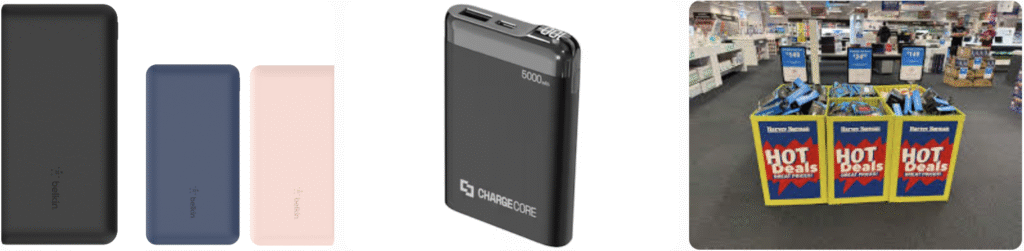
Power bank displays in Australian retail stores like JB Hi-Fi and Harvey Norman:
Australia Power Bank Market Snapshot (2025)
The Australian portable battery pack market is mature but still growing, powered by:
- Very high smartphone penetration
- Heavy mobile data use
- Demand for fast USB-C PD charging
- More devices per user (wearables, earbuds, tablets, handheld gaming)
Consumers increasingly expect a power bank to charge multiple devices quickly, be compact, and be compliant with airline travel rules.
Highly Concentrated Retail Distribution
Power banks in Australia are mainly found through:
High-end consumer electronics (CE)
- JB Hi-Fi
- The Good Guys
- Harvey Norman
- Bing Lee
Value & mass channels
- Kmart
- Big W
- Officeworks
- Woolworths / Coles
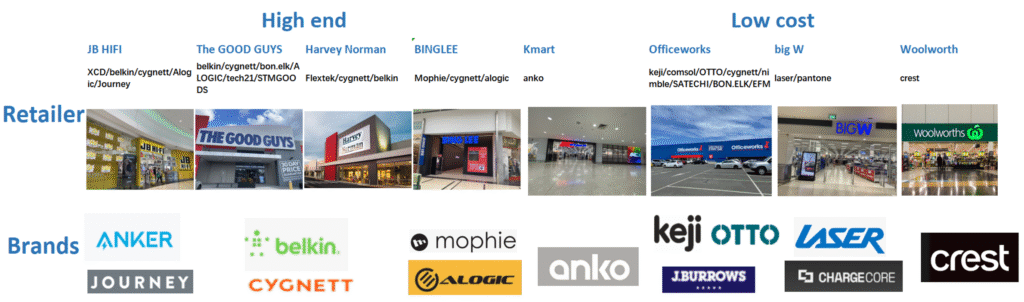
High-End vs Value Channels – How Australia Sells Power Banks
1. High-End Consumer Electronics Retailers
These stores treat power banks as part of a premium accessory ecosystem.
Key attributes:
- Fast charging (USB-C PD 20W–65W)
- Wireless & MagSafe-style
- Premium materials
- Ecosystem matching (Apple / Samsung)
Why prices are higher:
Shoppers here want trust、aesthetics、warranty、brand reputation—and are willing to pay for it.
2. Value, Mass & Grocery Channels
Kmart, Officeworks, Big W and Woolworths play a volume game:
Channel characteristics:
- Sharp, everyday low price points
- Clear “5,000 / 10,000 / 20,000 mAh” labels
- Simple packaging
- Entry–mid tier focus under A$39 (high volume)
Power banks are positioned as daily essentials & impulse buys, not tech accessories.
How We Selected the Top 10 Brands
This ranking is based on factors that matter to Australian retail buyers:
Selection Criteria
- Retail coverage & physical shelf presence
- Product range depth (compact → high-capacity PD)
- Brand reputation & reviews
- Strategic relevance for B2B buyers
- Consistency in supply chain & quality
This is an independent overview to help retailers and importers plan assortments—not a paid promotion.
⭐ Top 10 Power Bank Brands in Australia (2025)
(Optimised for SEO + structured for retailer decision-making)
1. Anker — Global Fast-Charging Leader
Anker is Australia’s most recognised global power bank specialist.
Strengths:
- Top-tier fast-charging performance
- Strong reliability record
- Broad range from compact 5k to laptop-capable models
- Premium yet accessible
For retailers:
Anker is a premium anchor brand that increases category credibility and drives trade-up.
2. Cygnett — Australia’s Local Hero
A homegrown Australian brand with deep retail penetration.
Strengths:
- Strong understanding of AU price expectations
- Modern designs (incl. magnetic wireless)
- Excellent packaging & in-store appeal
Retail role:
Perfect mid-tier anchor brand with strong value-for-money perception.
3. Belkin — Trusted Global Accessory Brand
Belkin is widely distributed through CE and telco.
Strengths:
- Slim, reliable, Apple-friendly
- Strong ecosystem accessories
- High brand trust
Retail role:
Ideal for premium CE retailers wanting a clean, professional assortment.
4. Mophie — Premium, Design-Led Power
The lifestyle brand for design-conscious consumers.
Strengths:
- Magnetic wireless power
- Beautiful finishes & compact shapes
- Apple-centric appeal
Retail role:
Excellent for premium fixtures and impulse upgrades.
5. Alogic — Professional Charging & Connectivity
Alogic straddles consumer and professional segments.
Strengths:
- High-wattage USB-C PD
- Corporate/education ready
- Strong B2B credibility
Retail role:
Perfect bridge brand between CE and IT channels.
6. Samsung — Galaxy Ecosystem Power
Samsung sells power banks tailored to Galaxy users.
Strengths:
- Fast wireless
- Multi-device compatibility
- High device trust
Retail role:
Perfect add-on at telco stores and CE retailers.
7. Laser — Australian Value Brand
Laser is a strong local player in the value/mass tier.
Strengths:
- Affordable price points
- Broad SKU coverage
- Supermarket-friendly packaging
Retail role:
A flexible value option that balances margin and reliability.
8. Anko — Kmart’s Private Label
Kmart’s private-label powerhouse.
Strengths:
- Super competitive pricing
- Clear, simple designs
- Massive national distribution
Retail role:
Textbook example of how private label wins in the entry tier.
9. Grocery & DIY Brands (Crest, ChargeCore, etc.)
Found across supermarkets, DIY and auto channels.
Strengths:
- Entry-level pricing
- High-volume impulse sales
- Simple spec structure
Retail role:
Important for covering budget shoppers and impulse purchases.
10. Online Driven Brands (Baseus, RAVPower, etc.)
Aggressive online competitors influencing expectations.
Strengths:
- Very high specifications
- Attractive pricing
- Tech-savvy following
Retail role:
Set performance benchmarks that physical retailers must consider.
How Retailers Can Build a Winning AU Power Bank Range
1. Core Capacities + Pricing Strategy
- 10,000 mAh → highest volume
- 20,000 mAh → trade-up hero
- 5,000 mAh → compact & MagSafe
- 20,000–30,000 mAh PD → premium
Key price landmarks:
- Under A$39 → mass channels
- A$49–A$99 → high-end CE
- A$99+ → premium / MagSafe / laptop PD
2. Balanced Brand Architecture
A successful retailer assortment usually contains:
- Global premium brand → credibility
- Local hero brand → relevance
- Private label → margin & price control
This mix prevents fixture overcrowding and maximises shopper coverage.
3. Safety & Compliance
AU retailers are strict on:
- Cell quality
- BMS design
- UN38.3 & transport approvals
- Incident records
Poor-quality battery cells = high returns + real safety risk.
This is where your battery expertise is a huge competitive advantage.
Why Battery Cell Strategy Still Matters
Even famous brands can suffer recalls if their internal cell quality isn’t well controlled.
Retailers should evaluate:
- Chemistry (NCM vs LFP vs LCO for compact units)
- Cell supplier tier
- Multi-protection IC
- Thermal & charging stability
- Long-term reliability
This is the “invisible part” of the product that defines 80% of safety and performance.
How Reachinno Helps Retailers Compete with Top 10 Brands
Reachinno supports B2B clients with:
- AU-tuned private-label & exclusive SKUs
- Cell/matching strategy (NCM compact SKUs, LFP outdoor SKUs)
- Fast PD architecture
- Channel-specific lineups (CE, mass, grocery)
- Strong reliability & safety control
Our goal is to help partners meet big-brand standards—at a better cost structure.
FAQ
Q1: What are the most popular power bank brands in Australia?
Anker, Cygnett, Belkin, Mophie, Alogic, Samsung, Laser, Anko, Crest/ChargeCore, Baseus/RAVPower.
Q2: Which retailers sell which brands?
CE stores → Belkin, Cygnett, Mophie
Value/grocery → Anko, Laser, Crest
Online → Baseus, RAVPower, others
Q3: How to choose safe power banks for Australia?
Check cell chemistry, test reports, protection ICs and supplier quality systems.
Q4: Should retailers build private label?
Yes—if quality is well managed. It increases margin and control.
Q5: How to compete with global brands?
Specialise your assortment + ensure top-tier engineering + partner with a reliable ODM like Reachinno.