In today’s crowded power bank market, most products look identical on the shelf. But inside the housing, everything changes.
The true difference between a high-risk, low-cost power bank and a premium, brand-safe power bank starts from one invisible component:
The battery cell — the heart of every power bank.
A weak heart means swelling, overheating, fast degradation and recall risk.
A strong heart means longevity, stability, safety and a smoother retail lifecycle.
For brands in Europe, North America and Australia, choosing the right cell chemistry, supplier tier and engineering strategy is no longer optional — it’s a strategic decision that directly impacts safety, margins and long-term sell-through.
1. Why Battery Cell Quality Defines Premium Power Bank Performance
Across countless ODM projects and industry recall cases, five performance dimensions are consistently dominated by cell quality:
1.1 Key performance factors driven directly by cells
- Safety & thermal stability (risk of swelling, venting, overheating)
- Fast-charging stability with 20–65W PD/PPS
- Usable capacity under real-world load
- Cycle life vs. warranty targets
- Shelf life (6–12 months of warehouse storage)
- Return rate & negative review rate
PCBAs and housings matter — but cannot compensate for poor-quality or mismatched cells.
2. Understanding Power Bank Cell Chemistries: LFP vs NCM vs LCO vs LMO
Different battery chemistries offer different trade-offs in size, safety, cost and lifetime.
Below is an overview tailored for retail buyers and product managers.
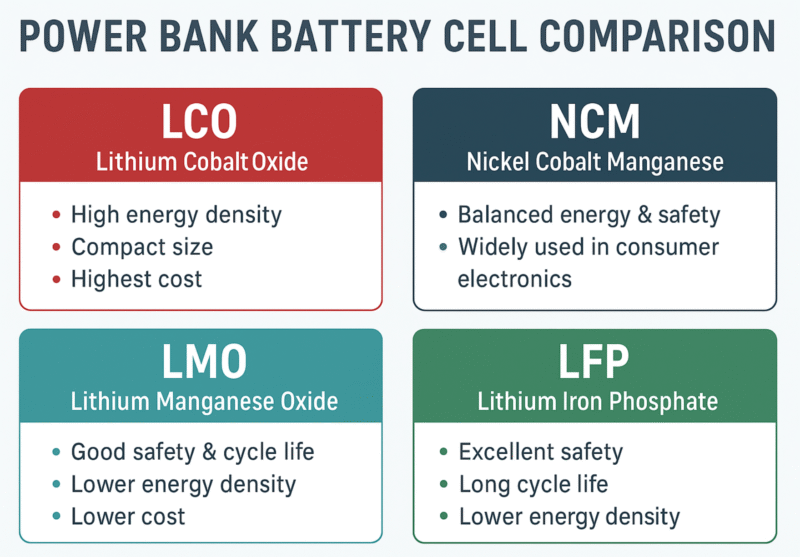
2.1 LCO – Lithium Cobalt Oxide
✔ Highest energy density
✔ Most compact size
✘ High cost
✘ Lower thermal stability
Use cases: high-end consumer electronics
Less recommended for modern power banks due to safety sensitivity.
2.2 NCM / NCA – Nickel Cobalt Manganese / Aluminum
✔ Excellent balance of density, cost, performance
✔ Ideal for everyday carry and travel power banks
✔ Supports strong fast-charging performance
✘ Higher cobalt content makes cost volatile
Use cases: mainstream power banks, smartphones, EVs
2.3 LMO – Lithium Manganese Oxide
✔ Safer & more stable than LCO
✔ Good cycle life
✘ Lower energy density
Use cases: mass-market power banks, stable low-cost packs
2.4 LFP / LFMP – Lithium Iron Phosphate
✔ Best-in-class safety
✔ Outstanding cycle life
✔ Minimal swelling
✔ Excellent thermal stability (hot climate friendly)
✘ Lower density → bigger size
Use cases: outdoor power banks, rental batteries, heavy-duty usage
Fast-rising in the power bank category globally.
3. Cobalt Market Update – Why NCM & LCO Costs Are Rising
Cobalt price fluctuations heavily influence LCO and NCM cell costs.
Recent cobalt market tightening is driven by:
3.1 DRC Export Restrictions
- DRC supplies 70%+ of global cobalt.
- Q4 2025 export quota: 18,125 tons.
- 2026–2027 quota: only 44% of annual production → massive shortage.
- Forecast global shortage in 2025: 122,000 tons.
3.2 Slow Recovery from Earlier Export Ban
- Many small mines under 60% capacity.
- Logistics delays & processing bottlenecks continue.
- Indonesia’s hydrometallurgical expansion slower than expected.
3.3 Surge in EV, drone, 3C demand
- High-nickel ternary EV batteries require 30% more cobalt.
- 3C electronics demand for LCO is up 15% YoY.
3.4 Ultra-low inventory levels
China cobalt inventory:
- Only 2,800 tons,
- Down 62% from start of the year
- Represents 10 days of demand
3.5 Capital inflow amplifies volatility
Pre-buying + futures investments = accelerating price spikes.
4. How Premium Power Banks Are Built: Cell Selection, Matching & Engineering
4.1 Tier-1 vs Tier-2 Cell Suppliers
Tier-1 = tighter tolerance, lower IR variance, better safety documentation
Tier-2 = cheaper, but with unstable IR/voltage/cycle behavior → higher swell/overheat/return risk
Retail rules in EU/US/AU strongly favor Tier-1 or vetted Tier-1.5.
4.2 Internal Resistance & Cell Matching
Fast-charging (20–65W) requires low and consistent IR.
Poor matching causes:
- overheating
- early shutdown
- imbalance swelling
- accelerated capacity decay
Premium factories implement:
- Strict IR/capacity matching
- Full batch traceability
- Multi-lot validation
Cheap assemblers skip this — risk is transferred to brands.
4.3 Engineering Validation System
Premium ODMs run:
Accelerated aging & cycle tests
- Early-life failure detection
- Real and extreme conditions
Thermal & mechanical reliability
- High/low temp storage
- Vibration & drop test
- Thermal runaway resistance
Fast-charging stability testing
- 20–65W PD/PPS
- Temperature vs. efficiency
- Adapter compatibility matrix
Outcome of a robust engineering system:
- Longer cycle life matching warranty windows
- Extremely low swelling rate
- Stable charging behavior across real user scenarios
5. Practical Cell Strategy for Your Next Power Bank Line
This framework helps brands avoid late redesigns or certification failures.
5.1 Step 1 — Define cell standard early
- Choose chemistry based on usage
- NCM → compact everyday models
- LFP → outdoor, rental, hot climate
- Require Tier-1/Tier-1.5 cell sources
- Align test requirements to strictest retail market
5.2 Step 2 — Match capacity to regulations & real usage
Mainstream recommendation
- 10,000–20,000 mAh → Europe, US, AU
Airline friendly, perfect for daily devices.
Growth segments
- 20,000–30,000 mAh → outdoor, multi-device, pro users
Airline rules:
- <100 Wh allowed in carry-on
(All consumer power banks fall under UN3480)
5.3 Step 3 — Prioritize fast-charging stability
Don’t chase “65 W” marketing numbers.
Brands should evaluate:
- Continuous output
- Temperature curve
- Compatibility
- Performance after 200–300 cycles
Stable fast-charging saves:
- Return rates
- Customer support cost
- 1-star reviews
- Retail delisting risk
6. Recommended SKU Concepts for EU / AU / US Markets
6.1 EU Travel Hero SKU
Characteristics:
- Chemistry: NCM
- Capacity: 10,000–20,000 mAh
- Output: 20–30W PD
- Slim, airline-friendly
- Strong CE/UKCA compliance focus
Why: Europeans prefer compact travel-friendly devices with strong safety credentials.
6.2 AU Outdoor Flagship SKU
Characteristics:
- Chemistry: LFP / LFMP
- Capacity: 20,000–30,000 mAh
- Output: 30–65W PD
- Rugged, hot-climate optimized
- Reinforced ports, IP-rated structure
Why: Outdoor culture + high temperature = ideal for LFP.
6.3 US Value Segment SKU
Characteristics:
- Chemistry: NCM (vetted Tier-1/T1.5)
- Capacity: 10,000–15,000 mAh
- Output: 20–30W PD
- Low return rate → critical for mass retail
- Robust thermal/protection IC design
Why: Price-sensitive market but increasingly strict about overheating recalls.
7. Checklist for Retail Buyers: How to Choose a Safe Power Bank
Ask suppliers:
- What chemistry is used and why?
- Which cell suppliers? Tier level?
- How are cells matched (IR/voltage/capacity)?
- Full certification package for EU/US/AU?
- Swell/overheat/return statistics?
- Fast-charging behavior after 200+ cycles?
- Traceability from raw cell to pack?
Suppliers who can answer transparently = real quality system.
8. Reachinno’s OEM / ODM Power Bank Quality System
A premium ODM partner should provide:
Cell Control
- Supplier qualification
- Batch validation
- IR/capacity matching
- Traceability
Engineering Tests
- Cycle & aging
- High/low temp storage
- Drop & vibration
- Fast-charging PD/PPS matrix
- Thermal design verification
Outcome
Power banks that remain safe, stable and low-return throughout their retail lifecycle — not just in lab conditions.
9. FAQ: LFP vs NCM & Safe Power Bank Selection
Q1: Is LFP safer than NCM?
Yes — LFP offers superior thermal stability.
But high-grade NCM with strong protection design is equally safe for compact SKUs.
Q2: What capacity is best for EU/US/AU?
10,000–20,000 mAh dominates daily/travel use.
20,000–30,000 mAh is growing quickly for outdoor/pro-use.
Q3: Does fast charging shorten battery life?
High power increases stress.
Use low-IR cells + strong thermal design → stable performance over lifecycle.
Q4: Are all power banks UN3480?
Yes — all lithium-ion power banks are shipped as UN3480 Class 9 Dangerous Goods.
Airline carry-on limit: under 100 Wh.