Introduction
Semi-solid batteries are increasingly promoted as the next evolution in lithium battery technology.
Higher safety.
Higher energy density.
Longer cycle life.
But when applied to consumer electronics — especially wireless power banks — do semi-solid cells represent a real engineering upgrade, or simply a marketing narrative?
This article examines the technical reality behind semi-solid battery adoption in portable power devices.
What Changes in a Semi-Solid Battery?
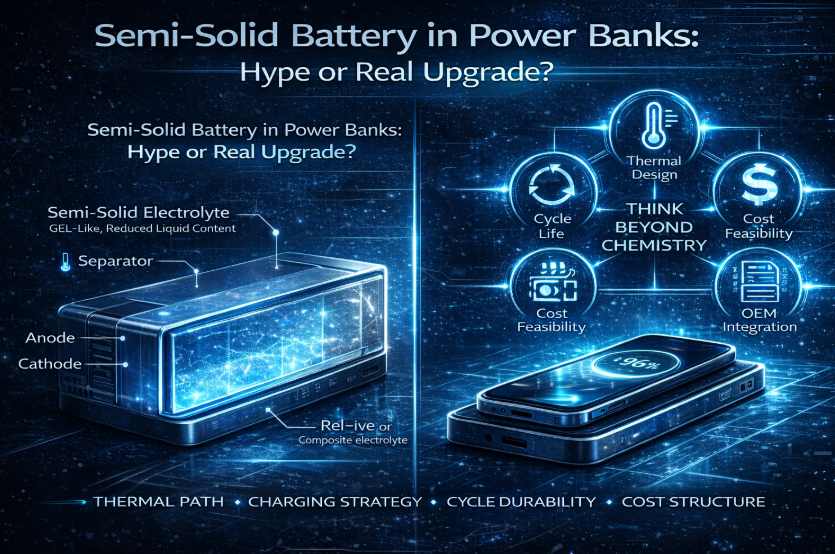
Traditional lithium-ion cells use liquid electrolytes.
Solid-state batteries replace them with fully solid electrolytes.
Semi-solid batteries sit between these two extremes:
- Reduced liquid electrolyte content
- Gel-like or composite electrolyte systems
- Modified separator and cathode structures
The goal is to improve stability without completely redesigning manufacturing infrastructure.
This hybrid approach makes semi-solid more commercially accessible than full solid-state.
Claimed Advantages in Consumer Devices
Manufacturers typically highlight:
- Improved thermal stability
- Reduced leakage risk
- Higher energy density
- Enhanced structural robustness
However, performance depends heavily on system integration, not just cell chemistry.
In portable power banks, the real question is:
How does semi-solid behave under wireless charging heat and compact mechanical constraints?
Thermal Stability — Material vs System
Semi-solid electrolytes can offer better resistance to thermal runaway propagation.
But wireless power banks generate heat from:
- Inductive charging inefficiency
- Continuous magnetic attachment
- High state-of-charge top-up behavior
If system-level thermal path design remains unchanged,
cell-level improvements may not fully translate into device-level reliability.
Thermal management still determines real-world performance.
Energy Density vs Safety Trade-offs
Higher energy density often increases:
- Thermal sensitivity
- Structural stress
- Manufacturing complexity
Semi-solid cells may allow moderate density gains without extreme volatility,
but safety margins remain dependent on:
- BMS strategy
- Charging profile
- Mechanical compression design
Energy density gains do not automatically equal safer products.
Cycle Life Reality
Marketing claims often highlight extended cycle life.
However, real-world aging in power banks is influenced by:
- High SOC exposure
- Elevated internal temperature
- Continuous attachment behavior
- Irregular charging patterns
Without optimized charging control and thermal path integration,
semi-solid chemistry alone will not prevent degradation.
Cost & Supply Chain Constraints
Semi-solid batteries:
- Require modified production lines
- Have limited large-scale consumer electronics adoption
- Currently carry cost premiums
For OEMs, adoption must balance:
- Brand positioning
- Target market sensitivity
- Product price tier
Technology readiness does not always align with commercial feasibility.
When Does It Make Sense for Power Banks?
Semi-solid cells may be appropriate when:
- Targeting premium flagship products
- Thermal risk tolerance must be minimized
- Brand positioning emphasizes innovation
- Volume is moderate and margins allow flexibility
For entry-level or cost-driven SKUs,
conventional high-quality lithium-ion may remain more rational.
Conclusion
Semi-solid battery technology is neither pure hype nor automatic upgrade.
It is a material-level advancement that must be evaluated through:
- System thermal design
- Charging strategy
- Mechanical structure
- Cost structure
Only when integrated thoughtfully into the full product system
does it become a meaningful innovation.