A Practical Guide to Capacity, Output Power, Runtime, Weight, Temperature, Solar Charging and Outdoor Use
Camping changes the way you think about portable power.
At home, you can plug almost anything into a wall outlet. Outdoors, every watt-hour matters.
Your phone may be your camera, GPS, emergency communication device and navigation tool at the same time. A smartwatch may track your route. A camera may need several battery recharges. A portable light may need to run through the night.
For a short weekend trip, a compact power bank may be enough.
For multi-day hiking, remote camping, winter travel or emergency use, however, choosing the right portable power solution becomes an engineering decision.
The question is no longer simply:
“How many mAh do I need?”
A better question is:
“How much usable energy do I need, at what power, under what environmental conditions, for how long?”
This guide explains how to choose a power bank for camping based on the factors that actually determine outdoor performance.
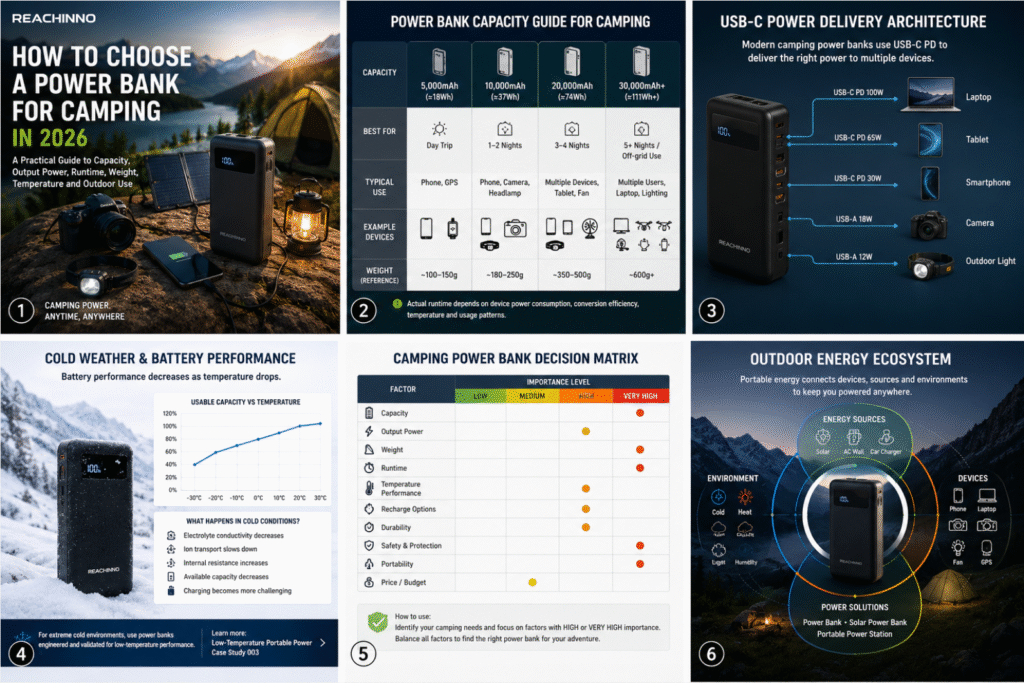
At a Glance
For most weekend camping trips, a 10,000–20,000mAh USB-C power bank is a practical starting point.
However, capacity alone does not determine whether a power bank is suitable for outdoor use.
You should also consider:
- Energy capacity
- Output power
- Number of devices
- Expected runtime
- Weight
- Operating temperature
- Recharge method
- Weather exposure
- Battery chemistry
- Safety and transportation requirements
For longer trips or off-grid applications, a 20,000mAh+ power bank, solar charging solution or portable power station may be more appropriate.
The right choice depends on the entire application rather than a single specification which detailed reference 2026 Portable Power Industry Report.
1. Start With Your Camping Energy Needs
Before choosing a power bank, list the devices you actually need to keep running.
This sounds obvious, but it is one of the most common mistakes in portable power selection.
People often start with capacity:
“I want a 20,000mAh power bank.”
A better approach starts with the devices.
What Will You Power?
A typical camping setup may include:
- Smartphone
- GPS or navigation device
- Smartwatch
- Headlamp
- Camera
- Action camera
- Drone
- Bluetooth speaker
- Portable light
- Small fan
- Tablet
- Laptop
- Emergency communication equipment
Each device creates a different energy requirement.
A smartphone may only need occasional charging.
A laptop can require substantially more power.
A drone or professional camera system may require several battery recharges during a single day.
A portable light may consume less power but operate continuously for many hours.
That means two campers can have completely different power requirements even if both are going outdoors for the same number of days.
How Many Devices Will You Charge?
The number of devices is one of the first variables to consider.
One smartphone
A compact 5,000–10,000mAh power bank may be sufficient for a short trip.
Smartphone + smartwatch + camera
A 10,000–20,000mAh power bank is usually a more practical starting point.
Multiple phones + cameras + lighting
A 20,000mAh or larger solution may be more appropriate.
Laptop + multiple devices
Capacity is only one part of the decision.
You also need sufficient USB-C PD output power.
A high-capacity power bank with insufficient output power may store plenty of energy but still fail to meet the needs of the connected device.
2. How Much Power Bank Capacity Do You Need for Camping?
Capacity is normally expressed in milliamp-hours, or mAh.
Common portable power bank capacities include:
- 5,000mAh
- 10,000mAh
- 20,000mAh
- 27,000mAh
- 30,000mAh and above
But mAh alone can be misleading.
Battery capacity should be evaluated together with voltage and usable energy.
For engineering and procurement decisions, watt-hours (Wh) provide a more meaningful way to compare energy storage.
A typical lithium-ion battery system operates around 3.7V nominally.
Therefore:
10,000mAh × 3.7V ≈ 37Wh
and:
20,000mAh × 3.7V ≈ 74Wh
These are nominal battery energy values, not the exact amount of energy that will reach your devices.
Energy is lost during voltage conversion, charging and heat generation.
Power Bank Capacity Guide for Camping
| Camping Duration | Typical Use | Recommended Starting Point |
|---|---|---|
| Day trip | Phone + GPS | 5,000–10,000mAh |
| 1–2 nights | Phone + camera | 10,000–20,000mAh |
| 3–4 nights | Multiple devices | 20,000–30,000mAh |
| 5+ nights | Multiple users/devices | 30,000mAh+ |
| Off-grid use | Lighting / equipment | Consider a portable power station |
These are practical starting ranges, not universal specifications.
Actual requirements depend on:
- Device battery size
- Daily usage
- Charging frequency
- Conversion efficiency
- Ambient temperature
- Number of users
- Reserve energy requirements
For more detail on capacity selection, see our guide to power bank capacity and the differences between 10,000mAh, 20,000mAh and larger configurations.
3. Capacity Is Not the Same as Usable Energy
This distinction is important.
A power bank may be advertised as 20,000mAh, but your connected devices do not receive 20,000mAh directly.
The battery operates at one voltage.
Your smartphone, laptop or other device may require another voltage.
The power bank therefore needs a power conversion system.
During this process, some energy is lost.
The actual usable energy depends on:
- Cell characteristics
- Battery voltage
- DC-DC conversion efficiency
- PCB design
- Charging protocol
- Cable resistance
- Thermal conditions
- Battery age
- Operating temperature
This is why two power banks with the same nominal capacity can provide different real-world runtimes.
Engineering takeaway
Nominal capacity tells you how much energy is stored. It does not tell you how efficiently that energy will be delivered.
This distinction becomes even more important in demanding outdoor environments.
4. Check Output Power, Not Just Capacity
Capacity answers:
How much energy can the battery store?
Output power answers:
How quickly can the battery deliver that energy?
These are different questions.
A 20,000mAh power bank may have plenty of energy but still be unsuitable for a laptop if its output is limited to a low charging power.
For modern outdoor users, USB-C Power Delivery has become particularly important.
20W Power Banks
Around 20W is suitable for many smartphones and smaller mobile devices.
Typical applications include:
- Smartphones
- Wireless earbuds
- Smartwatches
- Small GPS devices
- Compact accessories
For lightweight hiking or day trips, 20W can be a good balance between size and performance.
30W–65W Power Banks
Higher output becomes useful when charging:
- Tablets
- Cameras
- Handheld gaming devices
- Larger smartphones
- Some laptops
- Multiple mobile devices
A 30W–65W system is often a practical middle ground for travelers and outdoor users who want more flexibility without moving to a much larger power station.
100W and Above
High-power USB-C PD systems are designed for more demanding applications.
Examples include:
- Professional laptops
- Mobile workstations
- High-performance tablets
- Creator equipment
- Larger USB-C devices
However, higher wattage also creates additional engineering requirements.
Higher power means greater thermal stress.
It can require more advanced:
- Power conversion
- PCB design
- MOSFET selection
- Thermal management
- Battery configuration
- BMS protection
- Firmware control
This is why a 140W power bank should not simply be viewed as a 100W product with a bigger number.
For a deeper look at high-power portable charging, see our guide to 100W vs. 140W power banks.
5. Weight Matters More When You Are Hiking
A power bank is portable energy.
That means weight is part of the product specification.
For car camping, an additional 100–200 grams may not matter much.
For hiking, backpacking or cycling, it can matter significantly.
Consider the difference between carrying:
- One compact 10,000mAh power bank
- One heavy 30,000mAh power bank
- A power bank plus solar panel
- A full portable power station
The largest battery is not automatically the best solution.
The goal is to find the best balance between:
Energy × Runtime × Weight × Power
Backpacking vs. Car Camping
Backpacking
Prioritize:
- Low weight
- Compact dimensions
- Sufficient capacity
- Efficient USB-C charging
- Ruggedness
A 10,000–20,000mAh solution may be more practical than a very large battery.
Car Camping
Weight becomes less important.
You may prefer:
- Higher capacity
- Multiple outputs
- AC output
- Solar charging
- Larger lighting systems
- Portable refrigeration
- Small appliances
In this situation, a portable power station may make more sense than a conventional power bank.
6. Cold Weather Can Change Battery Performance
Temperature is one of the most overlooked factors when choosing portable power for outdoor use.
Lithium-ion batteries do not behave the same way at room temperature and in freezing conditions.
At low temperatures:
- Electrolyte conductivity decreases
- Ion transport becomes slower
- Internal resistance increases
- Voltage sag becomes more significant
- Available capacity can decrease
- Charging becomes more challenging
For normal camping, this may simply mean shorter runtime.
For winter camping, alpine activities or extreme outdoor applications, low-temperature performance can become a system-level engineering requirement.
Why Cold Weather Reduces Battery Performance
A lithium-ion battery depends on the movement of lithium ions through the electrolyte and electrode materials.
When temperature decreases, this movement becomes less efficient.
The result can be increased polarization and internal resistance.
The battery may still contain significant stored energy.
However, the system may not be able to deliver that energy efficiently under load.
This creates an important distinction:
Stored energy ≠ immediately usable energy under every environmental condition.
For a normal consumer power bank, this may not become obvious until temperatures fall significantly below freezing.
For a product designed specifically for harsh outdoor conditions, however, temperature must be considered from the beginning of the cell and system design.
Can You Charge a Power Bank in Freezing Temperatures?
This requires more caution than simply asking whether the battery can discharge.
Low-temperature charging can create different risks from low-temperature discharging.
Depending on cell chemistry and temperature, lithium-ion batteries may experience lithium plating during charging at sufficiently low temperatures.
Therefore, a product designed for cold environments may need:
- Temperature sensing
- Charging restrictions
- BMS protection
- Controlled charging current
- Cell selection
- Thermal management
- Environmental validation
The exact operating limits depend on the selected cell and system design.
Do not assume that a power bank rated for cold-weather discharge can automatically be safely charged under the same conditions.
Reachinno Engineering Case: Portable Power at Approximately −30°C to −40°C
Reachinno has developed an outdoor portable power solution for a low-temperature application involving outdoor lighting.
The product uses a 7,500mAh battery system and was designed for extended outdoor operation.
Under the target application conditions, the solution achieved approximately 22 days of operating time for the connected outdoor lighting system.
The project demonstrates an important engineering principle:
Extreme-temperature portable power cannot be solved by increasing battery capacity alone.
The battery, BMS, PCB, output architecture and application load must be considered as one system.
Read the complete Low-Temperature Portable Power Case Study 003 for the engineering background and solution approach.
7. Should You Choose Solar Charging?
Solar charging can be useful for long-duration outdoor applications.
But it is important to understand what solar charging actually provides.
A solar panel does not simply “make a power bank last forever.”
Its real output depends on:
- Solar irradiance
- Panel efficiency
- Panel size
- Orientation
- Weather
- Temperature
- Shading
- Charging controller efficiency
- Time available for charging
A small foldable solar panel may be useful for maintaining a small power bank during a multi-day trip.
It may not provide enough energy to continuously operate a high-power laptop or large appliance.
When Solar Makes Sense
Solar charging becomes more attractive when:
- You stay outdoors for several days
- Grid power is unavailable
- Weight can be managed
- Daylight is reliable
- Your energy demand is relatively low
- Emergency backup is important
Typical applications include:
- Long-distance hiking
- Remote camping
- Emergency preparedness
- Disaster response
- Outdoor events
- Remote work
- Field operations
Solar + Battery Is a System
The best way to think about solar portable power is not:
Solar panel + battery
but:
Energy source → charge controller → battery → BMS → power conversion → connected load
This is a small energy ecosystem.
The battery stores energy.
The solar panel generates energy.
The power electronics manage energy.
The BMS protects the battery.
The output stage delivers usable power to the device.
That system perspective becomes increasingly important as outdoor applications become more demanding.
8. Choose the Power Solution for the Camping Scenario
There is no single “best camping power bank.”
The right solution depends on the scenario.
Weekend Camping
Typical requirements:
- Smartphone
- GPS
- Camera
- Headlamp
- Small speaker
Recommended direction:
10,000–20,000mAh
Prioritize:
- USB-C PD
- Compact size
- Moderate weight
- Fast recharge
- Multiple outputs
For most users, there is little benefit in carrying an extremely large battery for a one- or two-night trip.
Backpacking and Hiking
Weight becomes a primary consideration.
A practical configuration may include:
- 10,000–20,000mAh power bank
- USB-C PD
- Short charging cables
- Low standby consumption
- Weather-resistant design
The goal is not maximum capacity.
The goal is maximum useful energy per gram.
Family Camping
Family camping usually involves more devices.
You may need to charge:
- Multiple smartphones
- Tablets
- Cameras
- Portable lights
- Fans
- Speakers
In this situation, 20,000mAh or more may be appropriate.
Multiple outputs can also reduce the need for several separate power banks.
Long-Duration Camping
For trips lasting several days or longer, the energy source becomes just as important as the battery capacity.
Consider:
- Larger battery capacity
- Solar charging
- Vehicle charging
- Multiple power banks
- Portable power stations
- Energy consumption management
The best solution may be a hybrid system rather than one oversized power bank.
Winter Camping
Cold-weather camping adds another design variable.
You should evaluate:
- Battery chemistry
- Cell specification
- Low-temperature discharge performance
- Charging temperature
- BMS behavior
- Thermal management
- Actual environmental testing
A product that performs well at 20°C should not automatically be assumed to perform equally well at −10°C or below.
Emergency and Disaster Preparedness
Emergency power is different from recreational camping.
The product may need to remain stored for long periods and operate when infrastructure is unavailable.
Important factors include:
- Shelf life
- Self-discharge
- Battery safety
- Storage temperature
- Reliability
- Lighting support
- Communication device charging
- Solar compatibility
- Ruggedness
For disaster response, reliability can be more important than maximum charging speed.
9. Camping Power Bank Decision Matrix
The following matrix provides a practical starting point.
| Requirement | Recommended Direction |
|---|---|
| Lightweight hiking | 5,000–10,000mAh |
| Weekend camping | 10,000–20,000mAh |
| Multiple devices | 20,000mAh+ |
| Laptop charging | 65W+ USB-C PD |
| Camera equipment | High-output USB-C |
| Cold environments | Low-temperature engineered battery system |
| Long off-grid trips | Solar + battery or portable power station |
| Emergency use | Reliability + long shelf life |
| Family camping | High capacity + multiple outputs |
| Remote work | 65W–140W USB-C PD depending on laptop |
This matrix should be treated as a starting point.
Actual product requirements should be calculated from the connected load and operating environment.
10. Don’t Choose a Camping Power Bank by mAh Alone
This is perhaps the most important takeaway from this guide.
A higher mAh rating does not automatically mean a better camping power solution.
Two products with the same nominal capacity can behave differently because of:
- Battery chemistry
- Cell quality
- Cell configuration
- Internal resistance
- Conversion efficiency
- PCB architecture
- BMS design
- Thermal management
- Charging protocol
- Operating temperature
For example, a high-capacity power bank may be heavier and slower to recharge.
A smaller power bank may provide better portability and sufficient energy for a short trip.
The correct question is not:
“Which one has the largest capacity?”
It is:
“Which architecture provides enough usable energy for my application with acceptable weight, power, runtime and environmental performance?”
11. A Practical Energy Calculation for a Weekend Camping Trip
Let’s consider a simple example.
Suppose a camper takes:
- Smartphone
- GPS device
- Camera
- Smartwatch
The trip lasts two days.
Instead of starting with a 20,000mAh specification, estimate daily energy demand first.
For example:
Smartphone
Assume one full battery equivalent per day.
GPS
Assume moderate daily use.
Camera
Assume one or more battery recharges depending on shooting behavior.
Smartwatch
Usually a relatively small energy requirement.
Now add:
- Daily energy consumption
- Charging conversion losses
- Temperature margin
- Reserve capacity
The resulting requirement can then be converted into a suitable battery capacity.
This method is more reliable than selecting capacity based only on trip duration.
Add a Reserve
Outdoor use is less predictable than indoor use.
You may use your phone more than expected.
You may take more photographs.
You may become delayed.
You may need additional navigation.
You may lose access to a planned charging point.
For this reason, a practical outdoor design should include an energy reserve.
The exact reserve depends on the application.
For critical applications, the reserve may be substantially larger than for casual recreational use.
12. What Output Ports Should a Camping Power Bank Have?
USB-C has become the most important interface for modern portable power.
A typical outdoor product may include:
USB-C
Useful for:
- Smartphones
- Tablets
- Laptops
- Cameras
- Gaming devices
- Other USB-C electronics
USB-A
Still useful for:
- Legacy cables
- Older accessories
- Lighting products
- Small electronics
Wireless Charging
Wireless charging can be convenient for compatible smartphones.
However, wireless charging typically introduces additional conversion and thermal considerations.
For outdoor applications, wired USB-C charging may still provide better efficiency and flexibility.
13. What Makes an Outdoor Power Bank Different From a Normal Power Bank?
A normal consumer power bank may be designed primarily for:
- Indoor use
- Travel
- Office use
- Daily smartphone charging
Outdoor products may face additional conditions.
These can include:
- Dust
- Rain
- Humidity
- Shock
- Vibration
- High temperature
- Low temperature
- Long periods without charging
Therefore, an outdoor power bank may require different engineering priorities.
Normal Consumer Power Bank
Focus:
- Size
- Weight
- Cost
- Charging speed
- Industrial design
Outdoor Power Product
Focus:
- Environmental durability
- Temperature performance
- Battery protection
- Mechanical robustness
- Runtime
- Reliability
- Recharge flexibility
Extreme Outdoor Power System
Focus:
- Environmental validation
- Battery chemistry
- Thermal design
- BMS behavior
- System architecture
- Load profile
- Fault protection
- Field reliability
The farther a product moves from normal consumer use, the more important system-level engineering becomes.
14. Battery Chemistry Matters
Most portable power products still rely on lithium-ion technology because it provides a strong balance of:
- Energy density
- Weight
- Cost
- Manufacturing maturity
- Power capability
However, different applications may benefit from different battery technologies.
Potential options include:
- Conventional lithium-ion
- Lithium iron phosphate (LFP)
- High-energy-density lithium-ion
- Semi-solid-state batteries
- Emerging solid-state technologies
There is no universally “best” chemistry.
Battery selection should be based on the application.
For example:
| Requirement | Key Battery Consideration |
|---|---|
| Lightweight hiking | Energy density |
| High safety | Chemistry + cell construction |
| Long cycle life | Cell chemistry + operating conditions |
| Extreme temperature | Low-temperature cell performance |
| High power | Internal resistance + C-rate |
| Premium compact design | Energy density |
| Cost-sensitive product | Cell availability + manufacturing maturity |
This is why battery selection should happen early in product development.
It should not be treated as a component purchasing decision at the end of the project.
15. Outdoor Portable Power Is a System, Not a Battery
A portable power product contains much more than a battery cell.
A typical system includes:
Cell → Battery Pack → BMS → Power Management → PCB → Output Interface → Connected Device
Each stage influences the final user experience.
For example:
A high-quality cell cannot compensate for poor thermal management.
A powerful battery cannot compensate for an inefficient power conversion system.
A good PCB cannot compensate for an unsuitable cell.
A large capacity cannot compensate for an incorrect application design.
This is why professional outdoor power development requires system-level engineering.
16. The Reachinno Outdoor Energy Ecosystem™
Choosing a camping power bank is part of a broader outdoor energy problem.
Reachinno’s Outdoor Energy Ecosystem™ framework — documented in our Reachinno Outdoor Energy Ecosystem™ article — evaluates portable power through several interconnected dimensions:
Energy
How much energy does the application require?
Environment
What temperature, humidity, dust, water and mechanical conditions will the product face?
Runtime
How long must the system operate before recharging?
Weight
How portable must the system be?
Power
What output power and interfaces are required?
Recharge
How will the battery be recharged?
Safety
What battery protection, certification and transportation requirements apply?
These seven dimensions should be considered together.
A product that performs well in six dimensions may still fail if the seventh is ignored.
For example:
A very lightweight power bank may not provide enough runtime.
A high-capacity power bank may be too heavy for backpacking.
A high-power product may generate too much heat.
A solar solution may not work reliably under poor weather conditions.
A battery designed for normal temperatures may not meet extreme cold requirements.
This is why outdoor portable power should be treated as an engineering system rather than a capacity specification.
17. A Simple Outdoor Power Selection Framework
Before choosing or developing a product, ask seven questions.
Question 1: What are you powering?
Phone?
Camera?
Laptop?
Lighting?
Medical equipment?
Industrial electronics?
Question 2: How long must it operate?
Hours?
One day?
Several days?
Several weeks?
Question 3: Where will it operate?
Indoor?
Camping?
Desert?
Mountain?
Winter?
Tropical climate?
Question 4: How much weight can you carry?
Pocket?
Backpack?
Vehicle?
Fixed outdoor installation?
Question 5: How much output power is required?
5W?
20W?
65W?
100W?
140W?
Higher?
Question 6: How will it recharge?
Wall charger?
USB-C?
Vehicle?
Solar?
Multiple energy sources?
Question 7: What happens if the power fails?
Is it inconvenient?
Or is it critical?
The answers determine the appropriate product architecture.
18. Common Mistakes When Choosing a Camping Power Bank
Mistake 1: Choosing the Largest Capacity
More capacity means more energy.
It also usually means more weight, larger dimensions and longer recharge time.
Mistake 2: Ignoring Output Power
A large battery with low output power may not charge a laptop effectively.
Mistake 3: Ignoring Temperature
A product that performs well at room temperature may behave differently in freezing conditions.
Mistake 4: Assuming Solar Means Unlimited Energy
Solar output depends on sunlight, panel size, orientation and weather.
Mistake 5: Looking Only at the Cell
Cell quality is critical, but system architecture matters too.
BMS, PCB, thermal design and power conversion all affect performance.
Mistake 6: Ignoring Recharge Time
A large power bank can take many hours to recharge.
For short trips, this may be acceptable.
For frequent outdoor use, recharge speed can be just as important as capacity.
Mistake 7: Forgetting the Energy Reserve
Outdoor plans rarely go exactly as expected.
Always consider a practical reserve for unexpected usage.
19. Camping Power Bank vs. Portable Power Station
These products are related but serve different purposes.
| Feature | Camping Power Bank | Portable Power Station |
|---|---|---|
| Portability | Very high | Moderate |
| Typical capacity | Lower | Higher |
| Weight | Low | Higher |
| USB-C | Common | Common |
| AC output | Usually unavailable | Common |
| Solar input | Some models | Common |
| Laptop charging | Selected models | Common |
| Small appliances | Limited | Better suited |
| Backpacking | Excellent | Usually impractical |
| Car camping | Good | Excellent |
| Emergency backup | Limited | Stronger |
For backpacking, a power bank is usually the more practical solution.
For vehicle camping, emergency backup or extended off-grid use, a portable power station may be more appropriate.
20. Designing Portable Power for Outdoor Brands
For brands developing their own outdoor power products, the selection process is different from choosing a consumer product.
The engineering team should define the application first.
A professional product requirement document should consider:
Battery
- Chemistry
- Cell format
- Capacity
- Voltage
- C-rate
- Internal resistance
- Cycle life
- Temperature range
Power System
- Input power
- Output power
- USB-C PD
- USB-A
- DC output
- Wireless charging
- AC output where required
Protection
- Overcharge
- Over-discharge
- Over-current
- Short circuit
- Over-temperature
- Under-temperature
- Abnormal operation
Mechanical
- Housing
- Impact resistance
- Water resistance
- Dust protection
- Thermal dissipation
- Port protection
Environmental
- Low-temperature operation
- High-temperature operation
- Humidity
- Vibration
- Drop testing
- Storage conditions
Compliance
Depending on the market and application, requirements may include:
- UN38.3
- IEC-related battery requirements
- UL requirements
- CE-related requirements
- FCC
- CCC
- Transportation requirements
- Market-specific environmental obligations
Compliance should be considered during design rather than added after engineering is complete.
21. Why Outdoor Portable Power Is Becoming a Broader Product Category
Outdoor portable power is no longer limited to camping.
The same engineering principles are being applied to:
- Hiking
- Cycling
- Outdoor photography
- Remote work
- Outdoor lighting
- Emergency preparedness
- Disaster response
- Travel
- Field operations
- Remote monitoring
- Industrial IoT
- Small outdoor appliances
The common requirement is simple:
Reliable energy when conventional infrastructure is unavailable or inconvenient.
That is what connects these seemingly different applications.
22. From Camping Product to Outdoor Energy Ecosystem
A mature outdoor power product strategy should not begin with:
“What power bank should we manufacture?”
It should begin with:
“What energy problem are we solving?”
For example:
Problem
A hiker needs reliable smartphone and GPS power for four days.
Solution
Lightweight 10,000–20,000mAh USB-C PD power bank.
Problem
A family needs to power multiple devices during a weekend camping trip.
Solution
Higher-capacity multi-output portable power system.
Problem
A remote outdoor team needs continuous lighting for several days.
Solution
Battery + solar recharge + efficient lighting architecture.
Problem
An outdoor device must operate in extreme cold.
Solution
Application-specific battery, BMS and power architecture validated for the target temperature range.
The product follows the problem.
Not the other way around.
23. What Should You Look for in an Outdoor Power Development Partner?
If you are a brand, retailer or distributor developing an outdoor portable power product, do not evaluate a supplier only by factory size or unit price.
Ask whether the partner can support the entire engineering chain.
Battery Engineering
Can they select the right cell for the application?
Power Electronics
Can they design the required charging and output architecture?
Thermal Management
Can they control heat under high load?
Environmental Validation
Can they test the actual operating temperature and environmental conditions?
Mechanical Engineering
Can the housing withstand the intended outdoor use?
Compliance
Can certification requirements be considered from the beginning?
Supply Chain
Can critical cells and components remain available throughout production?
Mass Production
Can the engineering solution be transferred reliably into production?
The strongest outdoor power development partners are not simply manufacturers.
They are engineering partners.
24. Reachinno’s Approach to Outdoor Portable Power
Reachinno approaches portable power as a product development and engineering problem rather than a simple capacity competition.
Our team has been involved in portable power development since around 2010, covering:
- Battery systems
- Power banks
- USB-C PD
- High-power charging
- Wireless charging
- Outdoor power products
- Battery management
- Product engineering
- OEM / ODM development
Our current product portfolio also includes outdoor products, portable power banks and higher-power charging solutions.
The objective is not simply to make a battery larger.
It is to develop a product that performs reliably under its intended conditions.
That may mean:
- Optimizing cell selection
- Adjusting capacity
- Improving power conversion
- Redesigning thermal paths
- Adding environmental protection
- Developing a more suitable BMS strategy
- Validating performance at the actual operating temperature
- Designing around the target certification requirements
This engineering-first approach becomes especially important when the product is intended for demanding outdoor environments.
25. FAQ: Power Banks for Camping
What size power bank is best for camping?
For most weekend camping trips, a 10,000–20,000mAh power bank is a practical starting point. Longer trips, multiple users or higher-power devices may require 20,000mAh or more. The correct capacity depends on actual device consumption, trip duration, conversion efficiency and environmental conditions.
Is 10,000mAh enough for camping?
It can be enough for a short trip involving one smartphone, GPS device and small accessories. For multiple devices or multi-day camping, 20,000mAh or more may provide a more comfortable energy reserve.
Is 20,000mAh too heavy for hiking?
Not necessarily. A 20,000mAh power bank can be practical for many hiking trips, but weight should be compared with the actual energy requirement. If your trip is short and device usage is low, a smaller battery may provide a better energy-to-weight ratio.
What wattage should a camping power bank have?
Around 20W is suitable for many smartphones. 30W–65W provides more flexibility for tablets, cameras and some laptops. High-power laptops may require 100W or more. The correct output depends on the connected device rather than capacity alone.
Can I use a power bank in freezing temperatures?
Some power banks can operate in cold temperatures, but performance generally decreases as temperature falls. Low-temperature discharge and low-temperature charging are different conditions and should be evaluated separately. For extreme cold, use a product specifically engineered and validated for the intended temperature range.
Can I charge a power bank with solar panels?
Yes, if the power bank or charging system supports solar input. However, actual charging performance depends on sunlight, panel size, efficiency, orientation, weather and the charging controller. Solar charging is particularly useful for multi-day or off-grid applications.
What is the difference between a camping power bank and a portable power station?
A camping power bank is smaller, lighter and generally designed for USB-powered electronics. A portable power station stores more energy and may provide AC, DC and USB outputs for larger equipment. Power banks are better suited to backpacking, while power stations are often better for car camping, emergency backup and extended off-grid use.
Does a higher mAh rating always mean better performance?
No.
Capacity is only one parameter.
Real-world performance also depends on battery chemistry, conversion efficiency, output power, temperature, BMS behavior, thermal management and the connected load.
What battery chemistry is best for outdoor power?
There is no universal answer.
Conventional lithium-ion cells provide a strong balance of energy density, cost and maturity. LFP can be attractive where safety and cycle life are priorities. Semi-solid-state technologies may be useful for premium applications requiring a different balance of safety, energy density and performance.
The correct chemistry depends on the product requirements.
26. Final Checklist: How to Choose Your Camping Power Bank
Before buying or developing an outdoor power solution, check these ten items:
1. Capacity
Do you have enough energy for the complete trip?
2. Output Power
Can it deliver the power your devices actually require?
3. Runtime
How long must the system operate between recharges?
4. Weight
Can you comfortably carry it?
5. Recharge
How and where will you recharge it?
6. Temperature
Will it operate in the actual outdoor temperature?
7. Durability
Can it withstand the intended environmental conditions?
8. Safety
Does the battery system have appropriate protection?
9. Compliance
Does it meet the requirements of your target market?
10. Reserve
What happens if the trip lasts longer than expected?
If you can answer all ten questions, you are much closer to choosing the right portable power architecture.
Conclusion: The Best Camping Power Bank Is the One That Matches the Mission
There is no universal best power bank for camping.
A lightweight 10,000mAh product may be ideal for a weekend hiker.
A 20,000mAh USB-C PD power bank may be better for multi-device travel.
A solar-assisted system may make more sense for long-duration off-grid use.
A portable power station may be the right choice for family or vehicle camping.
And an extreme-temperature application may require a completely different battery and system architecture.
The key is to start with the application.
Energy demand → Environment → Runtime → Weight → Power → Recharge → Safety
That is the foundation of good outdoor portable power engineering.
For brands developing the next generation of outdoor energy products, the opportunity is much larger than the traditional power bank category.
Camping, hiking, cycling, outdoor lighting, emergency preparedness, disaster response, remote work and field applications are all part of the same broader transition:
portable energy is becoming infrastructure for life beyond the grid.
Reachinno’s role is to help turn that energy requirement into a practical, manufacturable and market-ready product.
Related Reachinno Resources
Outdoor Portable Power in 2026
Outdoor Portable Power in 2026
Our market-level overview of outdoor portable power trends, challenges, and how to evaluate reliability in 2026.
Industry Report
2026 Portable Power Industry Report
Our broader analysis of portable power trends, battery technologies, fast charging, compliance and the changing requirements facing OEM buyers.
Framework
Reachinno Outdoor Energy Ecosystem™
Our framework for evaluating outdoor portable power across energy demand, environmental conditions, runtime, portability, power architecture, recharge and safety.
Engineering Case Study
Low-Temperature Portable Power Case Study 003
An engineering case involving a 7,500mAh portable power solution designed to support outdoor lighting in approximately −30°C to −40°C conditions.
Technical Guide
How to Choose the Right Power Bank Capacity
A practical comparison of 10,000mAh, 20,000mAh and larger power bank configurations.
Technical Guide
100W vs. 140W Power Banks: Is Higher Wattage Always Better?
A technical look at output power, thermal management and high-power portable charging.
About Reachinno
Reachinno is a Portable Power Product Development Partner focused on battery engineering, OEM/ODM development, product design, power electronics, supply chain integration and long-term customer partnerships.
Our core team has been involved in portable power development since around 2010.
We work with brands and product teams developing:
- Power banks
- Outdoor portable power
- High-power USB-C PD products
- Wireless charging products
- Battery-powered consumer electronics
- Customized portable energy solutions
The goal is simple:
Design the right power solution for the real-world application—not simply the largest battery.
For a deeper engineering view of extreme cold, heat, water and emergency power, see Extreme-Weather Portable Power in 2026: How to Engineer for Cold, Heat, Water and Emergency Use.