🌍 The Global Shift: From Capacity to Power
The power bank market is undergoing a major transformation in 2026.
👉 It’s no longer just about mAh capacity
👉 It’s about power output and real usage scenarios
💡 Featured Snippet
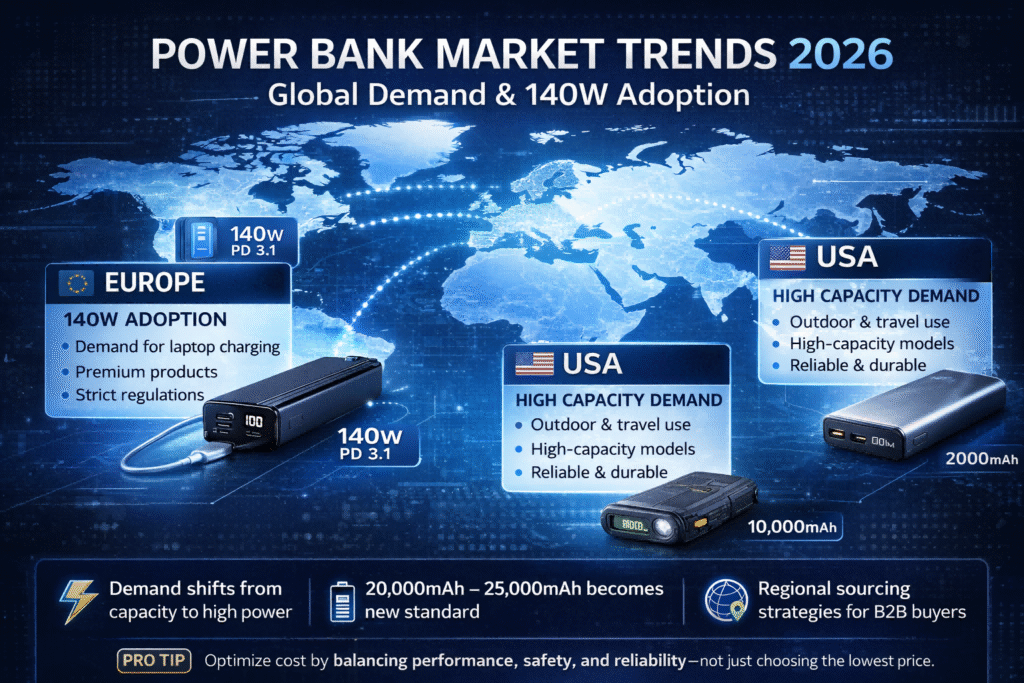
In 2026, power bank demand is shifting from capacity-focused products to high-power solutions driven by laptop charging and mobile work scenarios.
📊 The Rise of the 20,000mAh–25,000mAh Segment
Mid-range products are being replaced.
What’s happening:
- 10,000mAh → declining in professional use
- 20,000mAh–25,000mAh → fastest growth segment
- High-capacity + high-power → new standard
💡 Featured Snippet
The 20,000mAh–25,000mAh segment is becoming the dominant category due to its ability to support laptop charging while staying under aviation limits.
✈️ The 100Wh Aviation Limit Still Defines the Market
Airline regulations continue to shape product design.
👉 Key logic:
- Must stay under 100Wh
- Limits maximum usable capacity
- Drives optimization (not just bigger batteries)
👉 Example:
25,000mAh ≈ 92.5Wh → ✅ Safe for travel
🌍 Regional Demand Differences (Critical for B2B)
Different markets = completely different strategies
🇪🇺 Europe: Leading in 140W Adoption
Europe is the fastest-growing market for high-power power banks.
Why:
- Strong laptop usage
- Remote work culture
- Premium retail positioning
- Strict compliance requirements
💡 Featured Snippet
Europe leads the adoption of 140W PD 3.1 power banks due to demand for laptop charging and premium product positioning.
🇺🇸 North America: Performance + Outdoor Demand
The US market shows different behavior:
- High-capacity demand
- Outdoor usage (camping, travel)
- Rugged designs
👉 Key focus:
- Reliability
- Battery capacity
- Durability
🌏 Asia: Volume + Price Sensitivity
Asian markets are more:
- Price-sensitive
- High-volume
- Fast product cycles
👉 Strategy:
- Competitive pricing
- Efficient manufacturing
- Flexible product lines
⚡ Technology Trend: PD 3.1 Is Reshaping the Market
The shift toward 140W charging is accelerating.
👉 Driven by:
- Laptop charging demand
- USB-C ecosystem
- Faster charging expectations
💡 Featured Snippet
PD 3.1 is becoming the new standard for premium power banks, enabling high-power charging up to 140W and beyond.
👉 Learn more:
[PD 3.1 Fast Charging Guide]
🌡️ Design Trend: Smaller, Cooler, More Efficient
Thanks to GaN technology:
- Smaller size
- Less heat
- Higher efficiency
👉 This allows:
More power in smaller devices
🌱 Sustainability Is No Longer Optional
Especially in Europe:
- Recycled materials
- Battery traceability
- Carbon footprint
👉 Becoming a procurement requirement, not just a trend
👉 Read more:
[EU Battery Regulation 2026 Guide]
📉 What Products Are Losing Demand?
Declining categories:
❌ Low-power models
❌ No fast charging
❌ Generic designs
👉 Market is moving toward:
✔ Differentiation
✔ Performance
✔ Compliance
📈 What This Means for B2B Buyers
To stay competitive in 2026:
✔ Focus on high-power products
✔ Align with regional demand
✔ Invest in compliance
✔ Choose the right OEM partner
💡 Featured Snippet
Successful B2B strategies in 2026 require aligning product design with regional demand, compliance, and high-power charging trends.
🔗 Full Strategy
👉 Read the complete guide:
Ultimate 2026 B2B Guide to Mobile Power Solutions
❓ FAQ
Q1: What is the fastest-growing segment?
20,000mAh–25,000mAh high-power power banks.
Q2: Why is Europe leading adoption?
Higher demand for laptop charging and premium products.
Q3: Is 140W necessary?
For premium and professional users, yes.
Q4: What’s the biggest trend?
Shift from capacity → power + usage scenario.
📩 CTA
Looking to align your product strategy with 2026 trends?