A Comprehensive Guide for Power Banks and Beyond
Why This Article Matters (From Real Engineering Experience)
Energy density is one of those technical terms that get thrown around in marketing, specs sheets, and product comparisons — but most end users don’t truly understand what it means, how it’s calculated, or how it affects real performance.
I’ve spent over a decade working with lithium-ion batteries — from power bank design to certification and failure analysis — and almost every confusion I encounter can be traced back to misinterpretation of energy density.
In this article, we’ll explain:
- What energy density really is
- How it’s calculated and expressed
- Why it’s different from capacity
- How it impacts design choices in power banks and other devices
- Challenges in improving energy density
- Future trends
- Reachinno’s experience and advantages in energy-dense power bank cells
No fluff — just straight engineering logic grounded in real data.
1. What Is Energy Density? (Definition)
Energy density describes how much energy a battery can store relative to its size or weight.
There are two commonly used forms:
- Gravimetric Energy Density — energy per unit mass Wh/kg\text{Wh/kg}Wh/kg
- Volumetric Energy Density — energy per unit volume Wh/L\text{Wh/L}Wh/L
Both matter in different ways:
| Metric | What It Means | Why It Matters |
|---|---|---|
| Gravimetric (Wh/kg) | How much energy per kg | Lightweight devices |
| Volumetric (Wh/L) | How much energy per liter | Compact designs |
2. Why mAh Is Not Enough (Capacity vs Energy)
Most consumers see mAh printed on power banks:
“10,000mAh battery”
This number tells you capacity measured at a nominal voltage (usually ~3.7V for lithium-ion cells), but mAh alone does not reflect usable energy.
To get energy: Wh=mAh×Voltage/1000\text{Wh} = \text{mAh} \times \text{Voltage} / 1000Wh=mAh×Voltage/1000
Example:
- 10,000mAh × 3.7V = 37Wh
- But after conversion losses (USB boost, heat), usable energy is typically ~80–90% of that.
That’s why a 10,000mAh power bank rarely delivers “three full charges” to a phone — real energy is the limiting factor.
3. How Energy Density Is Calculated
Battery energy comes from the chemical reactions inside cells.
Gravimetric Energy Density
Energy (Wh/kg)=Total energy in WhMass (kg)\text{Energy (Wh/kg)} = \frac{\text{Total energy in Wh}}{\text{Mass (kg)}}Energy (Wh/kg)=Mass (kg)Total energy in Wh
Example:
- 37Wh battery weighing 0.2kg → 185Wh/kg
Volumetric Energy Density
Energy (Wh/L)=Total energy in WhVolume (L)\text{Energy (Wh/L)} = \frac{\text{Total energy in Wh}}{\text{Volume (L)}}Energy (Wh/L)=Volume (L)Total energy in Wh
Example:
- 37Wh battery with volume 0.075L → ~493Wh/L
These numbers are used to compare cells across chemistries and form factors.
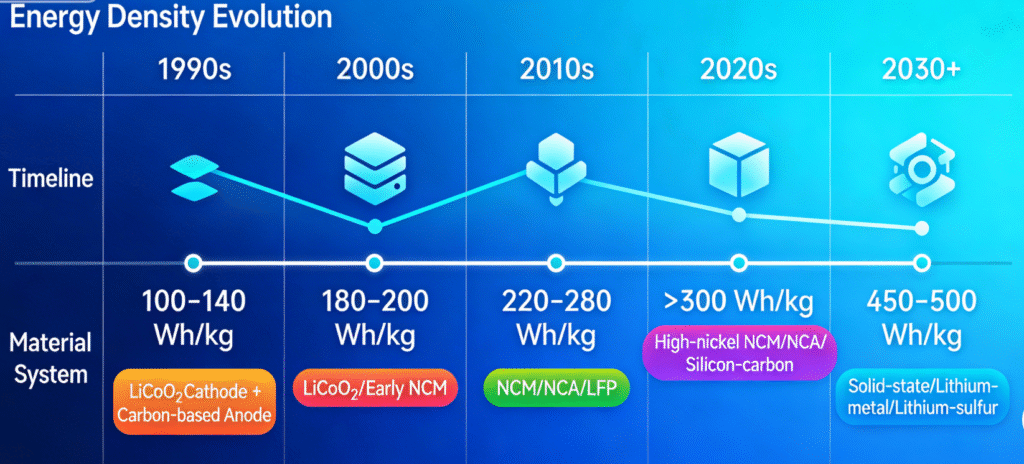
4. How Energy Density Has Evolved
Lithium-ion energy density has improved drastically over the past 30 years.
| Era | Technology | Typical Energy Density (Wh/kg) |
|---|---|---|
| Early Li-ion (1990s) | LiCoO₂ | ~100–130 |
| Mid-2000s | NMC / NCA | ~150–180 |
| Today | High-Ni NMC/NCA | ~200–250 |
| Emerging | Semi-solid / Solid | ~300+ (experimental) |
5. Naming Conventions of Cells
Understanding cell names also helps connect to energy density:
| Format | Dimensions | Typical Use | Energy Density Implication |
|---|---|---|---|
| 18650 | 18 × 65 mm | Power banks, laptops | Medium |
| 21700 | 21 × 70 mm | High power PD banks | Higher |
| Pouch | varies | Slim banks | Often optimized volume |
| 4680 | 46 × 80 mm | EV | Very high energy per cell |
The larger volumes of 21700 or 4680 cells allow more active material, boosting energy density and lowering resistance — key for fast charging and efficiency.
6. Why Energy Density Matters for Power Banks
Energy density influences:
🔋 Device Size
Higher energy density = smaller pack for the same Wh.
⚡ Power Output
Lower internal resistance at higher density helps higher PD outputs (20W, 45W, 65W, 100W).
🔥 Heat Generation
Better density often means better internal chemistry, lower wasted energy → less heat.
📦 Weight
Lower weight for travellers.
7. Physical Limits and Challenges
While chemistries improve, they hit trade-offs:
| Goal | Challenge |
|---|---|
| Higher energy | Higher heat & safety risk |
| Lower internal resistance | Stability becomes harder |
| More cycles | Lower capacity fade |
| Higher density | Expensive materials |
Examples:
- Increasing Nickel content → higher energy, but worse thermal stability
- Higher voltage platforms → more energy, but greater side reactions
Engineering solutions must balance energy density with safety.
8. Emerging Technologies
Solid State Batteries
- Use solid electrolyte → theoretically higher energy and safety
- Challenges: manufacturing complexity, interface resistance
Semi-Solid Batteries
- Hybrid electrolyte to reduce liquid volume
- Promise better safety without sacrificing energy
At Reachinno, our semi-solid power bank tests show:
- 600 full cycles → ≥80% capacity retained
- Better safety (pass full-charge nail penetration)
- Lower swelling compared to conventional cells
This matches real user feedback:
“Even after months of use, my power bank still holds charge well.”
9. Practical Data: Energy Density in Today’s Power Banks
| Cell Type | Typical Gravimetric (Wh/kg) | Typical Volumetric (Wh/L) |
|---|---|---|
| 18650 | ~150–180 | ~300–400 |
| 21700 | ~180–240 | ~400–500 |
| Polymer (high-performance) | ~200–250 | ~450–550 |
| Semi-solid (Reachinno tested) | ~230–280 | ~480–600 |
10. Misconceptions About Energy Density
❌ “Higher mAh always better”
No — if voltage is lower or conversion efficiency worse, usable energy can be lower.
❌ “Thinner is always lighter means better”
Slim designs often use polymer cells which compromise some energy density per kg.
❌ “More energy = more cycles”
Not necessarily — cycle life depends on chemistry, temperature, and C-rate.
Conclusion: A Balanced View of Energy Density
Energy density is a critical metric that:
- Explains usable energy
- Guides design choices
- Impacts performance, weight, heat, and price
But it must always be understood with:
- Cell chemistry
- Voltage platform
- C-rate tolerance
- Conversion efficiency
- Safety design
At Reachinno, we’ve used these principles to design power banks that are:
- Safe under stress
- Durable over long life
- Efficient in real use
Infographic Suggestions (blue-white Reachinno style)
1️⃣ Energy Density Evolution
From early lithium to semi-solid and beyond.
2️⃣ mAh vs Wh vs Usable Output
Visual explanation for consumers.
3️⃣ Cell Format Energy Density Comparison
18650 vs 21700 vs Polymer vs Semi-solid.
About the Author
OEM/ODM Battery Engineer at Reachinno
Over 10+ years working inside lithium battery factories, from prototype design to mass production, certification, and global retail deployment.