Power Bank Housing & Surface Finishes Explained
Why Laser Texture Is Becoming Essential for High-End Magnetic Power Banks
When choosing a power bank, most users focus on capacity, charging speed, or size.
But behind the scenes, housing material and surface finish play a critical role in durability, safety, heat dissipation, and long-term reliability—especially as magnetic and high-power power banks become mainstream.
This guide explains how power bank housings are really chosen in mass production, why options are more limited than they seem, and why laser-textured aluminum is emerging as a premium solution for ultra-thin magnetic power banks.
1. Power Bank Design: Three Core Building Blocks
Every power bank consists of three fundamental components:
- Battery cells – determine capacity, safety, and lifespan
- PCBA – controls charging, protection, and power delivery
- Housing (enclosure) – protects everything and manages heat, structure, and user touch
Surface treatment always applies to the housing, and its choice is never just cosmetic.
2. Cost-Effective & Series Products: Why “No Surface Finish” Is Often the Best Choice
Industry Reality
For mass-market and series-based power banks, the most common solution is:
Plastic housing with no secondary surface treatment
This is not a compromise—it’s an optimization.
Why manufacturers choose this approach:
- Stable BOM cost
- High production yield
- Minimal thickness impact
- No coating aging, peeling, or stickiness
- Consistent appearance across large volumes
Instead of paint or coating, texture is built directly into the mold (fine matte or micro-grain).
This delivers acceptable grip, scratch resistance, and visual consistency without extra processes.
👉 For value-oriented or multi-SKU product lines, this is the industry-standard solution.
3. High-End Visual Products: The Real Role of Leather & Fabric Finishes
Premium-looking finishes such as leather wraps or fabric skins are typically used for:
- Lower-power products
- Non-magnetic designs
- Appearance-driven collections
Advantages:
- Strong visual differentiation
- Warm, premium hand feel
Trade-offs:
- Higher BOM cost
- Thicker overall structure
- Lower heat dissipation
- More complex quality control
Because of these limitations, leather and fabric are rarely used in magnetic or high-power power banks.
4. Magnetic & High-Power Power Banks: Why Aluminum Is the Industry Consensus
Magnetic power banks introduce unique engineering constraints:
- Extremely thin profiles
- High heat density during fast charging
- Structural rigidity for magnetic alignment
- Long-term thermal cycling
Under these conditions, material choices become very limited.
Industry-standard solution:
Aluminum housing with anodized surface treatment
Why aluminum?
- Excellent heat dissipation
- Strong structural integrity at minimal thickness
- Long-term stability under high power
- Premium tactile and visual perception
This is why most leading magnetic and high-power designs converge on anodized aluminum.
5. Why Laser Texture Is a Higher-End Surface Solution
Laser texture is not a coating or paint layer.
It is a direct micro-structuring process applied to the aluminum surface itself, creating controlled patterns without adding thickness.
Key advantages over conventional anodizing:
| Aspect | Standard Anodizing | Laser Texture |
|---|---|---|
| Added thickness | Minimal | Nearly none |
| Scratch visibility | Moderate | Very low |
| Fingerprint resistance | Average | Excellent |
| Aging risk | Low | Extremely low |
| Heat dissipation | Unaffected | Unaffected |
👉 This makes laser texture uniquely suitable for ultra-thin magnetic power banks, where every fraction of a millimeter matters.
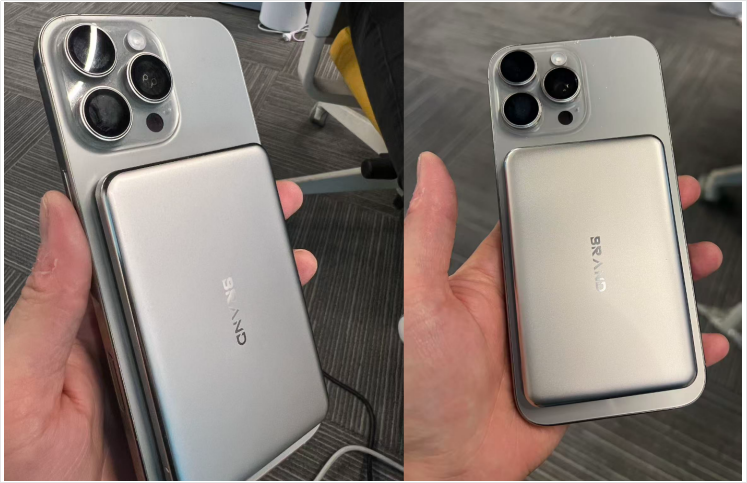
6. Reachinno’s Design Choice: Engineering Before Marketing
At Reachinno, laser texture was not selected for aesthetics alone.
Magnetic products face three non-negotiable constraints:
- No increase in thickness
- No compromise on heat dissipation
- No reduction in long-term reliability
Laser-textured anodized aluminum meets all three.
It delivers:
- Premium tactile feel without coatings
- Superior wear resistance for daily use
- Stable performance across long-term thermal cycles
This is why Reachinno applies laser texture specifically in magnetic, ultra-thin product lines, where conventional finishes reach their limits.
7. Industry Reference: Why Anker Follows the Same Logic
As the world’s No.1 power bank brand, Anker consistently prioritizes:
- Aluminum housings for high-power products
- Minimal coating layers
- Long-term durability over short-term visual impact
Different brands, same engineering logic.
8. Final Takeaway
In power bank design, housing finishes are not about “what looks best,”
but what survives heat, time, and daily use at scale.
Laser-textured aluminum is one of the few solutions that satisfies the demands of magnetic, high-power, ultra-thin power banks—both technically and commercially.
🔍 FAQ
Q1: What is the best housing material for a power bank?
For standard products, plastic housings are cost-effective and reliable. For high-power or magnetic power banks, aluminum is preferred due to superior heat dissipation and strength.
Q2: Why don’t all power banks use leather or coated finishes?
Leather and coatings increase thickness, reduce heat dissipation, and introduce aging risks, making them unsuitable for high-power or magnetic designs.
Q3: What is laser texture on aluminum power banks?
Laser texture is a micro-structuring process applied directly to aluminum surfaces, improving grip, wear resistance, and fingerprint control without adding thickness.
Q4: Are laser-textured power banks more durable?
Yes. Because there is no coating layer to peel or age, laser-textured surfaces maintain appearance and performance longer.
Q5: Why are magnetic power banks usually metal?
Magnetic alignment, heat control, and ultra-thin structure require the strength and thermal performance that metal provides.