🔌 What Is PD 3.1 and Why It Matters in 2026?
The demand for high-power portable charging is accelerating rapidly. As professional devices like the MacBook Pro 16 and the latest iPhone 15/16/17 Pro require higher sustained input power, traditional charging standards are hitting a physical ceiling.
💡 Featured Snippet :
PD 3.1 (EPR) is the latest fast-charging protocol that increases maximum output from 100W (PD 3.0) to 140W, 180W, and 240W. By raising the voltage handshake to 28V and beyond, it enables high-performance laptops to charge at original factory speeds via a single USB-C port.
For B2B buyers and brand owners, this shift means one thing: PD 3.1 is no longer an upgrade—it is the new baseline for premium power banks in 2026.
⚡ PD 3.0 vs PD 3.1: Key Differences
To understand why PD 3.1 is dominating the professional market, it is essential to compare it directly with the legacy PD 3.0 standard.
| Feature | PD 3.0 (Legacy) | PD 3.1 EPR (2026 Benchmark) |
| Max Output | 100W | 140W – 240W |
| Voltage Range | Up to 20V | 28V / 36V / 48V (EPR) |
| Target Devices | Phones, Tablets, MacBook Air | MacBook Pro 16, Gaming Laptops, Workstations |
| Market Position | Standard / High-Volume | Premium / High-Margin Professional |
Technical Insight: The core advantage of PD 3.1 lies in its 28V voltage handshake, which effectively bridges the gap between portable batteries and the intensive power requirements of modern mobile workstations.
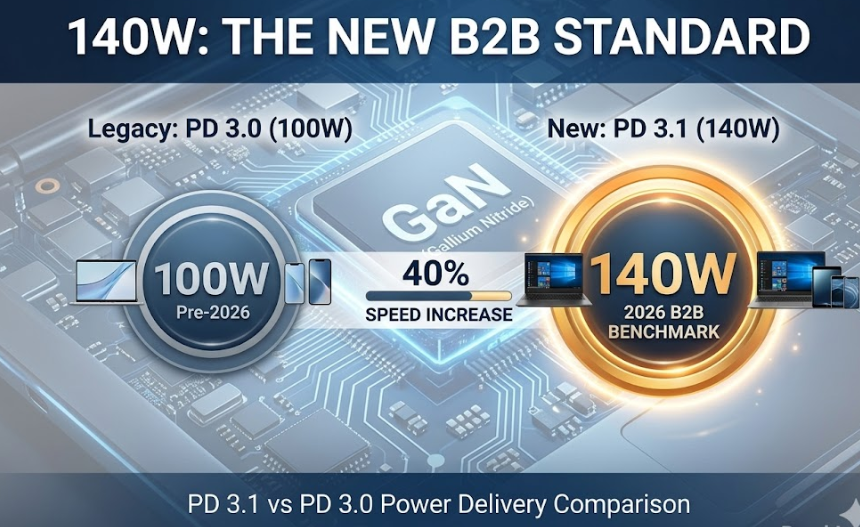
🔥 Why 140W EPR Is the New Industry Standard
While the PD 3.1 spec supports up to 240W, 140W EPR (Extended Power Range) has emerged as the most practical and sought-after benchmark for B2B applications in 2026.
Key Drivers for 140W Adoption:
- True Professional Support: It is the only standard that fully supports MacBook Pro 16 charging at maximum speed while under heavy workloads (video editing, AI rendering).
- Optimal Thermal Balance: 140W represents the “sweet spot” where high performance meets manageable heat dissipation.
- Aviation Compliance: 140W output is perfectly paired with 25,000mAh (92.5Wh) battery designs, ensuring they remain under the 100Wh Fly-Safe limit.
🌡️ Thermal Performance: The Hidden Decision Factor
In the 140W era, higher wattage introduces a critical engineering challenge: Heat Management. Poor thermal design leads to battery degradation, safety risks, and brand damage.
To support stable 140W output, a professional manufacturer must integrate:
- Advanced Multi-Layer PCB Design
- High-Quality Grade A Battery Cells
- Efficient Heat Dissipation Systems (Internal Heat Sinks & Thermal Paste)
🛡️ Pro Tip for B2B Buyers:
Always ask your supplier for a “Thermal Map Report” during the full 140W discharge cycle. Reliable manufacturers like Reachinno utilize infrared imaging to ensure surface temperatures stay below 48°C, a key differentiator from low-cost generic suppliers.
🧠 PD 3.1 + GaN 5: The Premium Combination
To solve the 140W thermal challenge, GaN (Gallium Nitride) 5th Generation technology is now widely adopted in premium power banks.
| Benefit of GaN 5 | Impact on B2B Success |
| 22% Lower Heat | Enhanced safety and longer battery cycle life. |
| Higher Efficiency | Faster energy transfer with minimal waste. |
| 30% Smaller Size | Sleek, portable designs that professionals love. |
🌎 B2B Buyer Strategy: When Should You Upgrade?
Not all market segments require PD 3.1 immediately, but the professional sector is moving fast.
- ✅ Upgrade to PD 3.1 if: Your target audience includes creative professionals, digital nomads, business travelers, or premium retail channels.
- ❌ Stay with PD 3.0 if: You are targeting entry-level, gift-only, or budget-sensitive phone users.
🏭 OEM Considerations for PD 3.1 Power Banks
When sourcing from an OEM power bank manufacturer in China, evaluate these three pillars:
- Certification Capability: Ensure they hold valid CE, FCC, and UL 2056 reports specifically for high-voltage (28V+) compliance.
- Battery Stability: Demand Grade A Lithium-ion cells with a documented cycle life of 800-1000 charges.
- R&D Track Record: At Reachinno, our PD 3.1 units undergo 48-hour continuous 140W stress tests to ensure zero-failure performance in global markets.
🔮 Future Outlook: Beyond PD 3.1
Looking ahead, the industry is moving toward AI-optimized charging systems that manage power distribution intelligently between multiple devices. By 2027, 140W will likely be the “standard” across all premium portable power categories.
🔗 Explore the Full 2026 Strategy
To understand how PD 3.1 fits into your broader portfolio and global compliance:
👉 Read our Ultimate 2026 B2B Guide to Mobile Power Solutions
❓ FAQ
Q1: Is PD 3.1 backward compatible with older iPhones?
Yes, PD 3.1 is fully backward compatible. However, the charging speed will be limited by the maximum input the device can handle (e.g., ~27W-30W for newer iPhones).
Q2: What is the best capacity for a 140W PD 3.1 power bank?
20,000mAh to 25,000mAh is the optimal range. It provides enough energy for a full laptop charge while remaining under the 100Wh aviation safety limit.
Q3: Is 140W output safe for continuous use?
Yes, provided the unit utilizes GaN technology and a high-quality PCB. At ReachInno, safety is ensured through multi-layer protection and thermal monitoring.
📩 Ready to Build Your 140W PD 3.1 Power Bank Line?
Don’t let your brand fall behind the technical curve. Partner with a certified OEM manufacturer with proven expertise in PD 3.1, GaN 5, and global compliance.
👉 Contact Reachinno Today to discuss your next-generation 140W project and request a sample.