💰 Why Power Bank Prices Vary So Much
If you’ve sourced power banks before, you’ve likely noticed:
👉 Products with similar capacity often have very different prices.
This is not random.
💡 Featured Snippet
Power bank cost is mainly driven by battery cells, PCBA design, charging technology, and manufacturing complexity—not just capacity.
📊 Cost Structure Overview (Industry Average)
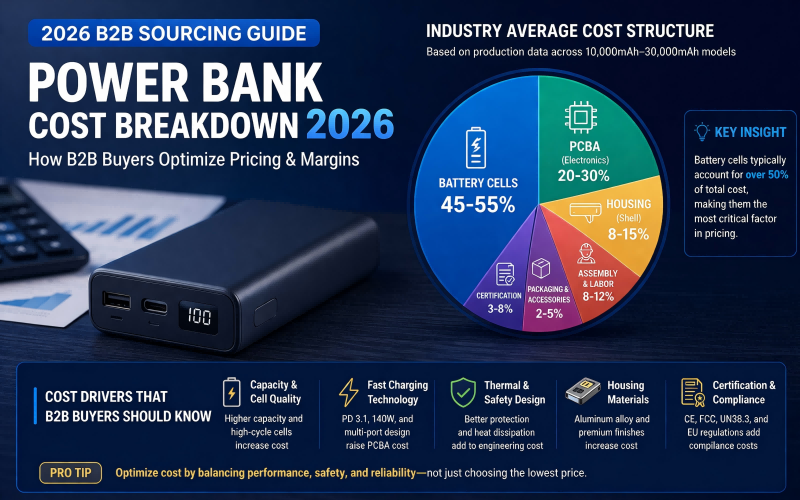
Based on multiple production projects across different capacities (10,000mAh–30,000mAh), the cost structure typically looks like this:
| Component | Cost Share |
|---|---|
| Battery Cells | 45–55% |
| PCBA (Electronics) | 20–30% |
| Housing (Shell) | 8–15% |
| Assembly & Labor | 8–12% |
| Certification | 3–8% |
| Packaging & Accessories | 2–5% |
🔋 1. Battery Cells: The Core Cost Driver
Battery cells are the largest cost component.
Typical pattern:
- 10,000mAh → low cost range
- 20,000mAh → mid cost range
- 25,000mAh+ → higher cost range
👉 Cost generally increases proportionally with capacity
💡 Featured Snippet
Battery cells typically account for over 50% of total cost, making them the most important pricing factor.
💡 Pro Insight
Even at the same capacity:
- Standard cells → lower cost
- High-cycle / branded cells → higher cost
👉 This explains why similar products can have very different pricing.
⚡ 2. PCBA Cost: Technology Drives Price
PCBA cost varies significantly depending on features.
Key factors:
- Fast charging protocols (PD 3.1 / 140W)
- Multi-port outputs
- Advanced chipsets
👉 Entry-level models → lower PCBA cost
👉 High-power models → significantly higher cost
💡 Featured Snippet
Advanced charging technologies like PD 3.1 and multi-port designs increase PCBA cost but enable premium product positioning.
🌡️ 3. Thermal Design & Safety Engineering
High-performance power banks require better thermal management.
Cost includes:
- Heat dissipation materials
- Protection IC
- Internal structure design
👉 Especially critical for high-wattage products
🧱 4. Housing & Mechanical Design
Housing cost depends on:
- Material (plastic vs aluminum)
- Surface finish
- Structural complexity
👉 Premium designs → higher cost
👉 Standard designs → cost-efficient
👷 5. Assembly & Manufacturing
Manufacturing cost varies based on:
- Automation level
- Product complexity
- Quality control standards
👉 Higher QC = higher cost but fewer returns
🌍 6. Certification & Compliance
Global markets require certifications such as:
- CE
- FCC
- UN38.3
- EU Battery Regulation
👉 These costs are usually included in unit pricing
💡 Featured Snippet
Certification costs are essential for market access and are often built into the final product price.
⚠️ Why Low Prices Can Be Risky
If a product is priced significantly below market level, it may indicate:
- Lower-grade battery cells
- Simplified electronics
- Missing certifications
👉 Potential risks:
- Product failure
- Returns and warranty issues
- Brand damage
📈 How B2B Buyers Optimize Cost
Smart buyers focus on value, not just price.
Recommended strategies:
✔ Choose the right capacity for your market
✔ Use high-power features only where needed
✔ Balance cost vs quality
✔ Work with experienced OEM partners
💡 Featured Snippet
The best cost strategy is optimizing performance, safety, and reliability—not simply choosing the lowest price.
🔗 Recommended Reading
👉 PD 3.1 Technology
[PD 3.1 Fast Charging Guide]
👉 EU Compliance
[EU Battery Regulation 2026 Guide]
👉 Full Strategy
[Ultimate 2026 B2B Guide to Mobile Power Solutions]
❓ FAQ
Q1: What impacts power bank cost the most?
Battery cells and charging technology are the primary factors.
Q2: Is higher capacity always more expensive?
Generally yes, but technology and design also play a major role.
Q3: Are cheaper power banks a good choice?
Not always—lower cost often comes with higher risk.
Q4: How can buyers reduce cost safely?
By optimizing specifications and working with reliable suppliers.
📩 CTA
Looking to optimize your product cost and performance?
👉 Contact us to develop a tailored power bank solution for your market.