20+ Battery Failures, Fire Risks & Safety Lessons
Portable power banks have become one of the most widely used consumer electronics accessories worldwide. As smartphones, tablets, laptops, and wearable devices continue to demand more energy, portable chargers play an increasingly important role in the mobile ecosystem.
However, as the global market for power banks grows rapidly, safety concerns related to lithium batteries have also become more visible.
Over the past decade, regulators across the United States, Europe, and other regions have issued multiple product recalls involving portable chargers due to potential safety risks such as overheating, battery failure, and fire hazards.
This report analyzes more than 20 global power bank recall cases between 2010 and 2025, combining collected recall data, regulatory announcements, and industry observations to better understand:
• why power banks are recalled
• the most common safety risks
• technical failure causes
• global safety regulations
• design lessons for safer portable energy devices
What Is a Power Bank Recall?
A power bank recall occurs when a manufacturer, distributor, or regulator removes a portable charger from the market due to safety risks that could harm consumers.
These risks may include:
• overheating
• battery swelling
• internal short circuits
• fire hazards
• electrical protection failures
In most cases, recalls are initiated after safety incidents are reported or when testing identifies potential defects that may lead to hazardous situations.
Global Power Bank Recall Statistics
Based on collected recall data and public reports, the number of power bank recalls has increased significantly in recent years.
Recent recall data shows a sharp rise in global safety incidents since 2023.
Estimated recall units by year:
2020 – 4,518 units
2022 – 50,000 units
2023 – 748,537 units
2024 – 1,505,962 units
2025 – 2,955,633 units
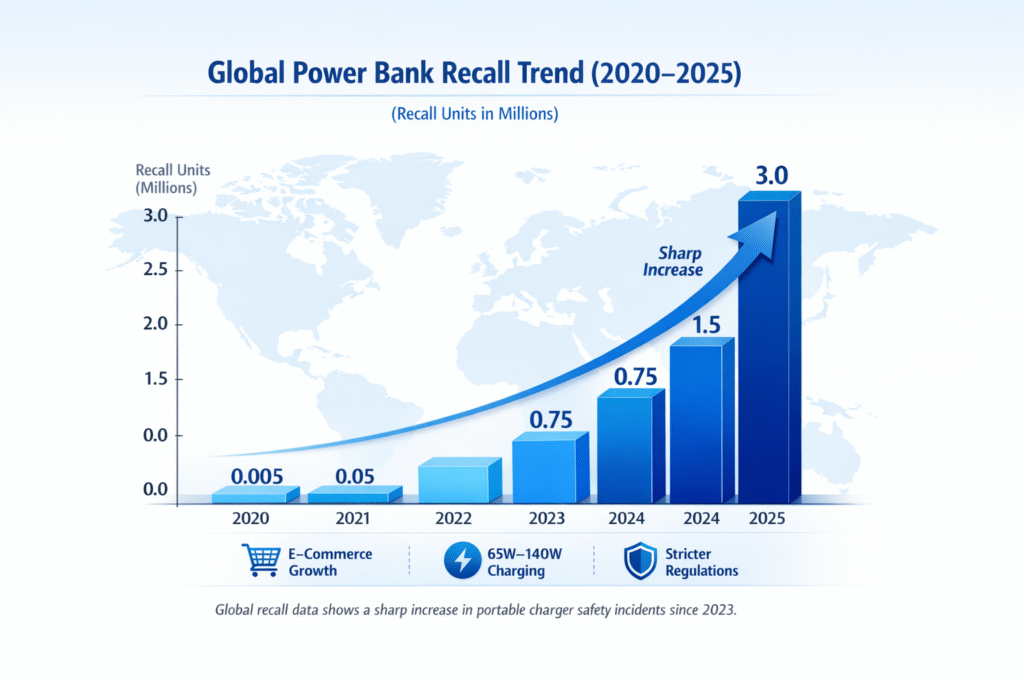
Several industry trends explain this increase:
• rapid growth of portable electronics
• expansion of global e-commerce channels
• higher charging power (65W–140W)
• stricter safety enforcement by regulators
As charging performance improves, engineering requirements for battery safety are becoming more demanding.
Major Markets with Power Bank Recalls
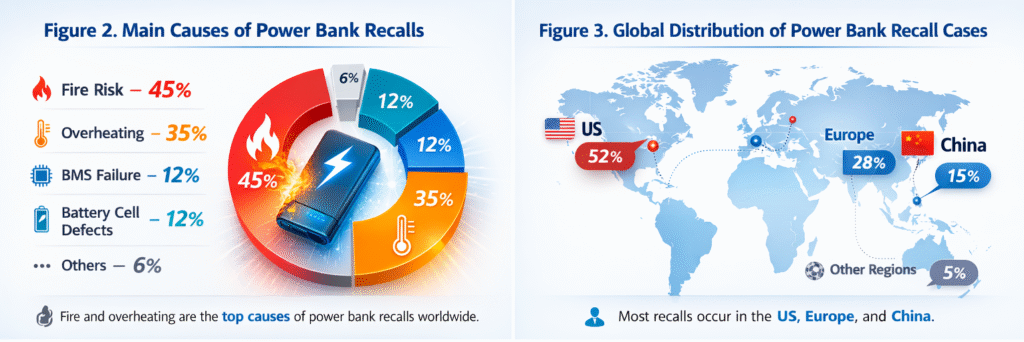
Power bank recalls are most frequently reported in regions with strong consumer safety regulations.
United States
The United States is one of the most active markets for lithium battery safety monitoring.
The Consumer Product Safety Commission (CPSC) regularly publishes recall notices when consumer electronics present potential fire or overheating hazards.
Many portable charger recalls involve products sold through major retail platforms and online marketplaces.
European Union
In Europe, product safety issues are monitored through the Safety Gate / RAPEX system, which coordinates consumer product safety alerts across EU member states.
Portable battery products that fail to meet safety requirements may be removed from the market or restricted from further sales.
Asia
Asia is a major manufacturing hub for portable electronics, including power banks.
As regional regulators strengthen lithium battery safety standards, product safety investigations have also increased.
Representative Power Bank Recall Cases
More than 20 recall cases were analyzed for this report. While the specific brands and models vary, the underlying causes often follow similar patterns.
Case 1 – Battery Overheating
Some power banks were recalled after reports that the battery could overheat during charging or discharging. Excessive heat may cause device deformation, smoke, or fire hazards.
Case 2 – Internal Battery Defects
Manufacturing defects inside lithium battery cells may cause internal short circuits. These defects can lead to thermal runaway under certain conditions.
Case 3 – Battery Management System Failure
The battery management system (BMS) controls voltage, current, and temperature. If protection circuits fail or are insufficient, the device may not shut down during abnormal operation.
Case 4 – Charging Circuit Failure
Failures in charging ports, PCB components, or power control circuits may cause unstable current flow and overheating.
Case 5 – Structural Design Issues
Poor mechanical design or insufficient internal protection may expose battery cells to mechanical stress or inadequate heat dissipation.
Technical Root Causes of Power Bank Failures
Based on recall data and engineering analysis, most power bank safety incidents fall into three major categories.
Battery Cell Quality
Battery cells are the most critical component of any power bank.
Differences in material quality, manufacturing consistency, and testing standards can significantly affect safety performance.
Low-quality cells may be more vulnerable to:
• internal short circuits
• thermal instability
• swelling or leakage
Choosing reliable battery cell suppliers is therefore essential for product safety.
Battery Management System (BMS)
A robust BMS protects the battery from abnormal conditions.
Essential protection mechanisms include:
• overcharge protection
• over-discharge protection
• overcurrent protection
• short-circuit protection
• temperature monitoring
If these systems fail or are poorly implemented, the risk of battery failure increases.
Thermal Management
Modern high-power power banks generate more heat than earlier designs.
Effective thermal management strategies include:
• heat dissipation structures
• temperature sensors
• intelligent power control algorithms
• optimized internal layouts
Without proper thermal design, high-power devices may overheat during operation.
The Impact of High-Power Charging
Charging technology has evolved rapidly in recent years.
Many modern power banks now support:
65W
100W
140W USB-C Power Delivery
These capabilities allow laptops and tablets to be charged using portable battery devices.
However, higher power levels also increase engineering challenges related to:
• current control
• thermal management
• battery stress
As a result, safety design becomes increasingly important in next-generation portable power devices.
Global Safety Regulations for Power Banks
Several international safety standards apply to portable battery products.
Common certifications include:
UL2056
Safety standard for portable power banks in the United States.
CE Certification
Required for consumer electronics sold in the European Union.
IEC Standards
International safety standards covering battery systems and electronic devices.
These certifications require extensive testing to ensure that products meet safety requirements before entering global markets.
Future Battery Technologies for Safer Power Banks
The industry is actively exploring new battery technologies to improve safety and performance.
Lithium Iron Phosphate (LFP)
LFP batteries offer improved thermal stability and longer cycle life compared with traditional lithium-ion batteries.
They are widely used in electric vehicles and are gradually gaining attention in portable energy products.
Semi-Solid Battery Technology
Semi-solid batteries use partially solidified electrolytes instead of fully liquid electrolytes.
Potential benefits include:
• improved structural stability
• reduced risk of leakage
• enhanced thermal safety
Although still developing, this technology may become more common in high-end portable electronics.
Safety Design Recommendations for Power Bank Manufacturers
Based on recall analysis, several design principles can help reduce safety risks.
Choose High-Quality Battery Cells
Reliable battery suppliers with strong safety records are essential.
Implement Multi-Layer BMS Protection
Redundant protection systems ensure safer operation during abnormal conditions.
Optimize Thermal Management
Proper heat dissipation and temperature monitoring are critical for high-power charging devices.
Conduct Comprehensive Safety Testing
Testing should include:
thermal testing
overcharge testing
short-circuit testing
drop testing
cycle testing
Conclusion
Power banks have become an essential part of modern portable electronics.
However, the rapid evolution of charging technology and battery systems requires greater attention to safety design.
By understanding the root causes behind power bank recalls and applying stronger engineering standards, manufacturers can significantly improve the safety and reliability of portable energy devices.
As the industry continues to innovate, battery safety will remain a critical factor shaping the future of portable charging technology.
FAQ
Are power banks dangerous?
Most power banks are safe when designed with high-quality battery cells and proper protection systems. Safety risks usually arise from low-quality components or inadequate thermal design.
Why do power banks catch fire?
Common causes include internal battery defects, short circuits, overheating, or failures in the battery management system.
What certification should power banks have?
Common safety certifications include UL2056, CE, and IEC safety standards.
Are higher-power power banks less safe?
Not necessarily. High-power power banks can be safe if they use high-quality battery cells, proper BMS protection, and effective thermal design.